iPhone 16 Repairability Review: Parts, Costs & Repair Challenges
The base iPhone 16 is the model where this generation’s repair story genuinely changed. In iFixit’s own teardown of this model — the base phone, torn down on its own — it earned a provisional repairability score of 7 out of 10, built on three findings: a battery held by adhesive that releases electrically, a body that can be entered from the front or the back, and a Repair Assistant in iOS 18 that paired and calibrated parts on iFixit’s test phone without bugs. This desk review works through those findings (attributed, from iFixit’s teardown), the challenges that remain — a Camera Control button laser-welded to the frame is the sharpest — and Apple’s published fee table, with each repair’s cost routed to its own guide.
How This Review Was Made
This is a desk review. FixUpPhone has not torn down this phone; every teardown finding here is attributed third-party evidence from iFixit’s own teardown of the base iPhone 16 specifically (iFixit, “We Hot Wired the iPhone 16”, September 2024, read directly for this review), including its repairability score — which iFixit itself labels provisional, and which is printed here with that label attached. Fees are Apple’s published US fees at current figures; construction facts are manufacturer specifications from Apple’s page for this model, read directly in October 2026. No score from any other model is used: the score quoted is this model’s own, from the teardown of this model.
ϟ Quick Expert Summary
iFixit gives the base iPhone 16 a provisional repairability score of 7 out of 10 (iFixit’s own teardown of this model, September 2024) — the strongest repair position in this generation’s base line, and a sharp rise from the 4 out of 10 iFixit awarded the iPhone 15. The score rests on this model’s own design: the battery sits on adhesive that debonds electrically (Apple’s repair manual describes passing 9V through it), the body opens from the front or the back, most components are independently accessible once inside, and iOS 18’s Repair Assistant paired and calibrated all components at once on iFixit’s vanilla iPhone 16. The challenges are equally specific: the Camera Control button is laser-welded to the frame with its own chip, so a button failure is a frame-level problem; entry still involves pentalobe screws and heat; and Apple’s fee table has no port, speaker, microphone or button line — that damage falls under “other damage” ($549). The wear items, though, are priced gently: battery $99, screen $279, back glass $159 at current figures.
Source-based editorial assessment from iFixit’s attributed teardown of this model and Apple’s published fees — not a FixUpPhone teardown, and the score is iFixit’s, labelled provisional by iFixit itself.
✓ What Got Easier
- Battery releases electrically — no brittle pull-tabs to fight
- Front-or-back entry: simple repairs need not disturb the display
- Repair Assistant paired and calibrated parts smoothly in iFixit’s test
- Wear-item fees are the gentle end of this generation’s table
× What Still Fights Back
- Camera Control is laser-welded to the frame, with its own serialized chip
- Entry needs heat and pentalobe screws — not a casual opening
- No port, speaker, mic or button fee exists — that damage is the $549 tier at Apple
- The score is provisional, and adhesive behaviour over years is unproven
7/10
iFixit provisional score — this model’s own teardown
9V
Electrical battery release in Apple’s own repair manual
2 ways in
Front or back entry (iFixit teardown finding)
$99
Battery fee at Apple (published fee)
Built to open
from either side.
With one welded exception.
① Key Specifications
| Repairability score (third-party) | 7 out of 10, PROVISIONAL — iFixit’s score from its own teardown of the base iPhone 16 (September 2024). iFixit’s comparison point: the iPhone 15 scored 4 out of 10 |
|---|---|
| Battery mounting (teardown finding) | Electrically debondable adhesive: a low-voltage current releases the battery cleanly. Apple’s own repair manual describes a 9V method; iFixit released its battery in about 60 seconds at 12V. This adhesive is on the base 16 and 16 Plus — not the Pro models, which keep stretch-release pull-tabs |
| Entry (teardown finding) | Dual entry — the phone opens from the front or the back, so repairs that do not involve the display need not remove it. Entry still involves pentalobe screws and heat |
| Parts pairing (teardown finding) | iOS 18’s Repair Assistant: on iFixit’s vanilla iPhone 16 it paired and calibrated all components in one pass, with no bugs found — including support for pairing used genuine parts |
| The welded exception (teardown finding) | The Camera Control button carries its own integrated circuit and appears laser-welded to the frame; iFixit found a button swap registers an “enclosure” component in the phone’s service history — a failed button points at frame-level repair, not a button swap |
| Fees that do not exist (published fees) | Apple’s table has no port-only, speaker-only, microphone-only or button-only fee for this model. Such damage falls under “other damage” — $549 |
| The phone | A18 (5-core GPU); 6.1-inch Super Retina XDR OLED; aluminum design, Ceramic Shield front, color-infused glass back; 170 g; IP68 laboratory rating when new; released 20 September 2024; from $799 at launch |
Apple Support — service and repair · iFixit — “We Hot Wired the iPhone 16” teardown (September 2024, read directly October 2026) · Apple — iPhone 16 technical specifications (live page, checked October 2026)
Percentages and totals in this article are calculated from Apple’s published fees and the $799 launch list price, and are labelled as calculations where they appear.
② Expert Analysis
Teardown findings are iFixit’s, from its teardown of this model; fees are Apple’s published figures. FixUpPhone did not tear down this device.
The battery change that drives the score
The single biggest repair advance on this model is invisible until the phone is open: the battery is held by an adhesive that debonds when a low-voltage current passes through it (iFixit teardown finding). Apple’s own repair manual — published on launch day — describes the method with a 9V battery and clips; iFixit’s cell released in about 60 seconds at 12V and lifted out with no force, leaving the frame almost residue-free. Against the stretch-release pull-tabs of earlier models — which grow brittle with age and routinely end in solvent and prying — this is a repeatable, low-risk removal of the most common repair there is. Two fences matter: the adhesive is fitted to the base iPhone 16 and 16 Plus only (the Pro models kept pull-tabs and, on the smaller Pro, a steel-cased battery — neither fact belongs to this phone), and iFixit notes Apple’s manual warns debond times may lengthen as the adhesive ages. Battery safety is unchanged in one respect: a swollen or damaged battery is never pried, heated or mailed — it is handled as a hazardous part by a professional.
Dual entry and independent access
The second finding is architectural (iFixit teardown): the phone can be entered through the front or the back, and once inside, most components — battery, speaker, Taptic Engine, cameras, display, back cover — are independently accessible rather than stacked behind one another. For repair economics this matters more than any single part price: a back-glass or battery job that does not require disturbing a fragile, expensive display is a shorter, lower-risk job. iFixit also recorded the limits honestly: entry still requires heat and pentalobe screws, which it flags in the context of European repairability rules — this is a phone designed to be opened by someone equipped to open it, not by a fingernail.
Software stopped fighting back — mostly
Parts pairing was what sank earlier scores, and on this model iFixit found the story changed (teardown finding): iOS 18’s Repair Assistant, run on their vanilla iPhone 16, paired and calibrated all components in one click with no bugs found, and the system supports pairing used genuine parts — a genuine change for independent repair. The exception iFixit surfaced is the Camera Control: the button has its own integrated circuit, appears laser-welded to the frame, and registers as an “enclosure” component in the phone’s service history when swapped. A serialized wear part is a manageable nuisance when calibration works; a welded one is a different category — if the button fails, the repair points at the frame, and at Apple that class of damage is the $549 “other damage” tier, there being no button-only fee in the table.
What the fees add up to
Against that design, Apple’s published fee table for this model is the gentle end of its generation: battery $99, screen $279, back glass $159 at its current figure (launched $169), screen and back glass $369 combined (launched $399), rear camera $169 — each worked through in its own guide, linked in the parts table below. The structural trap is the missing middle: no port, speaker, microphone or button fee exists, so a charging-port failure that is trivial as a part becomes a $549 question at Apple — the strongest argument in this review for an independent assessment, where the quote follows the diagnosis rather than a catch-all tier. FixUpPhone publishes no fixed price for this model; repairs are quoted after assessment, take 1–7 days and carry a 3-month warranty.
Before you open anything
- Is the battery swollen, hot or damaged? Stop — do not pry, heat or mail it; it needs professional handling
- Have you backed up? Every route below starts there
- Is the fault actually a priced line (battery, screen, glass, camera) — or a part with no Apple fee at all?
- Camera Control fault? Read the welded-button finding before pricing anything
③ Pros & Cons
✓ Pros
- iFixit’s provisional 7/10 for this model — up from the iPhone 15’s 4/10 (iFixit)
- Electrically released battery adhesive: the commonest repair became the cleanest (iFixit; Apple’s manual)
- Front-or-back entry with independently accessible components (iFixit)
- Gentle published fees for the wear items: battery $99, screen $279, back glass $159
× Cons
- Camera Control is laser-welded to the frame with its own chip — a button failure is frame-level (iFixit)
- Entry still needs heat and pentalobe screws; this is equipped work, not casual work
- No port, speaker, microphone or button fee exists — that damage is Apple’s $549 tier
- The 7/10 is provisional, and how the new adhesive ages over years is unproven (iFixit)
Buying — Parts & Costs
The official route’s headline numbers (Apple’s published US fees, current figures) — each guide carries the full route comparison:
| Part | Apple’s current fee | The guide |
|---|---|---|
| Battery | $99 ($0 with AppleCare+ below 80%) | Battery replacement cost |
| Screen | $279 ($29 with AppleCare+) | Screen replacement cost |
| Back glass | $159 ($29 with AppleCare+) | Back glass repair cost |
| Screen + back glass | $369 ($58 with AppleCare+) — published combined fee, not the $438 sum | Screen replacement cost |
| Rear camera | $169 ($99 with AppleCare+) | Camera repair cost |
| Charging port | No port-only fee exists — falls under “other damage” ($549) at Apple | Charging port repair cost |
| Power button | No button-only fee exists — falls under “other damage” ($549) at Apple | Power button repair cost |
Fees checked October 2026 and can change. Back glass launched at $169 and the combined fee at $399; both were later lowered — the current $159 / $369 are the figures to decide on. FixUpPhone publishes no fixed price for this model; independent repairs are quoted after assessment.
Repair Options, Practically
The six live guides carry this model’s repair routes in full: screen replacement cost, battery replacement cost, back glass repair cost, charging port repair cost, camera repair cost and power button repair cost. FixUpPhone quotes after assessment (general repair time 1–7 days; 3-month warranty on repairs).
Visit a store — Lynwood, CA · 3100 E Imperial Hwy, Store M1002, Lynwood, CA 90262 · Every day 11 AM–8 PM · (805) 857-4225 · Santa Barbara, CA · 619 A State St, Santa Barbara, CA 93101 · Mon–Fri 11 AM–8 PM; Sat 10 AM–8 PM; Sun 12 PM–7 PM · (805) 857-4226 · Las Vegas, NV · 875 S Grand Central Pkwy, Unit TT32, Las Vegas, NV 89106 · Mon–Sat 10 AM–8 PM; Sun 10 AM–7 PM · (818) 482-3605 — or start a mail-in repair: you pay inbound shipping, FixUpPhone pays the return, and you should not ship before instructions are confirmed. Back up first, and never mail a hot or swollen phone.
④ Who This Repairability Suits
| Your pattern | Verdict | Why |
|---|---|---|
| Keeping the phone for years | Strong fit | The wear items are the designed-for repairs: electrically released battery, dual entry, gentle fees. |
| A battery at the end of its life | Repair with confidence | $99 at Apple, and the removal process is the cleanest Apple has shipped (iFixit). |
| A dead charging port or button | Get an independent quote first | No such fee line exists at Apple — the $549 catch-all tier is the alternative. |
| Camera Control not responding | Assess before pricing | The button is welded to the frame with its own chip (iFixit) — the finding decides the route. |
| Opening phones yourself | Equipped hands only | Manuals and parts exist, but entry needs heat and pentalobes, and battery work carries real risk if mishandled. |
⑤ Alternatives & Comparison
Published fees and the combined-glass line, with AppleCare+ collapsing most rows to $29–$99 — and a $549 catch-all where no fee line exists.
Explore option →Quoted after assessment at FixUpPhone; the route that prices a port or button as the part it is. Repairs take 1–7 days with a 3-month warranty.
Explore option →For a phone this repairable, the repair-or-replace framework rarely lands on replace for a single fault.
Explore option →⑥ Frequently Asked Questions
What repairability score does the iPhone 16 get?
iFixit awards the base iPhone 16 a provisional 7 out of 10, from its own teardown of this model (September 2024). “Provisional” is iFixit’s own label — the score was issued pending Apple’s release of parts. For context, iFixit gave the iPhone 15 a 4 out of 10.
Why is the battery easier to replace on this model?
It is held by an adhesive that debonds electrically. Apple’s repair manual describes passing 9V through it; iFixit released the battery in about 60 seconds at 12V, with no prying against brittle pull-tabs. The adhesive is fitted to the base iPhone 16 and 16 Plus — the Pro models use a different system.
Can the iPhone 16 be opened from the back?
Yes — iFixit’s teardown confirms dual entry: the phone opens from the front or the back, so repairs that do not involve the display need not remove it. Entry still involves heat and pentalobe screws.
What is the Camera Control repair catch?
iFixit found the Camera Control button carries its own integrated circuit and appears laser-welded to the frame; swapping one registers an “enclosure” component in the phone’s service history. A failed button therefore points at frame-level repair rather than a simple button replacement — and Apple’s table has no button-only fee in any case.
Does parts pairing still block repairs on this model?
On iFixit’s test phone, no: iOS 18’s Repair Assistant paired and calibrated all components in one pass with no bugs found, and it supports pairing used genuine parts. That is iFixit’s finding on their vanilla iPhone 16, reported as such.
What does a charging port repair cost at Apple?
There is no port-only fee in Apple’s published table for this model — port damage falls under “other damage” ($549, published fee). An independent repair is quoted after assessment; FixUpPhone publishes no fixed price, and repairs take 1–7 days with a 3-month warranty.
Can I replace the battery myself?
Apple publishes repair manuals and sells parts through its Self Service Repair programme, and the electrical release makes the mechanical step cleaner than before. It is still lithium-battery work inside a sealed phone: a swollen or damaged battery must never be pried, heated or mailed, and most owners are better served by a professional service — the published Apple fee is $99, and FixUpPhone quotes after assessment.
What does a screen replacement cost on this model?
Apple’s published fee is $279 ($29 with AppleCare+); back glass is $159 at its current figure and the combined screen-and-back-glass fee is $369. The screen replacement cost guide carries the full route comparison.
Sources & Editorial Notes
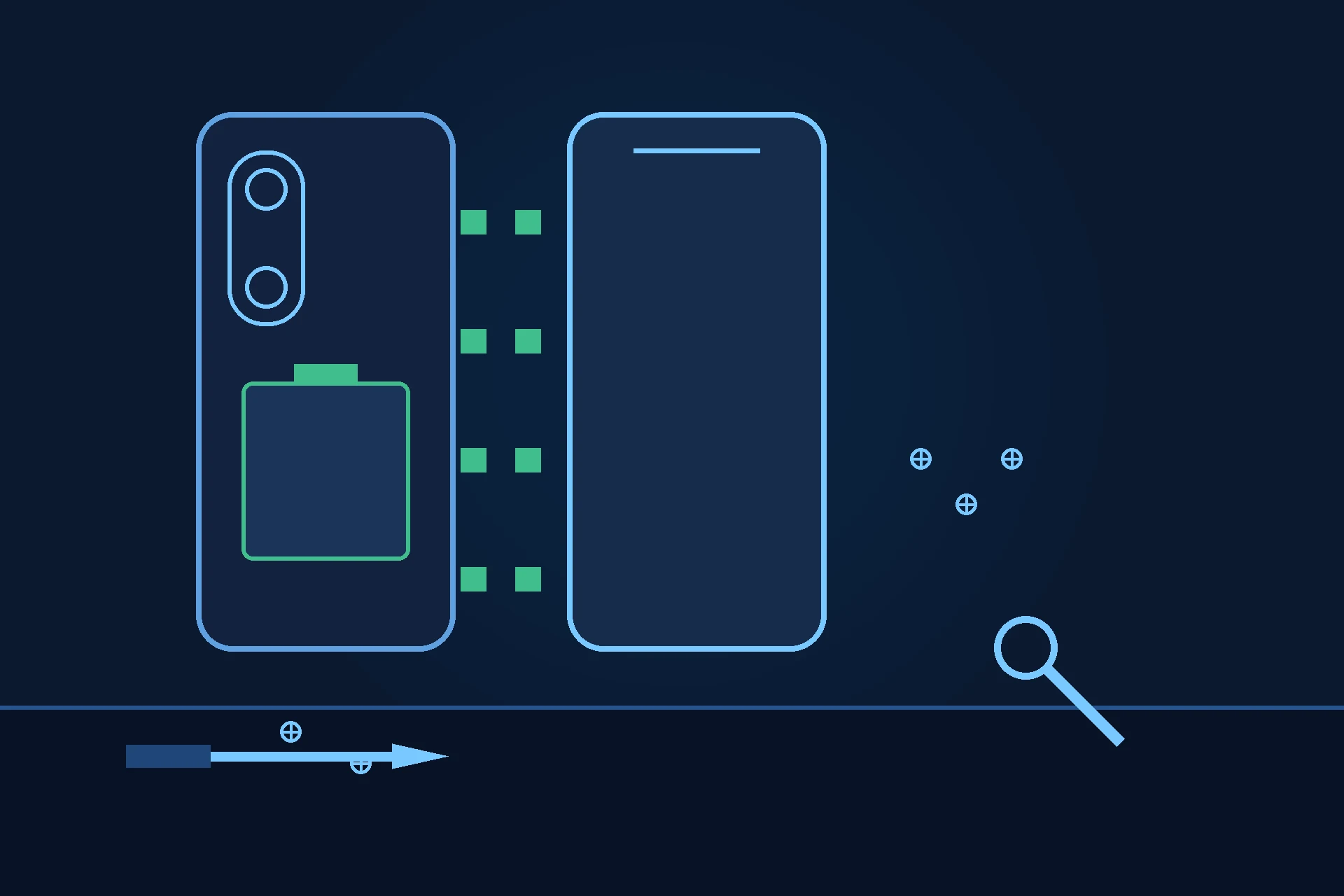
Prepared by FixUpPhone Editorial. Documentation checked October 2026. This is a desk review: FixUpPhone did not tear down this device. The repairability score and teardown findings are iFixit’s, from its teardown of the base iPhone 16, and the score carries iFixit’s own “provisional” label. Fees are Apple’s published figures. The featured artwork is an original illustration. Apple is not affiliated with FixUpPhone.
- iFixit — “We Hot Wired the iPhone 16” (September 2024; read directly 22 October 2026): provisional repairability score 7/10 for the iPhone 16 and 16 Plus; electrically debondable battery adhesive (about 60 seconds at 12V in iFixit’s trial; Apple’s manual describes 9V and notes debond times may lengthen with age); dual front/back entry; independent component access; Repair Assistant pairing all components on a vanilla iPhone 16; Camera Control laser-welded to the frame with its own IC and an “enclosure” service-history component; iPhone 15 comparison score of 4/10. Device coverage confirmed on iFixit’s iPhone 16 device page (models A3081 / A3286 / A3287 / A3288)
- Apple — iPhone 16 technical specifications (live page, read directly, checked October 2026) (aluminum design; Ceramic Shield front; color-infused glass back; A18; 170 g; IP68)
- Apple Support — iPhone service and repair and the published Apple US fee tables (launch table, September 2024, via iClarified; current figures, September 2025, via Neowin) — battery $99; screen $279; back glass $159 current (launched $169); screen + back glass $369 current (launched $399); rear camera $169; other damage $549; no port-only, speaker-only, microphone-only or button-only fee exists
- FixUpPhone’s published guides for this model — screen replacement cost, battery replacement cost, back glass repair cost, charging port repair cost, camera repair cost and power button repair cost
- FixUpPhone — Phone Repair Services and Mail-In Phone Repair, checked October 15, 2026
- FixUpPhone — Locations, checked October 15, 2026
For corrections or device help, contact FixUpPhone.