iPhone 17 vs iPhone 18 Pro: Which Model Fits Your Needs?
This is a comparison between a modern standard iPhone and a newer Pro, not simply old versus new. The right answer depends on whether you need the Pro’s additional camera and workflow options enough to pay for them.
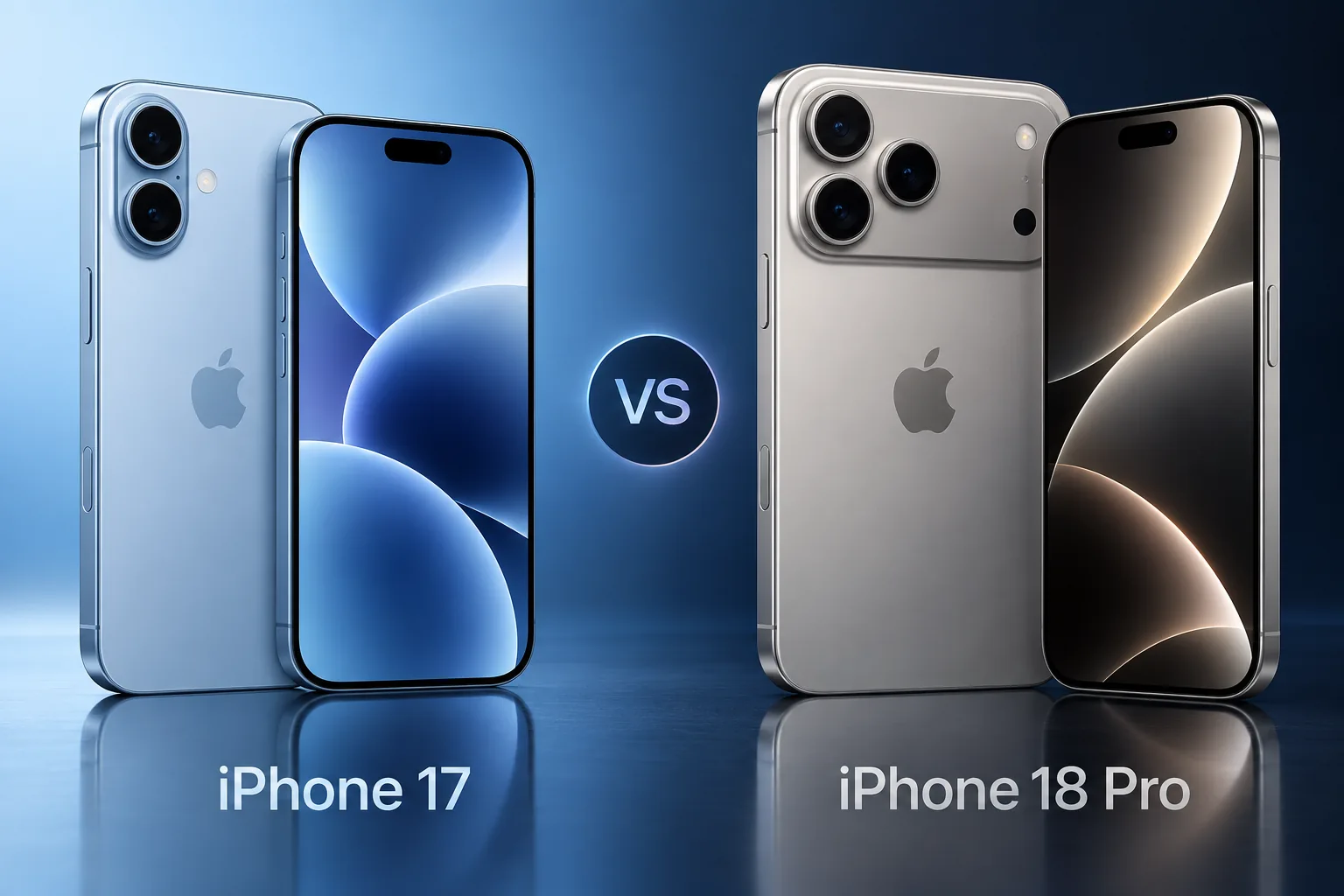
Quick Verdict
The iPhone 17 is the more natural starting point for everyday use when its current offer is attractive. The 18 Pro makes sense for someone who will deliberately use its dedicated telephoto, advanced camera control or Pro-oriented data workflow. Avoid paying for unused capability.
How we compare →
Key Differences at a Glance
| Feature | iPhone 17 | iPhone 18 Pro | What matters |
|---|---|---|---|
| Display | 6.3-inch OLED, adaptive up to 120Hz | 6.3-inch OLED, adaptive up to 120Hz | Size and handling |
| Processor | A19 | A20 Pro | App and workload needs |
| Rear cameras | 48MP main and ultra wide; no dedicated telephoto | 48MP main, ultra wide and 4x telephoto; variable main aperture | Capture requirements |
| Battery context | Up to 30 hours video playback (Apple US test) | Up to 36 hours video playback (Apple test) | Claims, not our tests |
| Connector / data | USB-C / USB 2 | USB-C / USB 3 | Cable and workflow |
| Construction | Aluminum design | Aluminum; 211g | Protection and handling |
Battery and performance claims are manufacturer figures, not FixUpPhone measurements. Current selling prices may differ from launch prices.
Detailed Comparison
Design & Display
Both occupy a similar display-size class, and the standard 17 already includes ProMotion. Do not frame this as a basic slow screen versus a smooth Pro screen. Compare weight, grip, case feel and how much the camera housing affects your preferred way of holding the phone.
iPhone 17
- 6.3-inch OLED, adaptive up to 120Hz
- Aluminum design
iPhone 18 Pro
- 6.3-inch OLED, adaptive up to 120Hz
- Aluminum; 211g
Handling & ownership considerations
The standard 17’s 6.3-inch ProMotion display means that smooth scrolling is not, by itself, a reason to move to 18 Pro. Students and everyday buyers can therefore make the decision around camera needs, handling and the actual offer rather than an outdated standard-versus-Pro screen assumption.
Performance
A19 and A20 Pro target different tiers, but routine apps do not necessarily make the premium worthwhile. Identify whether you need a specific professional feature or simply a dependable daily phone. Storage choice, app compatibility and backup practice may have a more immediate effect on ownership than an untested chip ranking.
The data connection is a clearer workflow distinction: Apple lists USB 2 for 17 and USB 3 for 18 Pro. Someone copying large files should consider the whole chain, including cable and destination. Someone who mostly streams and shares small files may rarely benefit from that difference.
Camera Comparison
The standard 17 lacks a dedicated telephoto, while the 18 Pro provides a fuller camera system and variable main aperture. This matters most when you repeatedly need reach or deliberate exposure control. For quick everyday photos, inspect actual examples before assuming the larger feature list produces a result you will prefer.
An optical-quality crop from the standard main camera is not a dedicated telephoto lens. That distinction matters for people who regularly compose distant subjects. The Pro also offers more deliberate capture controls; casual users should decide whether they would use them rather than pay simply for additional camera circles.
Battery Life & Charging
Compare your intended routine rather than assuming a Pro badge always means better endurance. Recording, navigation, signal quality and screen brightness all matter. If a phone already covers your charging schedule, extra features may be a stronger reason to upgrade than a manufacturer maximum that you may never reproduce.
Apple lists up to 30 hours of video playback for iPhone 17 and 36 for 18 Pro. These test figures offer context but do not establish the same advantage during every task. Consider whether your real priority is less charging or a specific Pro camera function.
Software & Features
Both participate in the modern Apple software ecosystem, so compare specific feature eligibility instead of treating AI as a single on/off capability. A Pro-only capture workflow may matter to a creator; a casual user should verify that the desired app behavior is not already available on the standard model.
Parents or students buying for general communication should first check the applications and storage needed throughout the intended ownership period. A feature-rich Pro is unnecessary if its specialized tools never enter that routine. Creators should check the capture and editing workflow explicitly.
Repairability & Ownership
Check exact-model accessory fit and service terms for either phone. A standard iPhone is not automatically cheap to repair, and a premium model is not automatically more durable. Keep purchase and repair records, back up important data and request an assessment before replacing a phone with one damaged component.
A protective case or screen protector must match the exact model even when display diagonals match. Confirm buttons, camera opening and charging requirements in the listing. Our accessory cards are shopping options, not a blanket statement that every offered variation fits both phones.
Explore FixUp repair services or request an assessment before deciding.
Price & Value
Compare the real price gap at the same storage level. The Pro premium is easier to defend when it replaces a tool or enables work you actually perform. If it mainly purchases features you rarely open, a well-priced 17 plus suitable protection may be the better allocation of your budget.
At checkout, compare the complete price with the same storage requirement and seller protection. The money saved by choosing a sufficient standard phone could remain available for future service or other needs. The Pro is the more appropriate tool only when its extra capabilities are relevant to your work or hobbies.
Pros & Cons: iPhone 17
Reasons to consider
- Modern standard model with ProMotion
- Simpler buying case for daily tasks
Trade-offs
- No dedicated telephoto
- USB 2 data capability
Pros & Cons: iPhone 18 Pro
Reasons to consider
- Expanded Pro camera system
- USB 3 capability
Trade-offs
- Premium price for specialized features
- More capability than many users need
Who Should Choose iPhone 17?
- Choose iPhone 17 for a modern everyday experience when you do not need a dedicated telephoto or professional capture workflow.
- Modern standard model with ProMotion
- Simpler buying case for daily tasks
Who Should Choose iPhone 18 Pro?
- Choose iPhone 18 Pro when you can name the Pro-specific camera or data feature you will use regularly.
- Expanded Pro camera system
- USB 3 capability
Ready to Buy?
Compare the exact model, storage, condition, return terms and complete price before ordering.
View Buying OptionsNo affiliate tracking links are currently used. Retailer stock and prices are not guaranteed.
Already Own One?
Describe the issue before deciding to replace your phone. Request mail-in or local repair help from FixUp.
Start Mail-In RepairSelect the mail-in optionMail-In Repair: How It Works
Device and issue2. Arrange shipping
Wait for instructions3. Assessment
Approve a quote4. Return
Agree return details
A request is not a confirmed appointment or prepaid shipping label. Confirm service eligibility, parts, cost, turnaround and return arrangements before shipping. Do not mail a swollen or damaged battery; contact the team for safe handling guidance.
Frequently Asked Questions
Should you choose iPhone 17 or iPhone 18 Pro?
The iPhone 17 is the more natural starting point for everyday use when its current offer is attractive. The 18 Pro makes sense for someone who will deliberately use its dedicated telephoto, advanced camera control or Pro-oriented data workflow. Avoid paying for unused capability.
What camera difference matters?
The standard 17 lacks a dedicated telephoto, while the 18 Pro provides a fuller camera system and variable main aperture. This matters most when you repeatedly need reach or deliberate exposure control. For quick everyday photos, inspect actual examples before assuming the larger feature list produces a result you will prefer.
Should you repair your current phone first?
Check exact-model accessory fit and service terms for either phone. A standard iPhone is not automatically cheap to repair, and a premium model is not automatically more durable. Keep purchase and repair records, back up important data and request an assessment before replacing a phone with one damaged component.
Does this article contain hands-on tests?
No. This is source-based analysis of manufacturer documentation and ownership considerations. We have not measured performance, endurance or image quality, and we do not assign a numerical review rating.
Are these affiliate offers?
No affiliate tracking links are currently used. Manufacturer buying links do not guarantee availability or a current price. Check the exact model and offer before ordering.
Sources & Editorial Method
Documentation checked September 18, 2026. We compare published features and explain ownership trade-offs; no physical testing, measured benchmark, technician case history or numerical review rating is claimed. Images are original illustrations. Buying recommendations are editorial judgments, not guarantees of price, stock or repair outcome.
Questions or corrections? Contact FixUpPhone.