iPhone 15 Pro Max Durability Review: Build Quality & Common Risks
The iPhone 15 Pro Max was the first iPhone built around a titanium frame, and durability is where that choice has to prove itself: a lighter phone at 221 g, a Ceramic Shield front in Apple’s plain wording for this model, a textured matte glass back, and an IP68 laboratory rating of 6 metres for up to 30 minutes when new. Those are manufacturer specifications, and this review keeps them labelled that way. What it does not do is invent the test Apple never published: Apple gives no drop height for this model, and no drop or scratch figure is printed here as if one existed. The laboratory evidence that does exist for this exact model is Notebookcheck’s build observation — a tight, gap-free build that gave no noises under bending in that lab’s handling — and the fee table that prices the common failures: back glass $199, screen $379 and both together $499 at Apple’s September 2023 launch figures.
How This Review Was Researched
This is a desk review. It is based on Apple’s published technical specifications and announcement for this model — the announcement prose calls the material aerospace-grade titanium, and grade 5 titanium is an Apple launch-event claim, not a line in the specifications Finish block, and both are labelled as such here — on Apple’s published September 2023 launch service fees, and on Notebookcheck’s review of the iPhone 15 Pro Max (published December 2023) for its build observations on this exact model. FixUpPhone did not hands-on test an iPhone 15 Pro Max, did not drop it, and did not scratch-test it. Figures from Apple are labelled manufacturer specifications or manufacturer claims; Notebookcheck’s observations are labelled as that laboratory’s observations wherever they appear, and no drop, scratch or survival figure measured on the smaller iPhone 15 Pro or on any 16-series model is used anywhere in this review.
Methodology note: specifications describe what Apple rates the device to do, and a laboratory measurement describes one tested unit under that lab’s conditions. Neither is presented here as the other.
ϟ Quick Expert Summary
The build sheet is this generation’s, not the next one’s: a titanium design at 221 g and 159.9 × 76.7 × 8.25 mm, a Ceramic Shield front (plain manufacturer wording — this model’s specifications block does not add a generation label), a textured matte glass back (not Ceramic Shield), and finishes in Black, White, Blue and Natural Titanium (manufacturer specifications). The Action button is present; there is no Camera Control button on this model. Notebookcheck’s laboratory, handling this exact model, reported great build quality with no visible gaps and no noises when trying to bend the phone (that laboratory’s observations) — a handling observation, not a drop test, and this review does not upgrade it into one. The water rating needs the same discipline: IP68 at 6 metres for up to 30 minutes is a laboratory rating for a new device under IEC 60529 (manufacturer specification), and liquid damage was never covered by Apple’s warranty. The ownership side is the fee table at Apple’s September 2023 launch figures: back glass $199 (16.6% of the $1,199 launch starting price, calculated), screen $379 (31.6%), both together $499 (41.6%), and other damage $699 (58.3%), with AppleCare+ service fees of $29, $29, $58 and $99 respectively. Because this model was discontinued in September 2024, launch-day buyers’ one-year warranty expired in September 2024 — any unit with cover today holds it through AppleCare+ or a later purchase date.
Source-based editorial guidance, not a hands-on review or a FixUpPhone price quote. Laboratory figures are that lab’s measurements of its test unit, not FixUpPhone results.
✓ The Build Is a Reason to Buy When
- You want the lighter Pro Max — 221 g in titanium, down from the steel generation it replaced
- You value a tight, well-finished build — Notebookcheck reported no visible gaps on its test unit
- You want the Pro Max-only 5x camera system in the same body (see the camera review for its own evidence)
- You will protect the glass anyway — the fee table, not the marketing, is your real durability budget
× Think Twice When
- You were expecting a published drop height — Apple gives none for this model, and none is invented here
- You treat IP68 as a swimming licence — it is a new-device laboratory rating, and liquid damage is never covered
- A $199 back-glass fee or a $699 other-damage fee on a used phone would be a shock, not a budget line
- You want a desert-named finish — this model’s four finishes are Black, White, Blue and Natural Titanium
221 g
Titanium design
IP68
6 metres, up to 30 minutes, when new
Ceramic Shield
Front, in plain wording
$199
Apple’s September 2023 launch back-glass fee
Titanium, glass, and a laboratory rating.
Read all three correctly.
The frame, the front, the back and the water rating are four different claims — and only one of them is a test result.
① Key Specifications
| Frame | Titanium design; Apple’s announcement prose calls it aerospace-grade titanium; grade 5 is an Apple launch-event claim, not a specifications-page line |
|---|---|
| Front | Ceramic Shield front (plain manufacturer wording for this model) |
| Back | Textured matte glass back (not Ceramic Shield) |
| Finishes | Black Titanium, White Titanium, Blue Titanium, Natural Titanium |
| Water and dust rating | IP68 — maximum depth 6 metres, up to 30 minutes, IEC 60529, laboratory rating when new; liquid damage never covered by Apple warranty |
| Buttons | Side button, Volume Up, Volume Down, Action button; no Camera Control button |
| Weight | 221 g (manufacturer specification) |
| Dimensions | 159.9 × 76.7 × 8.25 mm (manufacturer specification) |
| Chip | A17 Pro — 6-core CPU, 6-core GPU, 16-core Neural Engine (manufacturer specification) |
| Storage | 256GB / 512GB / 1TB; there is no smaller tier on this model (manufacturer specification) |
| US launch starting price | $1,199 for 256GB — labelled historical anchor only; this model was discontinued in September 2024 and is not sold new by Apple at that price today |
| Announced / released | 12 September 2023 / 22 September 2023 (manufacturer record) |
| Controls | Action button present; no Camera Control button on this model (manufacturer specification) |
Apple Support — iPhone service and repair; Apple technical specifications for this model (via the verified pack, checked 15 October 2026; Apple’s live specifications page for this discontinued model is not directly readable)
The titanium grade is the one place where the source matters as much as the word: the specifications Finish block says titanium, Apple’s announcement prose says aerospace-grade titanium, and grade 5 comes from Apple’s launch event. This review labels each accordingly and never presents the grade as a specifications-page line. The back is textured matte glass, not Ceramic Shield, in Apple’s own specifications wording.
② Durability Deep-Dive
Analysis based on Apple’s published specifications and attributed laboratory sources for this model. No measurement by FixUpPhone is claimed anywhere in this section.
The frame: what titanium does and does not promise
Apple’s announcement for this model describes an aerospace-grade titanium design (manufacturer claim in announcement prose), and Apple stated grade 5 titanium for this frame at its launch event (Apple launch-event claim, not a specifications-page line). The measurable specification is the weight that follows from the material change: 221 g (manufacturer specification) for a 6.7-inch phone with a triple-camera system — lighter than the steel-framed generation it replaced, and the single most noticeable durability-adjacent fact about carrying it. What titanium does not promise, in any Apple source read for this model, is a drop height, a scratch rating or a dent threshold. A frame can be lighter and stiffer without being invulnerable, and the honest durability statement for this phone is that its frame is a premium, lighter construction whose failure modes are still glass breakage and cosmetic frame damage — priced in the next section, not denied here.
The glass: front and back are different claims
The front is Ceramic Shield in Apple’s plain specifications wording for this model (manufacturer specification). The specifications Finish block does not add a generation label for this model, and this review does not add one either. The back is a textured matte glass back (manufacturer specification) — not Ceramic Shield, and the distinction matters when pricing damage: Apple prices the front as “screen” and the back as “back glass” in its service terms, and the two panels carry different launch fees ($379 and $199 respectively). Notebookcheck’s laboratory, handling this exact model, reported that its build quality is great, with no visible gaps, and that trying to bend the phone elicited no noises from it (that laboratory’s observations). That is a fit-and-finish observation from one test unit. It is not a drop test, not a bend-to-failure test and not a scratch test, and this review treats uncontrolled drop videos the same way: interesting footage is not measurement, and none is quoted as a result.
IP68, read correctly
IP68 for this model means a laboratory rating of 6 metres for up to 30 minutes under IEC 60529, for a new device (manufacturer specification). Three qualifications belong with that sentence every time it is printed. First, it is a laboratory result: still, clean water, a new device, controlled conditions — not a river, a pool with chemicals, or a phone that has already been opened or dropped. Second, resistance is not permanent: seals and adhesives age with normal wear, and a repair — however well done — does not restore the factory rating as a guarantee. Third, liquid damage was never covered by Apple’s warranty, so a phone that survives a splash and a phone that is covered after a swim are two different things. The practical guidance follows directly: if the phone gets wet, do not charge it until it is dry, do not open it, and if liquid got inside, treat it as a diagnosis, not a drying exercise. Never mail a phone that is hot, swollen or liquid-filled.
The common risks, in the order they actually cost money
Glass is the risk that dominates the fee table, and the back glass is the cheaper half of it at launch: $199 for back glass against $379 for the screen, and $499 for both together (Apple’s published September 2023 launch figures). That combined figure is worth pausing on, because a corner drop commonly damages both faces, and the combined fee is less than the two single fees added together. Beyond glass, the “other damage” row — $699 at launch, $99 with AppleCare+ — is where frame, button and internal damage lands, because Apple publishes no separate port-only, speaker-only or button-only service fee for this model; such damage falls under “other damage”. Battery swelling is the risk with a safety dimension rather than a cosmetic one: a swollen battery is a stop-using-it problem, not a wait-and-see one — do not charge it, do not puncture or press it, and do not mail it. Finally, the used-market risk: on a discontinued model, a previous repair, a replaced panel or a weakened seal is part of the phone’s history, and only inspection of the actual unit — glass, frame, seals, battery health — settles it.
③ Pros & Cons
✓ Pros
- Titanium frame at 221 g — a genuinely lighter large phone than the steel generation it replaced
- Tight, well-finished build on Notebookcheck’s test unit: no visible gaps, no noises under bending in that lab’s handling
- IP68 laboratory rating at 6 metres for 30 minutes when new, with a separately replaceable back glass that cut the launch back-glass fee sharply against the previous generation
- Action button replaces the Ring/Silent switch — one fewer moving switch to fail
× Cons
- Apple publishes no drop height, scratch rating or dent threshold for this model — durability beyond the fee table is unquantified
- IP68 is a new-device laboratory rating only; liquid damage was never covered, and resistance decreases with wear and after repair
- Back glass at $199 and other damage at $699 (launch figures) make an unprotected drop an expensive event
- On a discontinued model, prior repairs and seal condition are unknown without inspection of the actual unit
The Repair Angle: What Damage Costs
Durability is priced, not promised, by Apple’s fee table. Apple’s published September 2023 launch fees frame the risk; FixUpPhone quotes independently after assessment and publishes no fixed price for this model.
| Your route | Published price | What it means |
|---|---|---|
| Apple — back glass, no cover | $199 | Apple’s published September 2023 launch out-of-warranty back-glass fee — 16.6% of the $1,199 launch starting price (calculated). |
| Apple — back glass, with AppleCare+ | $29 | The AppleCare+ service fee for back-glass damage, where a plan is active. |
| Apple — screen + back glass, no cover | $499 | The launch combined fee — 41.6% of the launch starting price (calculated); with AppleCare+ the combined service fee is $58. |
| Apple — other damage, no cover | $699 | The launch fee where damage falls outside the named rows — including frame, port, speaker and button damage, for which no separate service fee is published; with AppleCare+ the service fee is $99. |
| FixUpPhone — damage diagnosis & repair | Quote after assessment | No fixed price is published. The damage is confirmed first, and work proceeds only after you approve the quote. |
Check Apple’s current iPhone repair terms, fees and coverage routes
Request a diagnosis and an assessed quote for your exact phone
Apple fees below are Apple’s published September 2023 launch figures for this model. Apple’s interactive repair estimator was re-checked at write time on 27 October 2026: the Apple Support repair page renders per-model fees through an interactive selector and no per-model figure was readable in text, so no post-launch revision was found as of October 2026 and the launch figures are headlined as launch figures, not as verified-current figures. Prices and terms can change. None of Apple’s figures is a FixUpPhone price. The full diagnosis and options are in the iPhone 15 Pro Max back glass repair cost guide.
④ Repairability & Common Issues
Back glass is the cheaper break — and the common one
A cracked back panel is not a cosmetic-only problem: it admits moisture and weakens the seal. The back glass repair cost guide prices the repair and the combined screen-plus-back case.
Water damage is a diagnosis, not a drying exercise
Liquid inside the phone needs inspection before charging or use. The water damage repair cost guide works through the signs, the risks and what not to do first.
Screen damage rides along
A drop that cracks the back often cracks the front too. Price both faces — the screen replacement cost guide carries the screen fee and the combined-fee logic.
After any glass or water work, run the standard checks on the repaired phone: touch in every corner, Face ID, cameras, charging and, where relevant, battery health — then keep the paperwork with the phone. Every FixUpPhone repair includes a 3-month warranty, and the general repair timeframe is 1–7 days. A swollen battery is an exception to every routine: stop using and charging it, and never mail a hot or swollen phone.
Cracked Glass or Water Damage on Your iPhone 15 Pro Max?
Tell FixUpPhone what happened to the phone and choose a local store or a mail-in enquiry.
- Cracked back glass or front screen
- Phone exposed to water or liquid
- Frame dented or buttons damaged after a drop
- Battery swelling, heat or a phone that will not charge after liquid exposure
An online booking is a request; the team confirms the next step with you.
Mail-In Repair Service
Start with the repair request form and choose Mail-In Repair. You pay to ship the phone to FixUpPhone; FixUpPhone pays the return shipping. Do not send the device until the receiving store and shipping instructions have been confirmed.
Start Mail-In Repair →Back up first where possible. Say what the phone is doing — it speeds up the diagnosis. Never mail a hot or swollen phone. Questions: support@fixupphone.com.
Prefer to visit? Find a repair location →Visit a FixUpPhone Store
Lynwood, CA · 3100 E Imperial Hwy, Store M1002, Lynwood, CA 90262 · Every day 11 AM–8 PM · (805) 857-4225
Santa Barbara, CA · 619 A State St, Santa Barbara, CA 93101 · Mon–Fri 11 AM–8 PM; Sat 10 AM–8 PM; Sun 12 PM–7 PM · (805) 857-4226
Las Vegas, NV · 875 S Grand Central Pkwy, Unit TT32, Las Vegas, NV 89106 · Mon–Sat 10 AM–8 PM; Sun 10 AM–7 PM · (818) 482-3605
How It Works
- BookSubmit the model, store or mail-in choice, and symptoms for review.
- DiagnoseThe team confirms what is at fault.
- ApproveReview the finding and confirmed quote before authorising work.
- RepairThe general repair timeframe is 1–7 days, plus shipping time for mail-in.
- Collect or ReturnCollect in store or receive the mail-in return; repairs include a 3-month warranty.
⑤ Who Should Buy It — and Who Should Skip
Durability here is a trade, not a superpower: a lighter titanium build and a separately replaceable back glass, against glass that still breaks and a water rating that still expires with wear. The fee table, not the material name, should set the protection budget.
| Reader | Verdict | Why |
|---|---|---|
| Careful owners who use a case | Buy | The build quality and the lighter frame reward protection; the fee table stays theoretical. |
| Outdoor, site and waterside users | Buy with a case | IP68 is a laboratory rating for a new device — treat water as a risk to manage, not a feature to test. |
| Buyers who run phones bare | Think carefully | Back glass $199 and other damage $699 at launch are the prices of that preference. |
| Used buyers | Inspect first | Glass, frame, seals and battery health on the actual unit matter more than the original specifications. |
⑥ Alternatives & Comparison
Newer generations carry newer frame and glass generations — at current-model prices.
Explore option →If your current phone is undamaged and its seals are intact, the durability case for upgrading is thin.
Explore option →Price the repair before pricing a replacement — the full numbers are in the back glass repair cost guide.
Explore option →⑧ Frequently Asked Questions
What is the iPhone 15 Pro Max made of?
A titanium design (manufacturer specification). Apple’s announcement prose calls the material aerospace-grade titanium, and grade 5 titanium is an Apple launch-event claim, not a specifications-page line. The front is Ceramic Shield in plain wording, and the back is textured matte glass.
Is it waterproof?
No phone is waterproof in the guarantee sense. This model is rated IP68 — 6 metres for up to 30 minutes under IEC 60529, as a laboratory rating for a new device (manufacturer specification). Liquid damage was never covered by Apple’s warranty, and resistance decreases with wear.
Has it been drop-tested?
Apple publishes no drop height for this model, and this review prints no drop or scratch figure. Notebookcheck reported a tight, gap-free build with no noises under bending in its handling of a test unit — a fit-and-finish observation, not a drop test.
What does back glass repair cost through Apple?
Apple’s published September 2023 launch out-of-warranty back-glass fee for this model is $199, or $29 with an active AppleCare+ plan. Screen plus back glass together is $499 at launch, or $58 with AppleCare+. No post-launch revision was found as of October 2026.
What finishes was it sold in?
Black Titanium, White Titanium, Blue Titanium and Natural Titanium (manufacturer specification).
Does it have an Action button or a Camera Control button?
It has an Action button, which replaced the Ring/Silent switch on this generation. It does not have a Camera Control button — that arrives with the next generation.
What should I do if my phone gets wet?
Do not charge it until it is dry, do not open it, and seek a diagnosis if liquid may have got inside. Never mail a hot, swollen or liquid-filled phone.
Where can FixUpPhone check my phone’s damage?
At the Lynwood, Santa Barbara or Las Vegas stores, or by mail-in after instructions are confirmed. An online booking is a request the team confirms; the general repair timeframe is 1–7 days and repairs include a 3-month warranty.
Sources & Editorial Notes
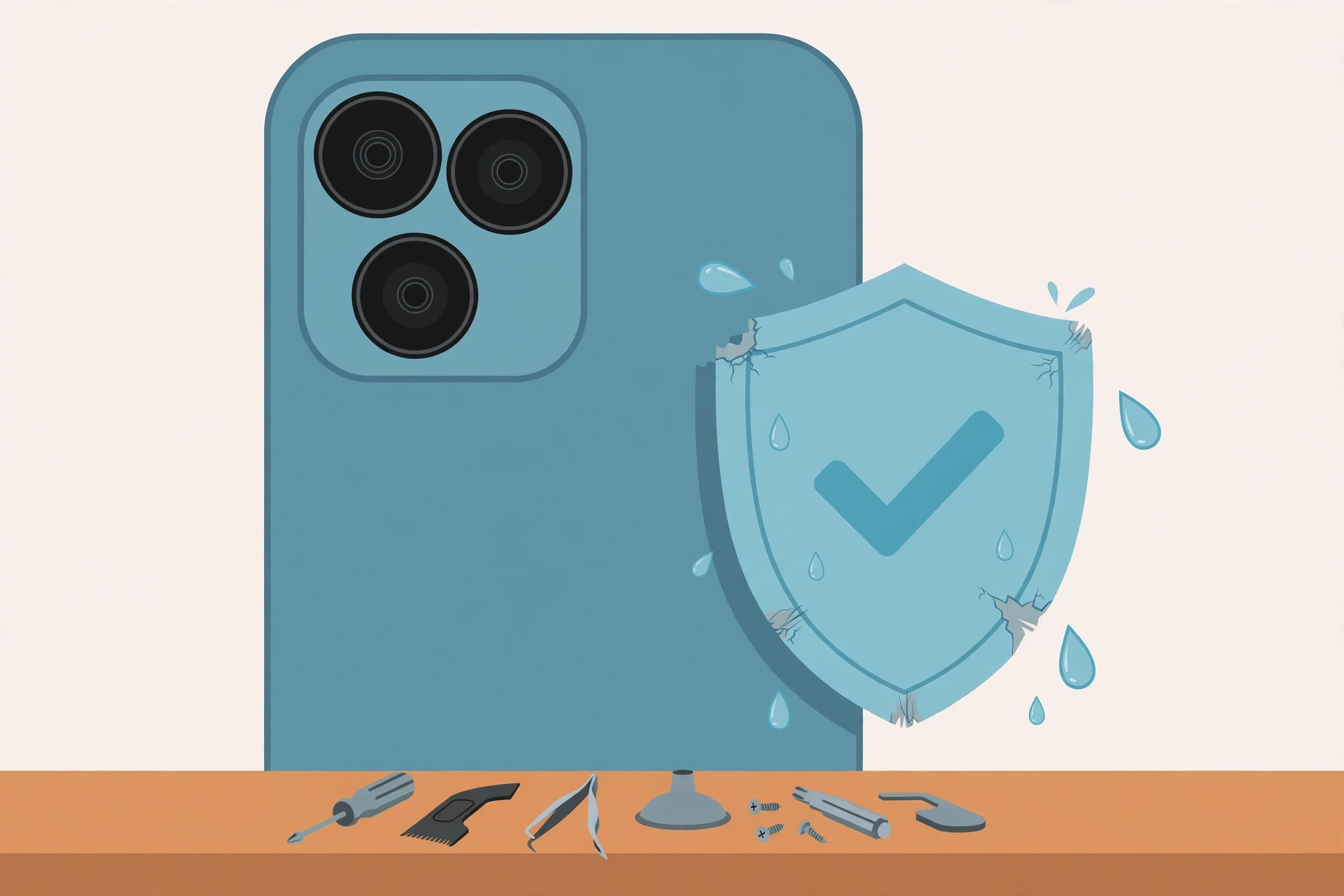
Prepared by FixUpPhone Editorial. Documentation checked October 2026. Apple specifications and service fees are distinguished from the third-party laboratory measurements cited and from FixUpPhone’s assessed repair process. No hands-on testing, measurement, customer experience or fixed FixUpPhone price is claimed for this model. The featured artwork is an original illustration. Apple is not affiliated with FixUpPhone; Apple’s specifications and fees are included only as a public reference.
- Apple — iPhone 15 Pro Max technical specifications (via faithful mirrors of Apple’s specifications text, checked 15 October 2026 — titanium design, Ceramic Shield front in plain wording, textured matte glass back, finishes, 221 g, dimensions, IP68 at 6 metres for up to 30 minutes, Action button — manufacturer specifications). Grade 5 titanium is an Apple launch-event claim, not a specifications-page line.
- Apple — iPhone 15 Pro and iPhone 15 Pro Max announcement, 12 September 2023 (aerospace-grade titanium prose; 5x telephoto exclusive to Pro Max; availability 22 September 2023).
- Notebookcheck — Apple iPhone 15 Pro Max review (published December 2023; page read at write time, October 2026) — build quality reported as great with no visible gaps and no noises when trying to bend the phone; IP68 described per IEC 60529 (that laboratory’s observations on its test unit).
- Apple Support — iPhone service and repair (inspection determines the final fee; liquid damage not covered by warranty; AppleCare+ terms; page re-checked 27 October 2026 — per-model fees render through an interactive selector and no per-model figure was readable in text)
- Apple’s published US service fees for this model, September 2023 launch figures (back glass $199; screen $379; screen + back glass $499; other damage $699; AppleCare+ $29 / $29 / $58 / $99) — no post-launch revision found as of October 2026
- FixUpPhone — Phone Repair Services and Mail-In Phone Repair, checked October 2026
- FixUpPhone — Locations, checked October 2026
For corrections or device help, contact FixUpPhone.