Reviews & Comparisons · iPhone 14 Pro
iPhone 14 Pro Used Buying Guide: What to Inspect Before You Pay
Apple discontinued the iPhone 14 Pro in September 2023, so a used or channel-stock phone is now the only route to this model — there is no new-from-Apple price to measure against. What the used market offers is a steep discount on the phone it was: Swappa’s completed-sale averages run from $363 to $482 across this model’s storage tiers (7 October 2026 snapshot, read 2 November 2026), against a $999 US launch starting price that is a historical anchor only, never a current price. Two model-specific facts shape the buy. Every storage tier from 128GB to 1TB genuinely exists here, so the trap is the opposite of the base models’ missing tier: a claimed 2TB unit does not exist. And warranty is per-unit and mostly gone: launch-day buyers’ one-year cover expired in September 2023, so a unit with cover today holds it through AppleCare+ or a later purchase date. This guide is the inspection, in the order to run it.
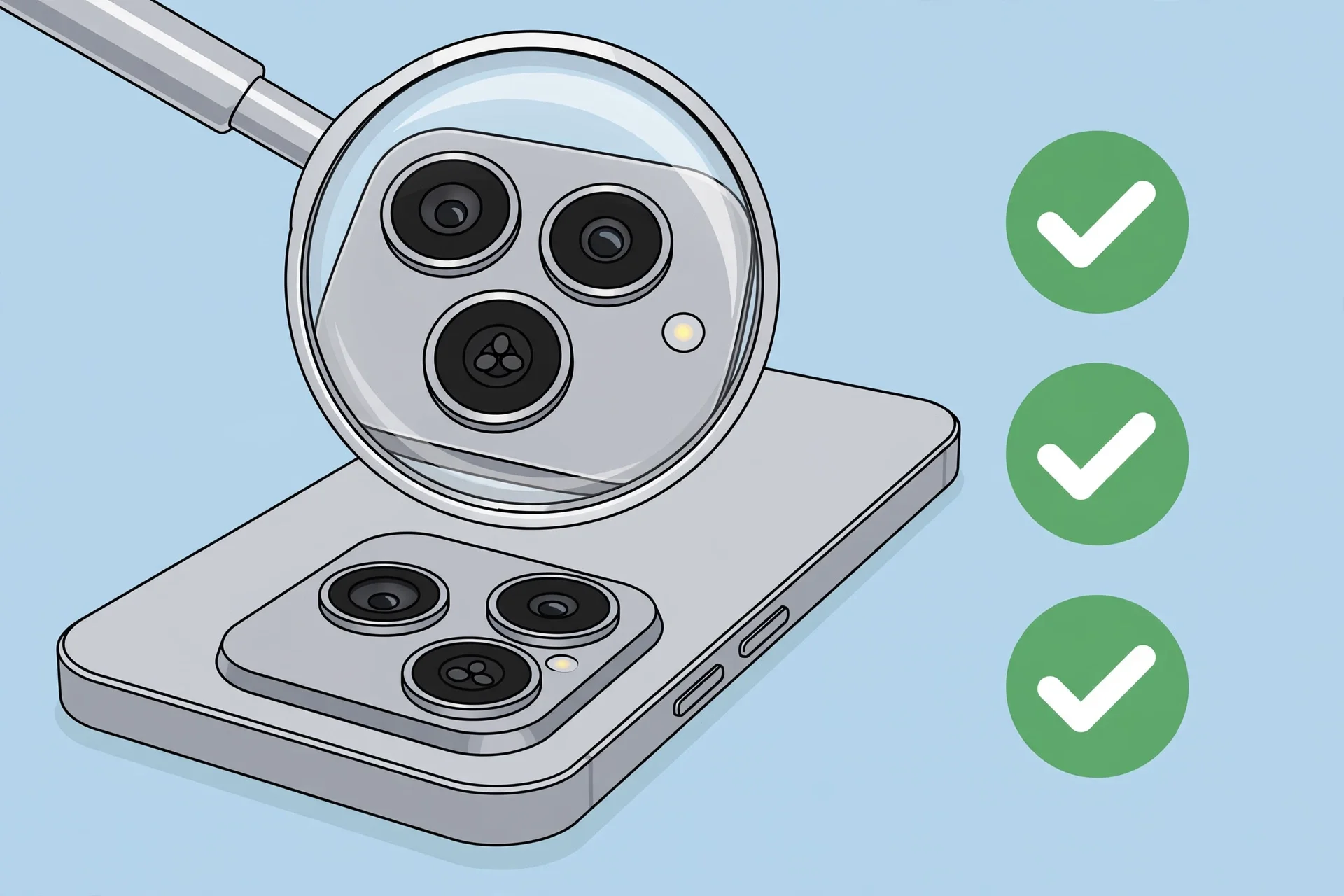
How we reviewed — methodology & evidence note
This is a desk review: FixUpPhone has not bought or handled the specific used phones discussed, and nothing here is a hands-on test. The checklist is built from Apple’s published specifications for this model (Apple technical specifications, via the FixUpPhone iPhone 14 Pro research pack, checked 15 October 2026), Apple’s published US repair fees at launch (September 2022, no post-launch revision found as of November 2026), and marketplace data read directly from Swappa’s iPhone values page on 2 November 2026, which reports average prices from completed sales on its marketplace as of 7 October 2026. Apple’s Certified Refurbished store was also checked directly on 2 November 2026 for the refurbished anchor discussed in the alternatives section. Every figure is labelled by origin — manufacturer specification, manufacturer claim, manufacturer fee, marketplace completed-sale average or our calculation from those — and prices should be re-checked on the day you buy, because used values move.
Quick Expert Summary
Verdict: A used iPhone 14 Pro is the value way into Apple’s 2022 Pro — Swappa’s completed-sale averages run from $363 to $482 across the storage tiers (checked 2 November 2026, from its 7 October 2026 snapshot), the low end sitting about $636 — nearly two-thirds — below the $999 launch starting price (our calculation) — provided the unit passes the full inspection below. Two facts shape this market. First, there is no new-phone anchor: the model was discontinued in September 2023, so used and channel stock is the route, and the honest comparison for any unit is other used units, not a sealed phone. Second, warranty is per-unit and usually absent: launch-day cover expired in September 2023, so only AppleCare+ or a later purchase date keeps a unit covered — check the individual phone’s coverage before assuming anything, and price accordingly. The tier trap is simple in the other direction from the base models: all four tiers from 128GB to 1TB are real, and a claimed 2TB unit does not exist. After four years of charge cycles, battery health is the other central fact about any individual unit. Buy the checklist, not the listing photo.
Evidence note: prices are Swappa completed-sale averages and Apple launch fees, each dated where used; specifications are Apple’s for this model.
Works in a used buyer’s favour
- Completed-sale averages of $363–$482 — the low end nearly two-thirds below the $999 launch starting price
- Battery health is visible in Settings before you pay
- A published Apple fee for every common fault — each defect is negotiable in dollars
- All four storage tiers genuinely exist here, from 128GB to 1TB
Watch out for
- A claimed 2TB unit is impossible: 1TB is this model’s ceiling tier
- Most units are out of warranty — launch-day cover expired in September 2023
- Battery wear varies by owner; a sub-80% unit adds $99 on day one
- Activation Lock or an unpaid carrier balance can brick the deal after payment
① The Phone You Are Buying
Specifications below are Apple’s for this model (manufacturer specifications, Apple technical specifications checked 15 October 2026). They matter to a used buyer twice over: they define what “correct” looks like during inspection, and they expose mislabelled listings.
| Item | What to verify on the unit |
|---|---|
| Model & storage | iPhone 14 Pro, sold new only as 128GB, 256GB, 512GB or 1TB. There is no 2TB version — see the red flags below. Both ends of the range are real here: the 128GB entry tier exists and so does the 1TB ceiling. |
| Display | 6.1-inch Super Retina XDR OLED, 2556×1179 at 460 ppi, with ProMotion, Always-On and Dynamic Island — Always-On and Dynamic Island debut on this model; brightness 1,000 nits typical, 1,600 nits peak (HDR), 2,000 nits peak (outdoor) (manufacturer ratings, not lab measurements). Apple states no minimum brightness for this model — do not expect a 1-nit figure, which belongs to the 16 series. |
| Chip & software | A16 Bionic with a 6-core CPU, 5-core GPU and 16-core Neural Engine (manufacturer specifications) — not the A17 Pro of the 15 Pro models; launched on iOS 16 |
| Build | Surgical-grade stainless steel design, 206 g, 147.5 × 71.5 × 7.85 mm, Ceramic Shield front in Apple’s plain specs wording, textured matte glass back (manufacturer specifications). The front is not “Ceramic Shield 2”, and the back is not Ceramic Shield — Apple prices its repair as back glass. This model is not titanium; titanium starts with the iPhone 15 Pro. |
| Finishes | Space Black, Silver, Gold or Deep Purple only — there is no titanium-named finish on this model |
| Cameras | 48MP Main at 24mm ƒ/1.78, 12MP Ultra Wide at 13mm ƒ/2.2 with macro photography supported, 12MP 3x Telephoto at 77mm ƒ/2.8, digital zoom up to 15x, and a 12MP TrueDepth front camera at ƒ/1.9 with autofocus; LiDAR present (manufacturer specifications). The 2x option is a crop of the main sensor, not a separate lens. Three lenses sit in a square module — a dual-camera pill module is a base model, and a larger, heavier body is the Pro Max. |
| Battery claims | Video playback up to 23 hours, streamed video up to 20 hours, audio up to 75 hours (manufacturer claims) — a single set, with no regional split, and claims about a new battery, not the worn one in a used phone; the used figure that matters is Maximum Capacity in Settings |
| Original price & current status | From $999 at the 16 September 2022 release (announced 7 September 2022) — a labelled historical anchor only, never a current selling price. The model was discontinued in September 2023, so it is not sold new by Apple; used and channel stock is the normal route. |
The tier red flags. This phone’s four storage tiers make mislabelling mechanical to spot. A listing advertising a “2TB iPhone 14 Pro” is wrong about the product itself — 2TB arrived on later Pro Max models, never on this phone — so either the seller does not know what they have or the listing is not honest. The same logic catches copy pasted from other models: a claimed 6.7-inch display, a 240 g weight, a 48MP ultra wide, a 5x telephoto, a “no macro” camera, Wi-Fi 6E or 7, 25W MagSafe, USB-C or USB 3 speeds, an Action button, Camera Control, a titanium frame or a “Ceramic Shield 2” front belongs to a sibling or a successor, not this phone (this phone’s MagSafe is up to 15W, its ultra wide is 12MP with macro, its Wi-Fi is 6, its connector is Lightning at USB 2 speeds up to 480 Mb/s per MacRumors’ launch confirmation, and it keeps the Ring/Silent switch). And one warning runs the other way: a genuine 128GB phone is the entry tier, not a suspicious one — price it against the completed-sale range, not against a Pro Max average. Treat any mismatch as a reason to walk away or re-verify everything from the serial number up.
② The Inspection Checklist
Run these checks in order — the early ones are free and instant, and a failure at any step ends the negotiation before money moves. The marketplace rules referenced are Swappa’s own listing requirements, read on its values page: its listings must be fully functional, with no cracked glass and no water damage, Find My / Activation Lock switched off, and the phone fully paid off with a clean IMEI — and a battery below 80% health with Apple’s battery message showing must be disclosed. Swappa sets no minimum battery-health percentage. Treat those as the floor for any seller, on any platform.
1. Identity: model, storage, serial
Open Settings → General → About and read the model name and capacity yourself; never rely on the listing text. Cross-check storage against the only four tiers this phone was sold in (128GB, 256GB, 512GB, 1TB) and the finish against the four published colours. Confirm it is the 6.1-inch, 206 g Pro in hand — not the heavier 240 g Pro Max, not the base 14, not a 15 or 16-series phone — since listings borrow each other’s copy freely. A mismatch on any of these is the tier red flag in action.
2. Battery: read Maximum Capacity first
Settings → Battery → Battery Health shows Maximum Capacity. A launch-cohort phone has had four years of charge cycles, and its remaining life is written here. Below 80%, the phone is at Apple’s service threshold: budget the $99 battery fee (manufacturer fee, launch figure) into the price, and remember the marketplace disclosure rule above. At 90% or better, the battery is unlikely to be your first repair. Also watch how the phone behaves in hand — a unit that sheds charge abnormally fast in a short test is telling you something the percentage alone does not; our iPhone 14 Pro battery draining fast guide lists the causes worth ruling out.
3. Coverage and locks: the checks that protect the money
Read the coverage dates in Settings → General → AppleCare & Warranty on the phone itself. Launch-day buyers’ one-year warranty expired in September 2023, so a unit with cover today holds it through AppleCare+ or a later purchase date — price a covered unit accordingly (it is worth more, and verifiably so), and treat a seller’s verbal “it has warranty” as unproven until the phone itself shows the dates. Then the locks: confirm Find My is off and the phone has been erased and removed from the seller’s Apple Account — an Activation-Locked phone is unusable to you. Confirm the phone is fully paid off and the IMEI is clean, as Swappa requires of its own listings; a financed phone can be blocked later by the carrier. On US models, remember the SIM situation is region-dependent: US models are eSIM-only, the first such generation, while other regions sold nano-SIM + eSIM — check the tray (or its absence) against the model the seller claims to be selling. Do all of this before payment, in the seller’s presence or through a marketplace that enforces it.
4. Screen and back glass: originality and condition
Check the front for cracks (which Swappa’s rules exclude from its listings entirely), even brightness, true colour and responsive touch across the whole surface, including the edges — a dead strip or lagging corner is exactly what our iPhone 14 Pro screen not responding fix guide covers. Turn the phone over: the textured matte glass back is the panel sellers forget to photograph, and a cracked back is a $499 Apple fee at launch (manufacturer fee) — nearly half the launch price, because this Pro never got the base 14’s removable-back redesign. Ask directly whether either panel has ever been replaced, and with what; a cheap non-original display is the most common hidden downgrade on used phones. If the screen needs replacing, that is a $329 Apple fee at launch (manufacturer fee) — price it in or walk.
5. Cameras, buttons, ports, radios — and the bundled case
Shoot a photo with all three rear cameras and the front camera, including a 2x shot, and remember the 2x is a crop of the main sensor, not a separate lens; look for spots, focus hunting or a fogged lens (persistent focus trouble is covered in our iPhone 14 Pro camera not focusing fix guide). Press every button — this model keeps the Ring/Silent switch; there is no Action button and no Camera Control — plug in a Lightning cable and confirm charging starts, and play audio through the speaker. Then check the radios before money moves: make a test call and confirm cellular signal holds (see our iPhone 14 Pro no service fix guide if it does not), and join a Wi-Fi network and load a page (our iPhone 14 Pro Wi-Fi not working guide covers the failure modes). If a case is bundled in, check it too: it should be cut for this exact 6.1-inch 14 Pro body, with a Ring/Silent switch cutout and a square triple-camera opening — Pro Max, base 14 and 15/16-series cases do not fit this phone, and neither does a case built around an Action button or Camera Control; a wrong case in the box is a small but telling sign the listing was assembled carelessly. Each failure maps to a published fee in the repairs section — none of them should be discovered after payment.
6. Water and repair history: ask, then verify what you can
Apple publishes no buyer-side liquid check for this model, so ask the question plainly — has it been wet, opened, or repaired, and by whom — and treat evasiveness as an answer. Liquid damage is not covered by Apple’s standard warranty even on a unit still inside cover, and it is the one history that can kill a phone months later. If the answers matter to the price, a professional assessment before payment is the honest substitute for a published test. One safety note that applies to any used phone: if the battery is swollen — a lifting screen, a bulging back — do not buy the phone and do not ship it anywhere; a swollen battery is a hazard, not a bargaining chip.
Pros & Cons of Buying This Phone Used
Pros
- Measured saving: completed-sale averages from $363 against the $999 launch starting price
- The 48MP main camera, 3x telephoto, ProMotion and Dynamic Island at a used price, with macro support
- Published fees make every fault negotiable in dollars
- Battery health is checkable in Settings in under a minute
Cons
- No new-phone route: discontinued in September 2023, so every unit is used or channel stock
- Most units are out of warranty — only AppleCare+ or a later purchase date keeps cover alive
- Battery wear is the wildcard on four-year-old units: priced per unit, not per model
- Lightning, Wi-Fi 6 and no Thread — the 2022 Pro’s limits, not defects, but price accordingly
③ Before You Pay: Price Sanity and Buying Route
The only price anchors worth trusting are completed sales, not asking prices. Swappa’s values page (read 2 November 2026; figures from its 7 October 2026 snapshot) reports average prices buyers actually paid on its marketplace:
| Reference | Figure | Origin |
|---|---|---|
| Used range across all tiers (128GB–1TB) | $363–$482 | Marketplace data (Swappa, 7 Oct 2026) |
| Saving at the range’s low end vs $999 launch start | about $636 (nearly two-thirds) | Our calculation |
| Apple Trade In | up to $285 | As listed on Swappa’s values page |
| Apple Certified Refurbished, iPhone 14 Pro | not found listed when checked, November 2026 | Manufacturer (Apple store, checked 2 Nov 2026) |
| Launch starting price (historical anchor only) | $999 | Manufacturer (launch, Sep 2022) |
Total cost, not ticket price. The range is a spread across four tiers and every condition — it is not a fair price for every unit. Run the fee maths on the specific phone in front of you: a unit at the $363 low end that needs a battery is a $462 purchase ($363 + $99, our calculation) before you have used it a day. A privately sold phone with a cracked back is a $499 fee away from whole — nearly half the launch price. Negotiate from the checklist findings, each priced by the fee table below, rather than from the listing’s optimism. And keep the disciplining anchor in view: with no iPhone 14 Pro found in Apple’s own refurbished store when checked on 2 November 2026, the honest comparison for a used unit is other used units at their completed-sale averages — a used unit earns its price by sitting at or below its tier’s average after its likely first repair, not by chasing a refurbished figure that does not currently exist for this model. A used unit earns its price by being clearly cheaper than its tier’s average after its likely first repair, or by carrying verified remaining cover of its own.
Where to buy. Prefer routes with enforceable standards: Swappa’s stated requirements (functional, uncracked, unlocked from the seller’s account, paid off, clean IMEI, battery disclosure) show what a serious marketplace enforces. For in-person sales, run the full inspection before payment and complete the account-removal steps together.
④ Repairs, Warranty & What It Means for You
Apple’s published US fees for this model at launch set the ceiling for fault costs — and, used well, they are your negotiation table:
| Repair | Apple US fee | With AppleCare+ |
|---|---|---|
| Battery | $99 | $0 under 80% health |
| Screen | $329 | $29 |
| Back glass | $499 | $29 |
| Screen + back glass | $599 | $58 |
| Rear camera | $219 | $99 |
| Other damage | $649 | $99 |
Fees: Apple US published prices at launch (September 2022); no post-launch revision was found for this model as of November 2026, and Apple’s interactive repair estimator renders per-model fees through a selector with no static figure readable (attempted 2 November 2026), so these are headlined as launch figures, not verified-current ones. They are this model’s fees, not the 15 Pro’s or the Pro Max’s: the screen here is $329, not $379, the back glass is $499, and other damage is $649. The rear camera $219 line carries a sourcing caveat: it rests on September 2023 comparison coverage stating the fee was unchanged from this model to the 15 Pro, plus a September 2024 estimator quote for this generation’s Pro Max, which shares the identical camera system. No port-only, speaker-only, microphone-only or button-only service fee exists — such damage falls under “other damage” ($649). Most used phones carry no AppleCare+, so the middle column is the realistic one — unless the unit’s coverage check in step 3 says otherwise.
The warranty reality
Apple’s standard warranty runs one year from original purchase. This model was released on 16 September 2022 and discontinued in September 2023, so a launch-cohort phone is well past its year, and any unit with cover today holds it through AppleCare+ or a later purchase date. There is no model-level answer; read the individual unit’s coverage in Settings → General → AppleCare & Warranty, and treat a seller’s verbal “it has warranty” as unproven until the phone itself shows the dates. Liquid damage is excluded from the standard warranty at any age, and an active AppleCare+ plan, where one exists, is a separate thing to verify.
FixUp’s role: check before you commit, repair if you buy
Bring a candidate phone — or send it after purchase — to FixUp for an assessment: battery health, screen originality, cameras, charging and damage can be checked, and any repair is quoted after assessment; we do not publish repair prices in advance. Repairs take 1–7 days and carry a 3-month warranty. Booking is a request our team confirms, not an instant confirmation.
- Lynwood: 3100 E Imperial Hwy, Store M1002, Lynwood, CA 90262 — daily 11 AM–8 PM — (805) 857-4225
- Santa Barbara: 619 A State St, Santa Barbara, CA 93101 — Mon–Fri 11 AM–8 PM, Sat 10 AM–8 PM, Sun 12 PM–7 PM — (805) 857-4226
- Las Vegas: 875 S Grand Central Pkwy, Unit TT32, Las Vegas, NV 89106 — Mon–Sat 10 AM–8 PM, Sun 10 AM–7 PM — (818) 482-3605
Mail-in works nationwide: how mail-in repair works. The customer pays inbound shipping and FixUp pays return shipping; back up first, confirm our instructions before shipping, and never mail a hot or swollen phone. Start from book a repair or contact the team (support@fixupphone.com).
⑤ The Decision
Buy used if the unit passes every check, the battery reads 88% or better, and the price sits at or below the completed-sale average for its tier — that combination buys Apple’s 2022 Pro with the main risks already priced. Pay above the average only for documented extras: verified remaining AppleCare+ cover, a receipt, mint glass with a high battery reading. Choose refurbished instead whenever a used phone’s price plus its likely first repair closes on a warrantied refurbished figure — the framework is in our companion iPhone 14 Pro refurbished buying guide, and note that Apple’s own store was not found listing this model when checked in November 2026, so a refurbished buy here usually means a third-party seller whose grading and warranty terms need the same scrutiny as any used listing. Walk away from any lock, balance or identity problem at any price, from a claimed 2TB unit on principle, and from any seller who will not let you run the checklist. Comparing repair-versus-replace maths on a phone you already own? Start with our repair-or-replace guide, and if you are selling rather than buying, a trade-in quote sets your floor.
⑥ Alternatives Worth Considering
Certified refurbished. A refurbished unit trades a higher price for a seller warranty and a graded, checked device. Apple’s own Certified Refurbished store is the usual benchmark route — but it was not found listing the iPhone 14 Pro when checked on 2 November 2026 (its listings at that check were 15- and 16-family models, including the 15 Pro and 15 Pro Max), so do not let a seller quote you an “Apple refurbished” price for this model without showing the listing. The full framework is in our iPhone 14 Pro refurbished buying guide, the companion to this guide in this series.
Channel stock, sealed. Sealed old stock still surfaces through carriers and retailers. Judge it the same way as refurbished: its price must sit clearly below what a warrantied refurbished unit would cost for the missing warranty to make sense, and its coverage clock starts at its own purchase date, not the 2022 launch.
A newer model instead. If listings keep pushing you toward the top of the used range anyway, the same money buys newer hardware — and the current models add the features this generation never had, which is the honest upgrade reason rather than a spec-sheet reflex.
Accessories to Budget From Day One
A used phone arrives without the protection budget a new buyer plans for. Budget for two things before anything else: a case cut for this exact 6.1-inch 14 Pro body — with a Ring/Silent switch cutout, a Lightning opening and a square triple-camera opening, since Pro Max, base 14 and 15/16-series cases do not fit — and a screen protector matched to this model’s 6.1-inch panel and its Dynamic Island cut-outs. Check magnetic alignment against this model’s MagSafe ceiling of up to 15W (manufacturer claim): a case that weakens the magnetic hold weakens the charging you actually get, and Qi2 at up to 15W applies only with iOS 17.2 or later, never as a launch feature. No product is named or priced here; the companion cases and screen-protector guides in this series carry the fit criteria in full.
Everything in our accessories shop is listed with its fit stated; whichever case you choose, confirm it names the iPhone 14 Pro itself.
Frequently Asked Questions
Is a used iPhone 14 Pro still under warranty?
Usually not — and that is this model’s honest starting point. Apple’s standard warranty runs one year from original purchase, and launch-day cover expired in September 2023. A unit with cover today holds it through AppleCare+ or a later purchase date. Read the coverage dates on the phone itself in Settings → General → AppleCare & Warranty before you pay, and price a covered unit accordingly.
What is a fair price for a used iPhone 14 Pro?
Swappa’s completed-sale averages ran from $363 to $482 across the storage tiers in its 7 October 2026 snapshot (read 2 November 2026). Mint phones with high battery health sit toward the top of the range for their tier; worn or repaired phones belong well below it. Re-check the average on the day you buy — and note that the range spans four tiers, so a 128GB unit priced near the range’s top end is overpriced for its tier.
How do I verify the storage tier on the unit in front of me?
Read it on the phone, not the listing: Settings → General → About shows the capacity. This model was sold only in 128GB, 256GB, 512GB and 1TB — a unit showing 2TB is not an iPhone 14 Pro at all, whatever the listing says. Verify the model name in the same screen.
Which storage tier should I buy?
128GB is the entry tier and genuinely sufficient for most users, and it is the cheapest way into this model. Storage cannot be added later, and this phone’s 48MP main camera invites large photo and video libraries, so heavier shooters should price the 256GB tier; 512GB and 1TB are the ceiling tiers for library-heavy owners. Judge each tier against its own completed-sale average, not the range’s low end.
What battery health should I accept?
88% or better needs no immediate budget. Between 80% and 88%, price in Apple’s $99 battery fee (launch figure) in negotiation. Below 80% the phone is at Apple’s service threshold — a serious marketplace must disclose it (Swappa requires exactly that where Apple’s battery message is showing), and the fee should come off the price in full.
How do I check for Activation Lock and unpaid balances?
Before paying: confirm Find My is off and the phone is erased and removed from the seller’s Apple Account, and confirm the phone is fully paid off with a clean IMEI. Swappa requires all of this of its listings; hold private sellers to the same standard, in person, before money moves.
What if the screen or back glass has been replaced?
Ask what it was replaced with. A non-original panel is a real downgrade in brightness, colour and durability, and it should cut the price accordingly — a genuine-quality screen replacement through Apple is a $329 fee at launch on this model, and the back glass is $499 at Apple’s launch figure, because this Pro never got a separately removable back. Check even brightness and colour in person before you pay.
Can FixUp check a used iPhone 14 Pro for me?
Yes — bring the phone to any of our three stores for an assessment of battery health, screen originality, cameras, charging and damage before you commit, or book a repair check online. Any repair work is quoted after assessment; repairs take 1–7 days and carry a 3-month warranty.
Specs, fees and marketplace figures are attributed and dated inline.
Desk review only — we do not claim hands-on use we did not do.
Lynwood · Santa Barbara · Las Vegas, plus nationwide mail-in.
1–7 day repairs, 3-month warranty, quoted after assessment.
Sources & Editorial Notes
- Swappa — “How Much Is My iPhone Worth?” values page (completed-sale averages as of 7 October 2026; marketplace listing requirements): swappa.com/blog/how-much-is-my-iphone-worth — read 2 November 2026.
- Apple — Certified Refurbished iPhone store (iPhone 14 Pro not found listed): apple.com/shop/refurbished/iphone — checked directly, 2 November 2026.
- Apple — iPhone 14 Pro technical specifications and US repair fees at launch, via the FixUpPhone iPhone 14 Pro research pack, checked 15 October 2026 (launch figures September 2022; no post-launch revision found; estimator re-check attempted 2 November 2026 — per-model fees render through a selector with no static figure readable).
- FixUpPhone — service terms, stores and mail-in rules: repairs, locations, mail-in repair.
Editorial note: this guide is a desk review. Marketplace averages are snapshots that move; Apple fees are the manufacturer’s published launch figures, headlined as such. No hands-on testing, ownership experience or customer stories are claimed anywhere in this article.