Samsung Galaxy S25 Ultra speaker quality Review & Buying Guide: Features, Trade-Offs & Value
Samsung publishes no loudness figure for the Galaxy S25 Ultra at all — and that absence is the finding this review starts from. What does exist is an independent laboratory’s measurement: a “Very Good” loudness rating on a hybrid stereo pair, with the same integrated loudness result as the previous generation and a little more low-end weight in some tracks. This desk review separates what Samsung does not publish from what the laboratory did measure, and keeps every sibling model’s number out of this model’s story.
How This Review Was Made
This is a desk review. FixUpPhone has not listened to, measured or compared this phone’s speakers; no loudness figure here comes from a FixUpPhone test, and no listening score has been invented for this article. Every figure is labelled by origin: the speaker layout and the phone’s specifications are manufacturer specifications and spec-database figures (via the verified fact pack checked 15 October 2026, with the drift-prone prices re-checked 5 November 2026); the loudness rating, the tuning comparison and the frequency-response description are GSMArena’s laboratory results for this exact model, read 5 November 2026 and named in the sources; and the repair figures are Samsung’s published US prices and terms. Two absences are findings, not gaps to fill: Samsung publishes no loudness figure and no microphone count for this model, so this review prints neither — no sibling model’s loudness number and no decibel figure appears anywhere in this article.
♪ Quick Expert Summary
The Galaxy S25 Ultra’s speakers are good in the way a flagship’s speakers usually are — loud enough, clean enough, and tuned a little warmer than the generation before — and the evidence for that comes from one laboratory, not from Samsung. Samsung publishes no loudness figure and no microphone count for this model, so there is no manufacturer claim to quote. GSMArena’s laboratory test of this exact model earned the phone a “Very Good” loudness rating (third-party lab result), with the same numerical result for integrated loudness as the previous generation, on a hybrid stereo pair — one speaker at the bottom, one at the top that also serves as the earpiece. Sound reproduction is very similar to the previous generation’s, with a bit more low-end weight in certain tracks, and the laboratory still ranks the leading rival’s speakers ahead in this category despite similar loudness. What this review cannot tell you is anything about the microphones: Samsung publishes no microphone count or quality wording for this model, so call quality’s microphone side is an open question, not a rated strength. A speaker that sounds muffled after liquid exposure is a different problem from a speaker that sounds thin by design, and the repair route for it runs through the guides below, not through a speaker-only Samsung fee, because none is published.
Source-based editorial assessment from GSMArena’s laboratory results for this exact model — not a hands-on listening test, and no listening score invented.
✓ The Speakers Deliver When
- Loudness is the measure: a “Very Good” loudness rating from the laboratory (third-party lab result)
- Everyday listening is the use — video, calls on speaker, podcasts and music at arm’s length
- Low-end weight matters: a bit more oomph in the low end than the previous generation in certain tracks (third-party lab finding)
- The phone is held normally — the bottom speaker is a touch louder than the top one, and the channels stay separate (third-party lab finding)
× They Will Disappoint When
- A Samsung loudness figure is expected — Samsung publishes none for this model
- Deep bass is the expectation — this is a phone-sized stereo pair, and the laboratory’s praise is for tuning, not for bass depth
- Microphone quality is the question — Samsung publishes no microphone count or quality wording, so nothing can be rated here
- A muffled speaker is blamed on tuning — liquid exposure or a blocked grille is a repair matter, not a sound-quality verdict
“Very Good”
Loudness rating, GSMArena laboratory test of this exact model (third-party lab result)
Hybrid stereo
Bottom speaker plus top speaker / earpiece (manufacturer specification)
No Samsung figure
Samsung publishes no loudness figure for this model — the absence is the finding
No mic count
Samsung publishes no microphone count — call quality’s mic side is unrated
No maker figure.
One lab verdict.
Samsung publishes no loudness number; the laboratory rates the speakers “Very Good”.
① Key Specifications
| Speaker layout (manufacturer specification) | Hybrid stereo: one speaker on the bottom, and one up top that also serves as the earpiece |
|---|---|
| Channel behaviour (third-party lab finding) | Samsung keeps the channels separate, rather than sending lower levels of each channel to the opposite speaker as some makers do; the bottom speaker is a touch louder than the top one |
| Loudness rating (third-party lab result) | “Very Good” — GSMArena’s rating for this exact model, the same rating as the previous generation, and the same numerical result for integrated loudness as the previous generation. No loudness number is printed in this article: the laboratory’s text gives the rating and the comparison, and no figure from another model’s test is substituted |
| Loudness figure from Samsung | NOT PUBLISHED — Samsung publishes no loudness figure for this model in the materials checked. No decibel figure is printed anywhere in this article |
| Sound character (third-party lab finding) | Sound reproduction is very similar to the previous generation’s, with only subtle differences — a bit more low-end weight in certain tracks. The laboratory would still pick this phone’s speakers over the leading Pixel rival’s, while the leading iPhone rival remains ahead in this category |
| How loudness is measured (laboratory method) | GSMArena measures the average loudness of the speakers in LUFS — a lower absolute value means a louder sound — and publishes a frequency-response chart against an ideal flat line. The method is described here; the model’s own LUFS number is not printed, for the reason in the row above |
| Microphone count | NOT PUBLISHED — Samsung publishes no microphone count or quality wording for this model in the materials checked. Do not state a mic count |
| Microphone repair price (Samsung US) | NOT PUBLISHED — Samsung publishes no microphone-only repair price; microphone faults are quoted through Samsung’s service flow after diagnosis |
| Speaker repair price (Samsung US) | NOT PUBLISHED — Samsung publishes no speaker-only repair price; speaker faults are quoted through Samsung’s service flow after diagnosis. Samsung’s only static US repair price is the front-screen tier ($279 suggested, last checked 5 November 2026) |
| The phone | Snapdragon 8 Elite for Galaxy in all regions (never an Exynos variant anywhere, never “Gen 5”); 12GB RAM at every tier — 256GB $1,299.99 / 512GB $1,419.99 / 1TB $1,659.99 (Samsung US list prices, last checked 5 November 2026; no October 2026 rise applies to this model); no microSD; titanium frame (never Armor Aluminum); Gorilla Armor 2 front, Gorilla Glass Victus 2 back (back-glass name attributed to spec databases / launch tables); 218 g; 162.8 × 77.6 × 8.2 mm; 6.9-inch Dynamic AMOLED 2X, QHD+, 1–120Hz adaptive, 2,600-nit peak (manufacturer specification); announced 22 January 2025, released 7 February 2025 in the US; Android 15 / One UI 7 at launch, seven generations of OS upgrades and seven years of security updates |
Fee note: Samsung US publishes no speaker-only or microphone-only price for this model; both faults are quoted through Samsung’s service flow after diagnosis. Samsung’s only static US repair price is the front-screen tier ($279 suggested, last checked 5 November 2026, may vary by region or authorised store, excludes taxes and fees) — see the sources. No FixUpPhone price is published; any FixUp repair is quoted after assessment.
② Expert Analysis
Every figure below is labelled by origin. No listening measurement was produced for this review.
The absence is the finding
Start with what Samsung does not say, because it shapes everything else in this review. Samsung publishes no loudness figure for the Galaxy S25 Ultra — no decibel rating, no “loudest ever” claim, no volume specification of any kind in the materials checked — and no microphone count or quality wording either. That is not an oversight in this article; it is the state of the manufacturer’s own documentation. A review that filled those gaps with a sibling model’s loudness number or a guessed microphone count would be inventing the very figures a buyer is trying to compare. So this review prints no loudness number at all: the laboratory’s “Very Good” rating stands on its own, and the microphone side of call quality is left openly unrated.
What the laboratory actually found
GSMArena’s laboratory test of this exact model gives the speakers a “Very Good” loudness rating (third-party lab result) — the same rating as the previous generation, and, in the laboratory’s own words, “even down to the numerical result for integrated loudness”. That sameness is informative: loudness did not move a generation, even though the phone around the speakers changed. What did move, slightly, is the tuning. Sound reproduction is very similar to the previous generation’s, with only subtle differences — a bit more low-end weight in certain tracks (third-party lab finding). The laboratory’s comparison is equally plain: it would still pick this phone’s speakers over the leading Pixel rival’s, while the leading iPhone rival remains ahead in this category. In plain terms, these are loud, clean, well-tuned phone speakers that sit in the same class as most other flagships — strong, but not the class leader.
The layout, and why it matters in the hand
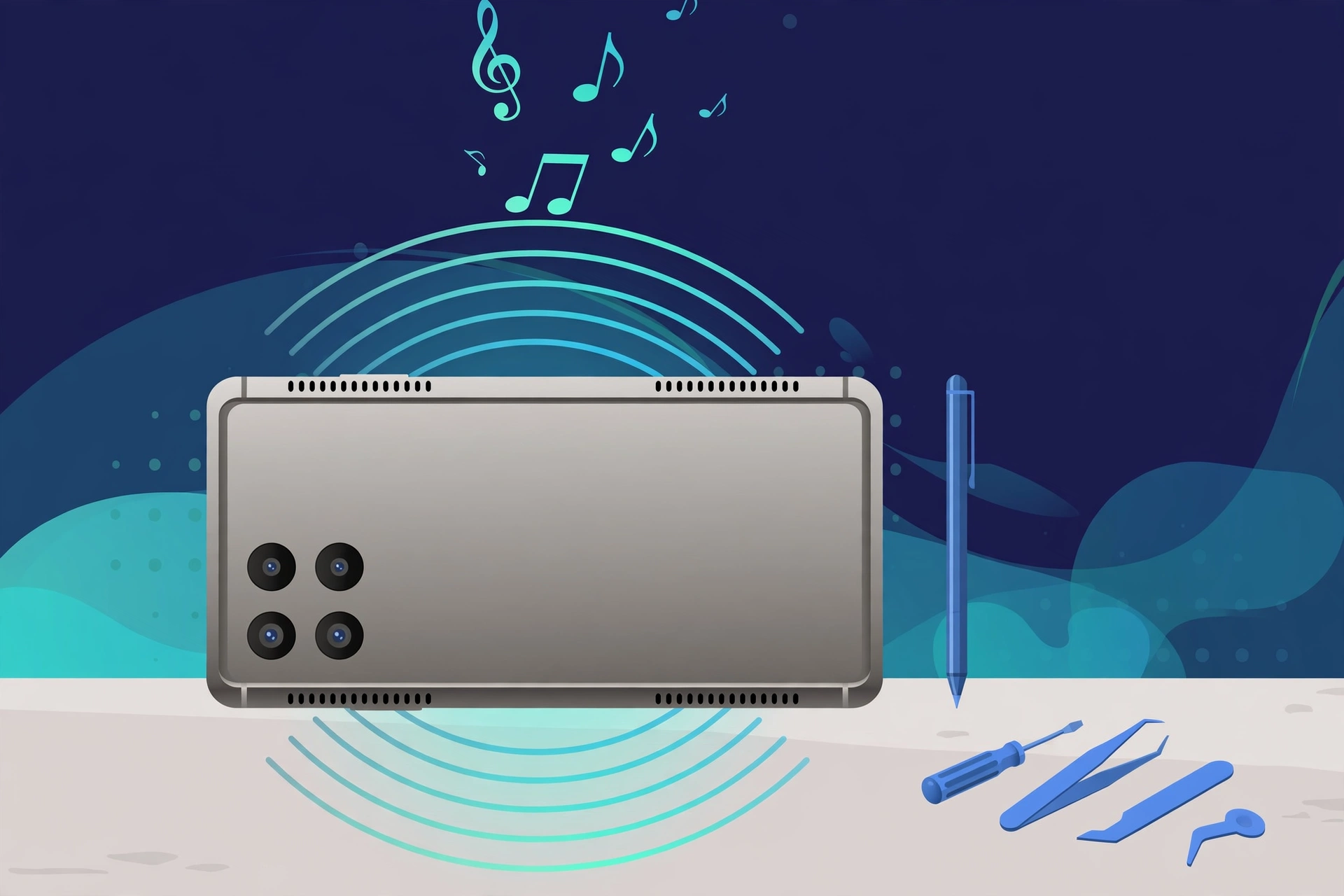
The hardware is the usual hybrid stereo arrangement: one speaker on the bottom, and another up top that also serves as the earpiece (manufacturer specification). Two details from the laboratory’s test are worth knowing before judging the sound. First, Samsung keeps the channels separate rather than sending lower levels of each channel to the opposite speaker, as some makers do — so stereo separation is real, not simulated. Second, the bottom speaker is a touch louder than the top one, which is normal for this layout and means the soundstage tilts slightly toward the bottom edge when the phone is held in landscape. Neither detail is a flaw; both explain why the speakers can sound slightly uneven if one grille is covered by a finger or a case edge — and why a case that blocks the bottom grille will do more damage to the sound than one that covers the top.
What “Very Good” does and does not promise
A “Very Good” loudness rating is a laboratory judgement about volume and measured response, not a promise that every track will sound full. Phone speakers are physically small, and the laboratory’s own praise is for tuning and loudness, not for bass depth: the extra low-end weight it notes is relative to the previous generation, in certain tracks, not a claim that this phone reproduces deep bass. A buyer who listens mostly to voices — calls on speaker, podcasts, video — will get the best of these speakers. A buyer who wants room-filling music should plan on an external speaker or headphones, as with any phone. And because the laboratory measures loudness in LUFS and publishes a frequency-response chart against an ideal flat line, its rating is comparable with other phones the same laboratory tested — but the numbers from those other tests are not this model’s numbers, and none of them is printed here.
When a speaker problem is a repair, not a review
Three speaker symptoms belong to the repair guides below, not to this review’s verdict. A speaker that sounds muffled or quiet after liquid exposure may have water in the grille or damage behind it — Samsung’s IP68 rating covers lab conditions (1.5 m freshwater for up to 30 minutes) and is not permanent, and liquid damage is not covered by Samsung’s standard warranty. A speaker that crackles or cuts out at volume may have a damaged driver or a loose connection. And a speaker that produces no sound at all while the earpiece still works — or the reverse — points to one side of the hybrid pair, not to the phone’s tuning. In all three cases the fix is diagnosis first: Samsung publishes no speaker-only price, so the quote comes after assessment, and the same applies to microphone faults.
Before calling the speakers weak
Run the checks in order: the volume and any volume limit, the case (a blocked bottom grille tilts the whole soundstage), the grilles themselves (pocket lint and dust muffle more than most owners expect), and whether the symptom follows the phone across apps — a single app’s quiet audio is the app’s problem. If the speakers are quiet or distorted in every app, with clean grilles and no case in the way, the fault is in the phone — and the speaker and microphone guides below are the next step.
The speaker picture in one page
- Layout: hybrid stereo — bottom speaker plus top speaker / earpiece, channels kept separate (manufacturer specification; third-party lab finding)
- Loudness: “Very Good” rating from GSMArena’s laboratory test of this exact model, same integrated loudness result as the previous generation (third-party lab result)
- Tuning: very similar to the previous generation, with a bit more low-end weight in certain tracks; ahead of the leading Pixel rival, behind the leading iPhone rival (third-party lab finding)
- Samsung publishes no loudness figure and no microphone count — both absences are stated, not filled
- No decibel figure, no LUFS number and no listening score is printed anywhere in this article
- No Samsung speaker-only or microphone-only repair price — both are quoted after diagnosis
③ Pros & Cons
✓ Pros
- “Very Good” loudness rating from the laboratory, matching the previous generation’s measured result (third-party lab result)
- A touch more low-end weight than the previous generation in certain tracks (third-party lab finding)
- Real stereo separation — channels are kept separate rather than blended across the two speakers
- Preferred by the laboratory over the leading Pixel rival’s speakers (third-party lab finding)
- Loud and clean enough for video, speaker calls and podcasts at arm’s length
× Cons
- Samsung publishes no loudness figure — there is no manufacturer claim to compare against
- The leading iPhone rival’s speakers still rank ahead in the laboratory’s comparison
- No deep bass — the praise is for tuning and loudness, not for bass depth
- The bottom speaker is a touch louder than the top one, so the soundstage tilts in landscape
- Samsung publishes no microphone count or quality wording — the microphone side of call quality is unrated
- No Samsung speaker-only or microphone-only price: a faulty speaker or mic is quoted after diagnosis, not from a published table
Buying & Listening Setup
What to check, and what to plan for, in order. No accessory price is asserted here — speaker and headphone prices vary by seller and date, so this section names the check to make, not a price:
| Item / check | What to look for | Why it matters |
|---|---|---|
| Case fit | A case for this exact model that leaves the bottom speaker grille fully open | The bottom speaker is the louder of the pair — a blocked grille tilts the whole soundstage |
| Grilles | Clean top and bottom grilles, free of lint and dust | Blocked grilles muffle more than most owners expect, and look like a speaker fault |
| Volume limits | Check for a volume limit or hearing-protection setting before judging loudness | A forgotten limit explains a phone that “isn’t loud enough” — it is a setting, not a fault |
| Listening test | Play the same track or video in two apps before deciding the speakers are weak | A single app’s quiet audio is the app’s problem, not the speakers’ |
| External audio | Headphones or an external speaker for music that needs real bass | Phone-sized speakers cannot reproduce deep bass, however well tuned they are |
FixUpPhone publishes no fixed repair price; if a speaker or microphone is the problem, the quote comes after assessment. Repairs take 1–7 days with a 3-month warranty.
If the Sound Itself Fails
The three guides below separate the three failure routes — speaker, microphone and liquid — instead of treating every sound complaint as one fault:
- Samsung Galaxy S25 Ultra speaker repair cost — the speaker route; Samsung publishes no speaker-only price, so the quote comes after diagnosis
- Samsung Galaxy S25 Ultra microphone repair cost — the microphone route; Samsung publishes no microphone-only price either
- Samsung Galaxy S25 Ultra water damage repair cost — the liquid route, for muffled sound after exposure
An online booking is a request; the team confirms the next step with you.
Mail-In Repair Service
Start with the repair request form and choose Mail-In Repair. You pay to ship the phone to FixUpPhone; FixUpPhone pays the return. Do not send the device until the receiving store and shipping instructions are confirmed.
Start Mail-In Repair →Back up first. Flag any liquid, heat or battery damage when you book. Never mail a hot or swollen phone. Questions: support@fixupphone.com.
Prefer to visit? Find a repair location →Visit a FixUpPhone Store
Lynwood, CA — FixUpPhone store · 3100 E Imperial Hwy, Store M1002, Lynwood, CA 90262 · Every day 11 AM–8 PM · (805) 857-4225
Santa Barbara, CA — FixUpPhone store · 619 A State St, Santa Barbara, CA 93101 · Mon–Fri 11 AM–8 PM; Sat 10 AM–8 PM; Sun 12 PM–7 PM · (805) 857-4226
Las Vegas, NV — FixUpPhone store · 875 S Grand Central Pkwy, Unit TT32, Las Vegas, NV 89106 · Mon–Sat 10 AM–8 PM; Sun 10 AM–7 PM · (818) 482-3605
How It Works
- BookSubmit the model, store or mail-in choice, and the fault.
- DiagnoseThe team confirms what is wrong and the full quote.
- ApproveReview the finding and confirmed quote before authorising work.
- RepairThe general repair timeframe is 1–7 days, plus shipping time for mail-in.
- Collect or ReturnCollect in store or receive the mail-in return; repairs include a 3-month warranty.
④ Who These Speakers Suit
| Your situation | Verdict | Why |
|---|---|---|
| You watch video and listen to podcasts on the phone itself | Well suited | “Very Good” loudness with clean, well-tuned stereo is exactly this use case. |
| You take calls on speakerphone through the day | Well suited | Loud, clear stereo with separate channels — though the microphone side itself is unrated by any published figure. |
| You want the best phone speakers in the class | Close, not first | The laboratory ranks the leading iPhone rival ahead in this category despite similar loudness. |
| You want deep bass from the phone alone | Plan around it | The praise is for tuning and loudness, not bass depth — plan on headphones or an external speaker. |
| Your speaker is muffled, crackling or silent | Diagnose first | Grilles, case, settings and app first — then the speaker, microphone and water-damage guides. |
⑤ Alternatives & Comparison
The default: loud, clean, well-tuned, and always with you.
Explore option →For music that needs real bass and for private listening.
Explore option →For room-filling sound the phone’s small drivers cannot produce.
Explore option →⑥ Frequently Asked Questions
How loud are the Galaxy S25 Ultra’s speakers?
Samsung publishes no loudness figure for this model, so there is no manufacturer number to quote. GSMArena’s laboratory test of this exact model rated the speakers “Very Good” for loudness (third-party lab result), with the same integrated loudness result as the previous generation. No decibel figure is printed in this article.
Does Samsung publish a loudness figure for this phone?
No. Samsung publishes no loudness figure, decibel rating or volume specification for the Galaxy S25 Ultra in the materials checked. The only loudness judgement available is the laboratory’s “Very Good” rating, which must be labelled as a laboratory result, never as a Samsung claim.
Are the speakers stereo?
Yes — hybrid stereo, with one speaker on the bottom and one up top that also serves as the earpiece (manufacturer specification). Samsung keeps the channels separate rather than blending them across the two speakers (third-party lab finding).
How do the speakers compare with the previous generation?
Very closely: the laboratory found the same “Very Good” loudness rating and the same integrated loudness result, with sound reproduction very similar and only subtle differences — a bit more low-end weight in certain tracks (third-party lab findings).
How many microphones does the Galaxy S25 Ultra have?
Samsung does not publish a microphone count for this model, so this review states no number. Any microphone count printed elsewhere for this model is not a Samsung-published figure.
Why does my speaker sound muffled after the phone got wet?
Water in the grille or damage behind it can muffle the sound. The IP68 rating covers lab conditions (1.5 m freshwater for up to 30 minutes), is not permanent, and liquid damage is not covered by Samsung’s standard warranty. Get the phone assessed rather than waiting for it to dry out on its own.
Can a case make the speakers sound worse?
Yes — the bottom speaker is a touch louder than the top one, so a case that covers the bottom grille tilts the whole soundstage. Check that the case fits this exact model and leaves both grilles fully open.
Can FixUpPhone diagnose a Galaxy S25 Ultra speaker or microphone problem?
Yes — bring the phone to any of our three stores for an assessment, or book a repair check online. Any repair work is quoted after assessment; Samsung publishes no speaker-only or microphone-only price, so the fault is diagnosed before it is priced. Repairs take 1–7 days and carry a 3-month warranty. Never mail a hot or swollen phone.
Sources & Editorial Notes
Prepared by FixUpPhone Editorial. Documentation checked 5 November 2026. This is a desk review: FixUpPhone did not hands-on test this device, listen to its speakers, or measure loudness. Figures are labelled by origin — manufacturer specification, manufacturer claim, third-party lab result, spec-database figure, or published fee. The featured artwork is an original illustration. Samsung is not affiliated with FixUpPhone.
- Samsung — Galaxy S25 Ultra product pages and Newsroom specification / launch coverage (via the verified fact pack, checked 15 October 2026): hybrid stereo speakers, Snapdragon 8 Elite for Galaxy in all regions, titanium frame, Gorilla Armor 2 front, Gorilla Glass Victus 2 back (back-glass name attributed to spec databases / launch tables), 218 g, 162.8 × 77.6 × 8.2 mm, 6.9-inch Dynamic AMOLED 2X, QHD+, 1–120Hz adaptive, 2,600-nit peak, announced 22 January 2025, released 7 February 2025 in the US. Samsung publishes NO loudness figure and NO microphone count for this model in the materials checked
- GSMArena — Samsung Galaxy S25 Ultra review, battery life / charging speed / speaker test page, read 5 November 2026 (https://www.gsmarena.com/samsung_galaxy_s25_ultra-review-2793p3.php): hybrid stereo setup (bottom speaker plus top speaker / earpiece, channels kept separate, bottom speaker a touch louder); “Very Good” loudness rating, same as the previous generation “even down to the numerical result for integrated loudness”; sound reproduction very similar to the previous generation with a bit more low-end weight in certain tracks; laboratory prefers these speakers over the leading Pixel rival’s, while the leading iPhone rival remains ahead; loudness measured in LUFS (lower absolute value means louder), with a frequency-response chart against an ideal flat line. No LUFS number for this model is printed in this article, because the laboratory’s text gives the rating and the comparison without a headline number to quote
- Samsung US Support — Cracked Screen Repair page (https://www.samsung.com/us/support/cracked-screen-repair/), re-checked 5 November 2026 via its indexed text: Screen Repair (front screen only) $279 suggested for the Galaxy S25 Ultra, may vary by region or authorised store, excludes taxes and fees; Screen Module Replacement listed as “–” (no published price); no speaker-only or microphone-only price published
- US list prices $1,299.99 / $1,419.99 / $1,659.99 (256GB / 512GB / 1TB, 12GB at every tier), re-checked 5 November 2026: Samsung US’s own store still lists the model from $1,299.99 (reported from Samsung’s US product page, October 2026), and the launch tier figures are corroborated by current reporting; no October 2026 list-price rise applies to this model — retailer street prices below list are promotions, not list-price changes
- Samsung US Support — Samsung Care+ page (https://www.samsung.com/us/support/samsung-care-plus/), re-checked 5 November 2026 via its indexed text: cracked screen and back glass $29 per claim (standard Care+), $0 per claim with Theft and Loss; unlimited battery repair subject to a diagnostics test confirming 79% or less battery capacity; lost/stolen deductible $99–$199 depending on the device; maximum three lost/stolen claims in any consecutive 12 months
- FixUpPhone’s published guides for this model — speaker repair cost, microphone repair cost and water damage repair cost
- FixUpPhone — Phone Repair Services and Mail-In Phone Repair, checked 15 October 2026
- FixUpPhone — Locations, checked 15 October 2026
For corrections or device help, contact FixUpPhone.