Samsung Galaxy S26 Ultra · Durability Review
Samsung Galaxy S26 Ultra Durability Review: Build Quality & Common Risks
The Galaxy S26 Ultra trades titanium for Armor Aluminum, keeps Gorilla Armor 2 up front and Victus 2 at the back, and carries an IP68 rating with real caveats — but its most breakable part is also its hardest to repair. This desk review separates Samsung’s build claims from iFixit’s teardown findings, so you know what is genuinely tough and what is genuinely risky.
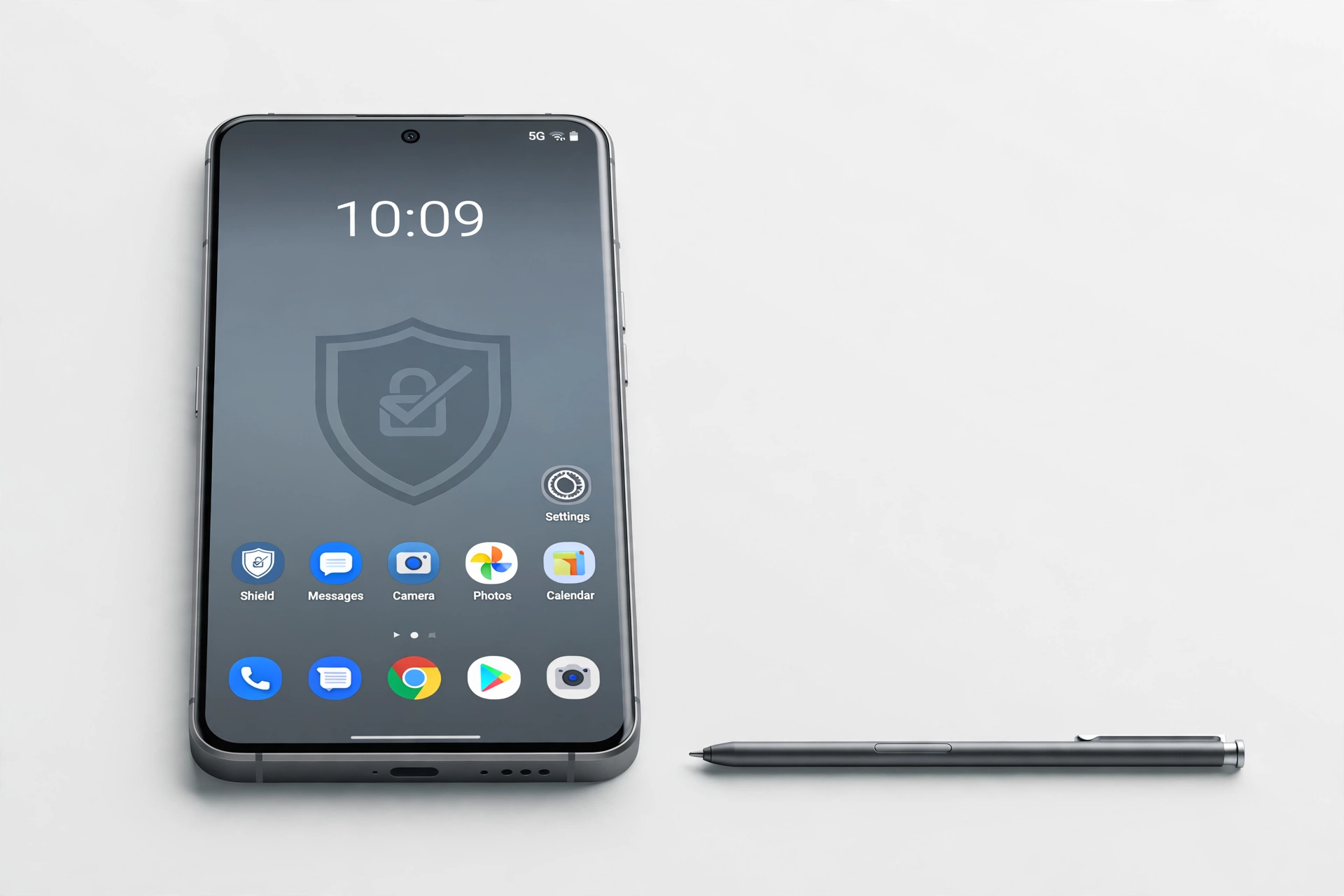
Methodology: a desk review, not a hands-on test
FixUpPhone did not drop-test, scratch-test or water-test this phone. This review is a desk review: it compares Samsung’s published build specifications with iFixit’s teardown of this exact model, and it labels every number by source. Where a figure comes from Samsung, it is called a manufacturer specification. Where it comes from iFixit, it is called an attributed third-party teardown finding. No drop height, scratch result or durability score from the Galaxy S25 Ultra, the base Galaxy S26 or S26+, or any iPhone is used as a figure for this phone — the frame material alone changed between generations, so last year’s results cannot stand in for this year’s.
Sources used: Samsung’s own product pages and Newsroom specification table for the Galaxy S26 Ultra (as recorded in the verified pack checked 15 October 2026, with the independent re-verification addendum of the same date); iFixit’s Galaxy S26 Ultra teardown (March 2026). Repair and list prices were re-checked at write time on 4 November 2026 — see the Repair section and the Sources section for the outcomes.
Quick Expert Summary
Verdict in one line: a well-built, well-sealed flagship whose everyday toughness is real — with one honest caveat: the frame is aluminum, not titanium, and the screen that breaks most often is the part that is hardest to fix.
- Build: Armor Aluminum frame (manufacturer specification — NOT titanium), Corning Gorilla Armor 2 front, Corning Gorilla Glass Victus 2 back, 214 g, 163.6 × 78.1 × 7.9 mm.
- Water: IP68 (manufacturer specification) — 1.5 m freshwater for 30 minutes under lab conditions only; resistance is not permanent, and liquid damage is NOT warranty-covered.
- Teardown: iFixit gave the phone a provisional repairability score of 5 out of 10 (attributed third-party finding): easy pull-tab battery and modular USB-C port, but a brutal screen repair path and weak parts availability.
- The catch: a bent or broken frame does more than dent the phone — it makes the phone ineligible for Samsung’s $289 front-screen-only repair tier.
- Repairs: Samsung’s suggested front-screen-only price is $289 (re-checked 4 November 2026); battery, back glass, camera and charging-port prices are not published and are quoted after diagnosis.
Specifications
All figures in this section are manufacturer specifications from Samsung unless noted.
| Frame | Armor Aluminum (Samsung’s own wording; spec databases add a “2” that Samsung’s consumer copy does not — headline Samsung’s wording) |
|---|---|
| Front glass | Corning Gorilla Armor 2, with DX anti-reflective coating |
| Back glass | Corning Gorilla Glass Victus 2 (NOT Gorilla Armor, and not any ceramic material) |
| Weight / size | 214 g; 163.6 × 78.1 × 7.9 mm |
| Water / dust | IP68 (IEC 60529): dust-tight; immersion in up to 1.5 m of fresh water for up to 30 minutes under laboratory test conditions |
| Rear cameras | Raised camera island housing (Samsung’s wording varies by page — “ambient island”, “translucent camera island” and “glass camera island” all appear; no single phrasing is Samsung’s global term) |
| S Pen | Built in, stored in a silo; passive EMR — no Bluetooth, no internal battery, no Air Actions; Air Command remains |
| Colours (launch) | Black, White, Sky Blue, Cobalt Violet at retail; Silver Shadow and Pink Gold as Samsung.com exclusives |
| SIM (US model) | Physical nano-SIM slot plus eSIM (US model SM-S948U/U1; max two lines active) — NOT eSIM-only |
| Drop / scratch rating | Samsung publishes no drop-height or scratch-resistance figure for this model — none is claimed here |
Finding, not a gap in this review: Samsung publishes no drop-test height, no scratch-test result and no operating-temperature range for this model, and no microphone count, modem name, Thread radio or Samsung-confirmed satellite feature in its US copy. Those absences are stated here rather than filled from another phone: the S25 Ultra’s titanium frame and the iPhone’s materials vocabulary (“Ceramic Shield”, titanium-by-default framing) belong to other models and are not used for this one.
Analysis: what the build does, and where it breaks
The aluminum decision — and why it matters
The single biggest build change of this generation is the frame: after two titanium generations, the S26 Ultra returns to aluminum. Samsung’s own copy says “Armor Aluminum frame”, and that wording is the headline — not titanium, and not the “Armor Aluminum 2” label that appears in spec-database build lines. For everyday durability the practical difference is modest: aluminum is lighter for its strength and easier to work with, which is part of why this phone’s battery and port repairs are as accessible as iFixit found them. But aluminum also dents and bends more readily than titanium under the same impact, and that has a repair consequence unique to Samsung’s pricing: a bent or broken frame disqualifies the phone from the front-screen-only repair tier. A drop that bends the frame therefore does not just add cosmetic damage — it can change which repair route, and which price, applies. Case choice matters more on this phone than the titanium framing of its predecessors suggested.
Glass: strong in different ways, front and back
The front and back glass are deliberately different materials, and the distinction matters. The front is Gorilla Armor 2 — the anti-reflective, scratch-resistant glass that also carries the Privacy Display — while the back is Gorilla Glass Victus 2. PhoneArena’s materials line mislabels the back glass; Samsung’s own FAQ wording (front and back “respectively”) is the source used here. The practical upshot: the front glass is the more advanced, more expensive surface, and it is also the surface that takes the first impact in a face-down drop. The back glass sits under a raised camera island, so a rear drop can crack the back panel, the island, or both in one impact — one rear surface story, but two repair considerations, since Samsung publishes no back-glass price at all (quoted after diagnosis). Neither glass is unbreakable, and neither is rated here with a drop height, because Samsung publishes none.
IP68: a lab rating, not a swimming promise
IP68 on this phone means dust-tight and water-resistant to immersion in up to 1.5 metres of fresh water for up to 30 minutes — under laboratory test conditions, on a new, undamaged phone. Samsung’s standing caveats travel with the rating and are repeated here because they are routinely dropped in summaries: resistance is not permanent and may diminish with normal wear; beach and pool use are not advised (salt water and chlorinated water are not the freshwater of the lab test); and a phone that has been repaired or already has a cracked screen or back does not carry the lab rating in practice. Most importantly, Samsung’s standard 1-year limited warranty does not cover liquid damage — accidental damage is what Samsung Care+ exists for. An IP68 rating that survives a splash is not a warranty against a swim, and any used buyer should treat a seller’s “it’s waterproof” as a misunderstanding, not a guarantee.
What iFixit actually found inside
iFixit’s teardown is the most useful durability document for this phone because it separates the genuinely good from the genuinely bad. Good: the battery uses a pull-tab adhesive system that comes away cleanly by hand, with no tools or heat — iFixit calls it simpler than Apple’s approach — and the USB-C port is modular, so a worn port does not require dismantling the whole phone. Cameras and ports generally earned solid marks. Bad: the screen repair path is, in iFixit’s words, one of the hardest on a flagship in a while. The display connector is accessible only from the back panel, so a cracked screen requires a full teardown; the display layers wanted to separate before the assembly came free, even with heat; and the selfie camera is glued in so aggressively that removing it risks damaging the screen — iFixit damaged the Privacy Display panel during its own teardown. Parts availability compounded the problem: Samsung’s official repair listings showed part numbers without images or descriptions. The provisional 5 out of 10 score, unchanged from the previous generation, is best read as “good bones, bad screen path” rather than as a uniform verdict.
The S Pen and the small parts
The built-in S Pen is a durability footnote with a real consequence: it is a passive EMR stylus with no Bluetooth, no internal battery and no Air Actions — the same removal Samsung made on the S25 Ultra, confirmed by Samsung Australia’s own S Pen page for this model. That is good news for durability (nothing to charge, nothing to pair, no battery to age inside the silo) and bad news only for buyers expecting the S24 Ultra’s remote-shutter gestures, which this pen cannot do. Air Command, which needs no Bluetooth, remains. The circulating 2.8 ms latency and 4,096 pressure-level figures come from enthusiast coverage, not Samsung’s checked copy, and are not relied on here. The silo itself is a small-part risk of the ordinary kind: a lost pen is a lost accessory, not a phone repair, and no price for one is stated in the sources used here.
Pros & Cons
Pros
- Armor Aluminum frame with Gorilla Armor 2 front and Victus 2 back — a coherent, Samsung-specified materials set (not borrowed titanium framing).
- IP68 sealing to 1.5 m freshwater for 30 minutes under lab conditions, with dust-tight protection.
- Battery and USB-C port are genuinely repair-friendly — pull-tab battery removal and a modular port (iFixit).
- Passive S Pen: nothing to charge, pair or wear out inside the silo.
- Still inside Samsung’s 1-year warranty until at least March 2027, so defects (not accidents) are covered for early buyers.
Cons
- Aluminum bends more readily than the titanium it replaced — and a bent frame disqualifies the phone from Samsung’s $289 front-screen-only tier.
- Screen repair is exceptionally difficult: full teardown, separating display layers, selfie-camera adhesive risk (iFixit).
- IP68 is a lab rating, not permanent, and liquid damage is NOT warranty-covered.
- No Samsung-published drop height, scratch figure, back-glass price or operating-temperature range — the honest gaps are stated, not filled.
- Parts availability is weak: Samsung’s listings showed part numbers without images or descriptions (iFixit).
Buying: the durability checks that matter
If you are buying a used Galaxy S26 Ultra, inspect it the way its risks are actually distributed. Check the frame first, all four edges and corners, for bends and dents — a bent frame is not cosmetic trivia on this phone, because it changes the repair tier for any future screen damage. Check the front glass for cracks and the back glass and camera island for cracks in one pass, since a rear drop damages them together. Check the S Pen: does it slide in and out cleanly, and does Air Command engage? (Do not test for Air Actions — this pen does not have them, and a seller demonstrating them is demonstrating a different phone’s pen.) Check the SIM tray on the US model: it should be a physical nano-SIM tray plus eSIM support, not an eSIM-only configuration. Ask about water exposure directly, and treat any swimming or pool story as a risk flag, not a selling point — IP68 does not survive as a warranty promise, and liquid damage is not covered. Ask whether the screen has ever been replaced, and test Privacy Display side-angle dimming: a non-genuine or wrong-assembly panel is a durability clue as well as a display clue. Finally, check the purchase date against the March 2026 release: any unit is still inside its 1-year warranty until at least March 2027, but that warranty covers defects, not the drops and spills that Care+ exists for.
Repair angle: the durability question that matters most is the screen question. Samsung’s suggested front-screen-only price is $289 (re-checked 4 November 2026), but only for an undamaged-frame phone: a bent frame, a swollen battery or another detected hardware failure routes the repair to the module tier, for which Samsung publishes no price (“–”). Under standard Samsung Care+ the screen claim is $29 and back glass is $29; under Care+ with Theft and Loss both are $0. If the phone you are considering already has a cracked screen, price that repair — and check the frame — before you pay.
Repairability: durability
Durability and repairability pull in opposite directions on this phone, and the teardown score captures the tension: a provisional 5 out of 10 from iFixit (March 2026), the same as the previous generation. The easy parts are genuinely easy — pull-tab battery, modular USB-C port, accessible cameras and ports — which means the repairs a phone needs as it ages (a tired battery, a worn port) are not the problem. The problem is the repair a phone needs after the accident it is most likely to have: a cracked screen, which requires a full teardown, risks separating display layers, and risks the selfie camera’s aggressive adhesive damaging the panel on the way out. Parts availability makes it worse rather than better, with Samsung’s listings showing part numbers without images or descriptions at teardown time. FixUp offers durability-related repairs (screen, back glass, water-damage assessment) at all three stores and by mail-in, with 1–7 day turnaround and a 3-month warranty; FixUp does not publish a fixed repair price — you receive a quote after assessment, because the final scope depends on frame condition, which parts are involved, and whether the damage is front-screen-only or module-route.
Repair & Mail-In: Galaxy S26 Ultra durability
Samsung US publishes only the front-screen tier statically for this model. The $289 figure below was re-checked at write time on 4 November 2026: Samsung’s US Cracked Screen Repair page still lists the Galaxy S26 Ultra at $289 for Screen Repair (front screen only) and “–” for Screen Module Replacement, and current US list prices were confirmed unchanged at $1,399.99 / $1,599.99 / $1,999.99 (256GB / 512GB / 1TB) against TechRepublic’s updated cheat sheet and October 2026 reporting of Samsung’s store. Samsung’s figures are suggested prices, may vary by region or authorised store, and exclude taxes and fees. Reports attribute the October 2026 list-price rise (from launch prices of $1,299.99 / $1,499.99 / $1,799.99) to the global memory-component shortage — that reason is reported, not presented as a confirmed Samsung statement. Samsung publishes no static US price for battery, back glass, rear camera or charging-port repair for this model: those are quoted through Samsung’s service flow after diagnosis. There is no Samsung “other damage” tier price. FixUp’s own pricing is a quote after assessment, never a published fixed price.
| Repair | Samsung US suggested price | With Samsung Care+ |
|---|---|---|
| Front screen only | $289 (re-checked 4 Nov 2026; eligible only if frame not bent/broken, battery not swollen, no other hardware failure) | $29 per claim (standard); $0 (Theft and Loss) |
| Screen Module (screen + bezel/frame + battery) | Not published — Samsung’s table lists “–” | Via Care+ claim terms |
| Back glass | Not published — quoted after diagnosis | $29 per claim (standard); $0 (Theft and Loss) |
| Battery | Not published — quoted after diagnosis | Included, subject to a diagnostic confirming 79% or less capacity |
| Water damage | Not published — quoted after diagnosis; liquid damage is NOT covered by the standard warranty | Via Care+ accidental-damage terms |
At the current $1,399.99 list price for the 256GB model, the $289 front-screen repair is 20.6% of the phone’s list price. Samsung’s completed repairs carry a 90-day warranty, and Samsung’s mail-in turnaround estimate is 5–7 business days. No per-model Samsung Care+ monthly price is published by Samsung (a series-level $10 / $15 Theft and Loss statement only); lost/stolen deductibles under Theft and Loss are a $99–$199 range, with no Ultra-specific point figure published. Every unit is inside Samsung’s 1-year warranty until at least March 2027 — the warranty covers defects, not accidental or liquid damage.
FixUp stores
- Lynwood: 3100 E Imperial Hwy, Store M1002, Lynwood, CA 90262 — open daily 11 AM–8 PM — (805) 857-4225
- Santa Barbara: 619 A State St, Santa Barbara, CA 93101 — Mon–Fri 11 AM–8 PM, Sat 10 AM–8 PM, Sun 12 PM–7 PM — (805) 857-4226
- Las Vegas: 875 S Grand Central Pkwy, Unit TT32, Las Vegas, NV 89106 — Mon–Sat 10 AM–8 PM, Sun 10 AM–7 PM — (818) 482-3605
Mail-in repair
Mail-in is available for durability-related repairs. You pay the inbound postage and FixUp pays the return postage. Back up first, and do not ship your phone before your mail-in instructions are confirmed — confirm instructions before shipping. Never mail a hot or swollen phone — contact support@fixupphone.com first. Repairs take 1–7 days once the phone is received, and carry a 3-month warranty.
What to do first
- Back up the phone before any repair.
- Photograph frame bends, cracks and water indicators before handing the phone over — they change the diagnosis and the repair route.
- Get the quote after assessment before authorising work, and confirm whether the repair is front-screen-only or module-route.
Decision
Buy the Galaxy S26 Ultra for durability if you want a well-sealed, well-built flagship and you will use a case — the materials, the sealing and the internal battery and port design are genuinely good, and the phone is still inside its warranty year. Do not buy it on the assumption that titanium toughness or a cheap screen fix comes with it: the frame is aluminum, a bent frame changes the repair tier, and the screen repair is among the hardest on any current flagship. The single best durability investment for this phone is unglamorous: a good case, used from day one, because it protects both the glass and the frame condition that Samsung’s repair pricing turns on. For a trade-in quote on your current phone, bring it to any FixUp store or contact support@fixupphone.com — quotes are given after an in-person assessment of the device’s condition, never sight unseen.
FAQ
Is the Galaxy S26 Ultra made of titanium?
No. The frame is Armor Aluminum — Samsung’s own wording. Titanium belonged to the S24 Ultra and S25 Ultra generations, not this one. Any “titanium flagship” description of this phone is wrong.
What glass does the Galaxy S26 Ultra use?
Corning Gorilla Armor 2 on the front (with a DX anti-reflective coating) and Corning Gorilla Glass Victus 2 on the back, per Samsung’s own FAQ wording. The back is not Gorilla Armor, and neither face uses any ceramic material.
Is the Galaxy S26 Ultra waterproof?
No phone in this class is waterproof. It is IP68 rated: dust-tight and resistant to immersion in up to 1.5 metres of fresh water for up to 30 minutes under laboratory test conditions. Resistance is not permanent, beach and pool use are not advised, and liquid damage is not covered by Samsung’s standard warranty.
Does a bent frame really change the repair price?
It changes the repair route, which is what matters. Samsung’s $289 front-screen-only tier requires a frame that is not bent or broken, a battery that is not swollen, and no other detected hardware failure. A bent frame routes the repair to the module tier, for which Samsung publishes no price (“–”) — it is quoted after diagnosis.
How repairable is the Galaxy S26 Ultra?
iFixit’s teardown gave it a provisional score of 5 out of 10: the battery (pull-tab, no tools or heat) and the modular USB-C port are easy, but the screen repair is exceptionally difficult — full teardown, separating display layers, and selfie-camera adhesive that risks damaging the panel. Parts availability was also weak at teardown time.
Does the S Pen need charging?
No. It is a passive EMR stylus: no Bluetooth, no internal battery, no charging, no Air Actions. Air Command, which needs no Bluetooth, remains. Do not expect the S24 Ultra’s remote-shutter gestures from this pen.
How much does a Galaxy S26 Ultra screen replacement cost?
Samsung’s suggested front-screen-only price is $289 (re-checked 4 November 2026; may vary by region or authorised store, excludes taxes and fees), or $29 per claim under standard Samsung Care+ and $0 under Care+ with Theft and Loss. Samsung publishes no Screen Module price (“–”). FixUp quotes after assessment, with 1–7 day turnaround and a 3-month warranty.
Is the Galaxy S26 Ultra still under warranty?
Yes — every unit is inside Samsung’s standard 1-year warranty until at least March 2027, since the phone went on sale 11 March 2026. The warranty covers defects, not accidental or liquid damage; accidents are what Samsung Care+ exists for.
Desk review — no hands-on testing by FixUpPhone · Every number labelled by source · Sources dated in the sources section
FixUp repairs: 1–7 days · 3-month warranty · Quote after assessment · Mail-in: you pay inbound, FixUp pays return
Questions? support@fixupphone.com · Lynwood (805) 857-4225 · Santa Barbara (805) 857-4226 · Las Vegas (818) 482-3605
Sources
- Samsung — Galaxy S26 Ultra product pages and Newsroom specification table (Armor Aluminum frame, Gorilla Armor 2 front, Gorilla Glass Victus 2 back, 214 g, 163.6 × 78.1 × 7.9 mm, IP68 lab conditions, built-in S Pen, US nano-SIM plus eSIM), as recorded in the verified pack (checked 15 October 2026) and its independent re-verification addendum (same date; addendum wins on conflicts).
- iFixit — “Samsung’s Galaxy S26 Ultra Has a Brilliant Display with a Brutal Repair” (teardown, March 2026), read 4 November 2026: provisional repairability score 5 out of 10, pull-tab battery removal without tools or heat, modular USB-C port, display connector accessible only from the back panel, display layers separating during removal, selfie-camera adhesive risk, parts listings without images or descriptions.
- Samsung US Support — Cracked Screen Repair page (samsung.com/us/support/cracked-screen-repair/), re-checked 4 November 2026 via current page text: Galaxy S26 Ultra Screen Repair (front screen only) $289, Screen Module Replacement “–”, suggested prices may vary by region or authorised store and exclude taxes and fees, front-screen eligibility conditions, 90-day repair warranty, 5–7 business-day mail-in estimate.
- TechRepublic — “Samsung Galaxy S26 Ultra Cheat Sheet” (updated October 2026), read 4 November 2026: US list prices $1,399.99 / $1,599.99 / $1,999.99 after the 1 October 2026 rise from $1,299.99 / $1,499.99 / $1,799.99 launch prices; rise attributed by reports to the global memory-component shortage, not presented as a confirmed Samsung statement per the addendum.
- Samsung US Support — Samsung Care+ page (checked 15 October 2026, per the verified pack): $29 cracked screen / $29 back glass per claim (standard), $0 / $0 with Theft and Loss, battery repairs subject to a diagnostic confirming 79% or less capacity, lost/stolen deductible $99–$199 range, no per-model Ultra monthly price published by Samsung; standard 1-year warranty, liquid damage not covered.