iPhone 16 Camera Review: Photo, Video & Everyday Results
This camera review publishes no sample photographs, no comparison galleries and no scores — FixUpPhone did not shoot with this model for this article, and invented test results would tell you nothing. What it does instead is read the camera system the way a specification sheet allows it to be read honestly: two physical lenses (a 48MP Fusion main and a 12MP ultra wide with autofocus), a 2x “telephoto” that Apple’s own specification page describes as something the main camera “also enables” — a crop, not a lens — digital zoom to 10x, a 12MP front camera, and video up to 4K Dolby Vision at 60 fps. From those published facts (Apple’s technical specifications, checked October 2026) the everyday consequences follow without any testing at all: what subjects this system is built for, where its reach honestly ends, what macro adds, and what a damaged camera costs to put right (rear camera $169 at Apple’s current published fee). Every claim below is labelled by origin.
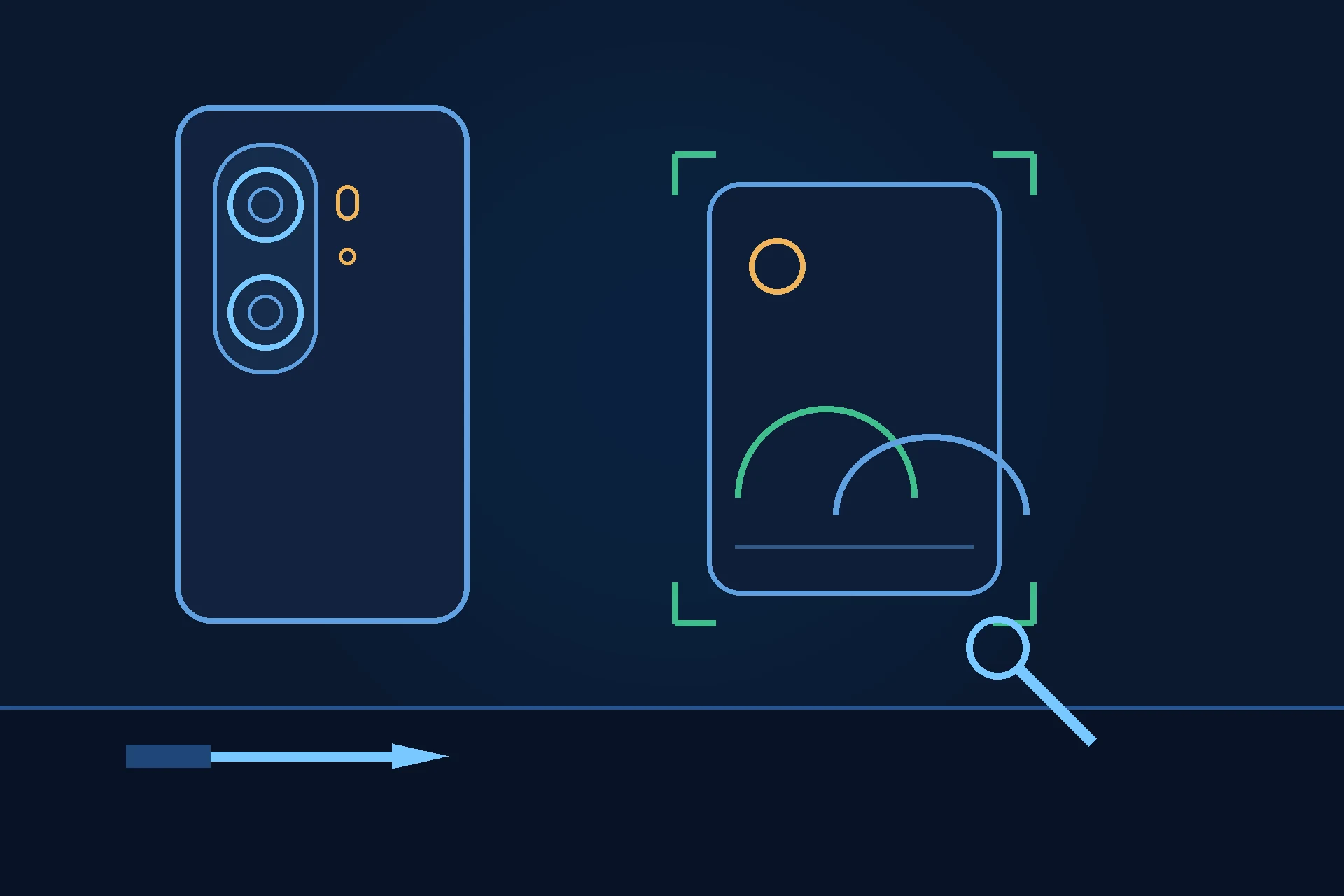
How This Review Works — Methodology
This is a desk / specifications-based review. Its camera facts come from Apple’s technical specifications for this model (live page, read in full October 22, 2026), Apple’s September 2024 announcement materials, and Apple Support’s published US service fees. FixUpPhone did not hands-on test this model’s cameras and shot no photographs for this article — there are no sample images, no low-light verdicts from our own shooting, no benchmark or DxO-style figures, and no score. Where everyday behaviour follows from a published specification (a crop’s reach, an aperture, a zoom ceiling), the reasoning is shown and the specification is labelled a manufacturer specification; where only shooting could answer the question, the article says so and stops.
ϟ Quick Expert Summary
The iPhone 16’s camera system, on its published specification, is a strong main camera with honest limits around it. The 48MP Fusion main (26mm, ƒ/1.6, sensor-shift optical image stabilization) is the lens nearly every everyday photograph will come from, and Apple lists support for 24MP and 48MP high-resolution captures. The “12MP 2x Telephoto” in Apple’s specification is not a second telephoto lens: Apple’s own page states the Fusion camera “also enables” it — a 52mm-equivalent crop from the main sensor, which is why it keeps the main camera’s ƒ/1.6 and stabilization, and why reach beyond it is digital zoom, capped at 10x for photos. The 12MP ultra wide (13mm, 120° field of view) autofocuses, which is what gives this model macro photography and macro video — a capability the previous standard model did not have. Video is specified to 4K Dolby Vision at up to 60 fps, with Cinematic mode to 4K at 30 fps and 1080p slow motion at 120 or 240 fps. There is no telephoto lens and no LiDAR scanner. If your subjects are people, food, rooms, documents and close-ups, the published system covers them; if they are distant, no setting changes the arithmetic.
Desk-review guidance from Apple’s published camera specifications — no hands-on testing, sample photographs or scores are claimed.
✓ Strengths on the Specification
- 48MP Fusion main at ƒ/1.6 with sensor-shift stabilization and 24MP/48MP capture modes
- Ultra wide autofocuses — macro photos and macro video are in the published specification
- Video specified to 4K Dolby Vision 60 fps, Cinematic 4K 30, slow motion to 240 fps
- Camera Control hardware for exposure, depth, zoom, cameras, styles and tone
× Limits on the Specification
- No telephoto lens: the 2x is a main-sensor crop, and beyond it zoom is digital (10x photo cap)
- No LiDAR scanner — depth hardware is the TrueDepth system on the front only
- The ultra wide’s ƒ/2.2 gathers less light than the main’s ƒ/1.6 — a specification, visible in the numbers
- No sample-based claims are possible from a desk review — and none are made
48MP
Fusion Main camera — 26mm, ƒ/1.6, sensor-shift OIS
12MP
Ultra Wide, 13mm, 120° — autofocus, so macro is supported
2×
“Optical-quality” telephoto — a crop from the main sensor
4K 60
Dolby Vision video ceiling — manufacturer specification
Two lenses.
Honest limits.
What the published camera system can and cannot do.
① Key Specifications — The Camera System
| Main camera | 48MP Fusion Main: 26mm, ƒ/1.6 aperture, sensor-shift optical image stabilization, 100% Focus Pixels; support for super-high-resolution photos (24MP and 48MP) |
|---|---|
| 2x “Telephoto” | 12MP 2x Telephoto: 52mm, ƒ/1.6 — Apple’s specification states the Fusion Main “also enables” it: a crop from the main sensor, not a separate lens |
| Ultra Wide | 12MP: 13mm, ƒ/2.2 aperture, 120° field of view, 100% Focus Pixels (autofocus); macro photography supported; lens correction |
| Zoom | 2x optical zoom in, 2x optical zoom out; 4x optical zoom range (Apple’s framing of the two lenses plus the 2x crop); digital zoom up to 10x |
| Front camera | 12MP TrueDepth: ƒ/1.9 aperture, autofocus with Focus Pixels; Night mode; 4K Dolby Vision video to 60 fps; slow motion 1080p at 120 fps |
| Video (rear) | 4K Dolby Vision at 24/25/30/60 fps; Cinematic mode up to 4K Dolby Vision at 30 fps; Action mode up to 2.8K at 60 fps; slow motion 1080p at 120 fps or 240 fps; macro video including slo-mo and time-lapse; digital zoom up to 6x; sensor-shift stabilization (Fusion Main) |
| Photo features | Night mode; Photonic Engine; Deep Fusion; Smart HDR 5; next-generation portraits with Focus and Depth Control; Portrait Lighting (six effects); Photographic Styles; spatial photos; panorama up to 63MP; Camera Control (exposure, depth, zoom, cameras, styles, tone); sapphire crystal lens cover; HEIF and JPEG capture |
| Not present | No dedicated telephoto lens; no LiDAR scanner (both confirmed by omission from — and contrast within — Apple’s published specification for this model) |
| Repair reference | Apple’s current published rear camera fee for this model: $169 ($99 with AppleCare+) — Apple Support, checked October 2026 |
Apple — iPhone 16 technical specifications (live page) · Apple Support — iPhone service and repair, checked October 2026
A note on the numbers Apple leads with: “48MP” describes the main sensor’s full resolution; the specification also lists 24MP as a supported capture size, and the 2x output is 12MP. Those are the resolutions the system works with — no resolution figure in this review comes from anywhere else.
② In Depth: The Camera System
Analysis based on Apple’s published camera specifications for this model — each figure labelled a manufacturer specification; no test results are cited because none were used.
The main camera is the system
Read the specification in the order photographs actually happen and one fact organizes everything: the 48MP Fusion main camera (26mm equivalent, ƒ/1.6 aperture, sensor-shift optical image stabilization, 100% Focus Pixels — all manufacturer specifications) is the camera this phone takes pictures with. It is the default view, the low-light view (Night mode is listed across the system, but the main sensor’s wider aperture and larger pixel area are where the specification puts the capability), the portrait view, and — through the crop explained next — the “telephoto” view as well. Apple lists support for super-high-resolution photos at 24MP and 48MP, which is the specification-level basis for detailed daylight shots and for cropping after the fact. What a desk review cannot tell you is how Apple’s processing (Photonic Engine, Deep Fusion, Smart HDR 5 — Apple’s named pipeline, listed in the specification) renders skin, foliage or a night street; that requires shooting, and this review makes no claim about it. The honest summary of the main camera is a strong published specification with a wide aperture and stabilization, surrounded by processing whose results we have not measured and will not describe.
The 2x is a crop — Apple’s own page says so, in its own way
The specification lists a “12MP 2x Telephoto: 52 mm, ƒ/1.6 aperture” — and directly above it, the mechanism: the 48MP Fusion camera “also enables” it. There is no third lens on this phone; the 2x view is the centre of the main sensor read at 12MP and framed at 52mm equivalent. Apple markets the result as optical-quality, and the specification supports treating it as a real working focal length rather than a pinch-zoom: it keeps the main camera’s ƒ/1.6 aperture and sensor-shift stabilization because it is the main camera. Its limit is equally mechanical — past 2x there is no more sensor to crop into at full quality, and the specification’s remaining reach is digital zoom up to 10x, which enlarges rather than resolves. Everyday translation, without a single test shot: portraits and subjects across a room sit comfortably inside the system; a bird, a stage or a scoreboard sits outside it, and no setting on this model changes that. Buyers for whom reach is the point should read the absence plainly — a dedicated telephoto lens is a different model’s specification, not this one’s hidden feature.
The ultra wide’s autofocus is the quiet upgrade: macro
The 12MP ultra wide (13mm, 120° field of view — manufacturer specifications) does the two jobs ultra wides do: interiors and landscapes that the 26mm main cannot fit, and — because this one autofocuses (100% Focus Pixels, per the specification) — close-ups. Apple lists macro photography for this model, and macro video including slow motion and time-lapse, which makes the base iPhone 16 the first standard model in its line with a specified macro mode; the preceding standard model’s ultra wide had no autofocus and no macro in its specification. For everyday results this is the most concrete camera difference in the phone: product shots for a listing, a flower, a label, a screw head — subjects inside a few centimetres are a designed use here, not a workaround. The counterweight is also in the numbers: at ƒ/2.2 the ultra wide’s aperture is narrower than the main camera’s ƒ/1.6, so in dim light the specification points you back to the main camera and its Night mode rather than to the widest view.
Video and the front camera, on the page
Video is where this model’s specification is least “base”: 4K Dolby Vision recording at up to 60 fps on the rear system, Cinematic mode up to 4K Dolby Vision at 30 fps, Action mode to 2.8K at 60 fps, and slow motion at 1080p up to 240 fps (all manufacturer specifications), with sensor-shift stabilization on the main camera and digital zoom capped at 6x in video. The front TrueDepth camera is a 12MP ƒ/1.9 unit with autofocus — a specification that matters more to everyday results than its megapixel count, since a front camera that can focus is what makes close-range selfies and video calls consistent — and it records 4K Dolby Vision to 60 fps and 1080p slow motion at 120 fps. Spatial photos and spatial video (1080p at 30 fps) are listed for both capture and the Vision Pro ecosystem. None of this is a quality verdict — bitrates, stabilization behaviour and processing are shooting questions — but as a published capability set it covers the everyday list: family video, social clips, slow-motion of a pet or a play, and front-camera calls, all inside the specification rather than at its edge.
Questions to ask before trusting this camera
- Are your subjects near (people, food, rooms, products) or far (sport, wildlife, stages)?
- Will you actually use macro — listings, crafts, close detail — enough to value it?
- Is 2x framing enough, knowing everything past it is digital enlargement?
- Do you shoot video beyond casual clips — 4K 60, Cinematic, 240 fps slow motion?
- On a used unit: is the rear camera original, focusing at every range, free of spots?
- Has the camera glass been replaced — and does the parts history say so?
③ Pros & Cons
✓ Strengths
- Main camera specification is flagship-shaped: 48MP, ƒ/1.6, sensor-shift stabilization
- Macro photography and macro video — new to the standard line, via ultra wide autofocus
- Video specification runs to 4K Dolby Vision 60 fps and 240 fps slow motion
- Front camera autofocuses (12MP, ƒ/1.9) — the spec that matters for calls and selfies
- Camera Control puts exposure, depth, zoom and styles on hardware
× Trade-Offs
- No telephoto lens — distance work is crop, then digital zoom (10x photo ceiling)
- No LiDAR scanner — the depth hardware some buyers assume is simply absent
- Ultra wide at ƒ/2.2 is the low-light weak leg on paper
- Two physical lenses is the whole system — there is no third framing to grow into
- Processing quality (Photonic Engine, Smart HDR 5) cannot be judged from a specification
Should This Camera Settle Your Choice?
Only if your subjects live where this system is strong. The storage and condition decisions from this series’ main review still govern the purchase itself; the camera adds one question — reach.
| Your shooting | How the specification answers | Watch for |
|---|---|---|
| Everyday: people, food, travel, rooms | Fully covered: 48MP main, usable 2x framing, 0.5x ultra wide for the tight spaces | Nothing camera-specific — judge the unit’s condition and storage |
| Close work: products, crafts, listings | The macro specification is a genuine reason to choose this model over the previous standard iPhone | Macro uses the ultra wide — check that lens specifically on a used unit |
| Distance: sport, stage, wildlife | Not covered: past the 2x crop, zoom is digital to 10x | Do not let “2x Telephoto” wording sell you a lens that is not there |
| Video-first use | 4K Dolby Vision 60 fps, Cinematic mode, 240 fps slow motion — all in the published specification | Storage: high-resolution video is what fills the 128GB tier first |
Check Apple’s current camera fee and coverage terms for this model
Camera focusing badly, spotted or cracked? Get an assessed quote
Repair fees checked October 2026. Apple’s figures are Apple’s; FixUpPhone publishes no fixed camera price for this model.
④ Repair Angle: When the Camera Is the Problem
Camera faults divide into glass, mechanism and software, and the guides below keep them separate. Apple’s current published rear camera fee for this model is $169 — 21.2% of the $799 launch price — or $99 with AppleCare+; lens glass damage alone is usually assessed as back glass ($159 current published fee; $29 with AppleCare+) rather than a camera service, but only an inspection settles which line a given crack belongs to. FixUpPhone quotes after assessment (general repair time 1–7 days; 3-month warranty on repairs). Two live guides carry the working detail:
- iPhone 16 camera repair cost — the fee lines, the glass-versus-camera distinction and the routes compared.
- iPhone 16 camera not focusing fix — the checks to run before a focusing fault becomes a repair bill.
Visit a store — Lynwood, CA · 3100 E Imperial Hwy, Store M1002, Lynwood, CA 90262 · Every day 11 AM–8 PM · (805) 857-4225 · Santa Barbara, CA · 619 A State St, Santa Barbara, CA 93101 · Mon–Fri 11 AM–8 PM; Sat 10 AM–8 PM; Sun 12 PM–7 PM · (805) 857-4226 · Las Vegas, NV · 875 S Grand Central Pkwy, Unit TT32, Las Vegas, NV 89106 · Mon–Sat 10 AM–8 PM; Sun 10 AM–7 PM · (818) 482-3605 — or start a mail-in repair: you pay inbound shipping, FixUpPhone pays the return, and you should not ship before instructions are confirmed. Back up first, and never mail a hot or swollen phone.
⑤ The Verdict
On the published specification — the only evidence this review is entitled to — the iPhone 16’s cameras are a well-aimed everyday system with its limits printed in the open. The main camera carries the specification (48MP, ƒ/1.6, stabilized), the 2x is a genuinely usable framing so long as it is understood as the crop Apple’s own page describes, the autofocus ultra wide adds macro as a real capability rather than a bullet point, and the video specification is generous for the tier. What it is not is a reach camera or a depth-hardware camera: no telephoto lens, no LiDAR, and digital zoom as the only road past 52mm equivalent. If your photographs are of your life at arm’s length — people, places, plates, products — this system’s specification covers them completely. If they are of things far away, believe the specification and choose accordingly.
Request a trade-in assessment →⑥ Accessories Worth Budgeting For
The dual lenses sit in a raised vertical plateau; a case with a proper raised lip around it is the difference between a drop and a camera repair. Apple prices back glass damage at $159 out of warranty ($29 with AppleCare+) and the rear camera service at $169.
The lenses wear a sapphire crystal cover per Apple’s specification, but the plateau around them is glass-bodied phone. Choose protectors cut for this model’s plateau; a misaligned cover that shadows the True Tone flash degrades every flash photograph.
The specification supports 4K 60, Cinematic mode and slow motion to 240 fps — handheld shake is the limiting factor the spec sheet cannot fix. A small grip helps every one of those modes; check mount compatibility with this model before ordering.
Check specifications and compatibility before ordering. No accessory prices are quoted here — check the maker or our shop for current pricing.
⑧ Frequently Asked Questions
Where are the sample photos for this camera review?
There are none, deliberately. This is a desk review built from Apple’s published camera specifications (checked October 2026); FixUpPhone did not shoot with this model for this article. Publishing stock or invented samples as if they were evidence would mislead you — the analysis above works only from specifications whose consequences can be reasoned about honestly, and says so where only shooting could answer.
Is the iPhone 16’s 2x zoom a real telephoto lens?
No. Apple’s specification lists a “12MP 2x Telephoto: 52 mm” and states the 48MP Fusion main camera “also enables” it — the 2x is a crop from the main sensor, which is why it shares the main camera’s ƒ/1.6 aperture and stabilization. Apple calls the quality optical-grade, and it is a real working focal length; but there is no separate telephoto lens, and zoom beyond 2x is digital, up to 10x for photos.
Does the iPhone 16 have macro mode?
Yes — macro photography is in Apple’s published specification for this model, and macro video (including slow motion and time-lapse) as well. It works through the 12MP ultra wide camera, which autofocuses on this model; the previous standard iPhone’s ultra wide did not autofocus and had no macro in its specification.
Does the iPhone 16 have LiDAR?
No. Apple’s published specification for this model lists no LiDAR scanner, and the phone has none. Depth sensing for Face ID lives in the front TrueDepth system. Features on other models that lean on LiDAR — certain low-light autofocus and measurement behaviours — are not part of this model’s specification and no figure for them is quoted here.
How good is the camera in low light?
A desk review cannot honestly grade that, and this one does not. The specification-level facts: the main camera is 48MP at ƒ/1.6 with sensor-shift stabilization and Night mode is listed; the ultra wide is ƒ/2.2, which gathers less light on paper. Any stronger claim — ours or a third party’s — would be a test result, and no test results are used in this article.
What video can the iPhone 16 record?
Per Apple’s specification: 4K Dolby Vision at 24, 25, 30 or 60 fps; Cinematic mode up to 4K Dolby Vision at 30 fps; Action mode up to 2.8K at 60 fps; slow motion at 1080p 120 fps or 240 fps; macro video; and spatial video at 1080p 30 fps. The front camera records 4K Dolby Vision to 60 fps. Those are manufacturer specifications of capability, not quality verdicts.
What does a broken rear camera cost to fix?
Apple’s current published rear camera fee for this model is $169, or $99 with AppleCare+ (checked October 2026). Cracked lens glass without camera damage is often assessed under back glass instead — $159 current published fee, $29 with AppleCare+ — but an inspection decides which line applies. FixUpPhone publishes no fixed price; its quote follows an assessment.
My camera will not focus. Is it definitely hardware?
Not necessarily — focusing faults have software, dirt and case-fit causes that cost nothing to check, and the live guide linked in the repair angle walks through them in order. If the fault survives those checks, an assessment separates an autofocus mechanism fault (priced as a camera service) from surface damage (often the back-glass line).
Sources & Editorial Notes
Prepared by FixUpPhone Editorial. Documentation checked October 2026. This is a desk review: every camera figure is from Apple’s published technical specifications for this model (read in full October 22, 2026), every fee is Apple’s published US fee, and no hands-on test, sample photograph, benchmark, lab result, customer experience or fixed FixUpPhone price is claimed. The 2x explanation follows Apple’s own specification wording, which states the Fusion Main camera “also enables” the 12MP 2x Telephoto. The artwork is an original illustration. Apple is not affiliated with FixUpPhone. For help, email support@fixupphone.com.
- Apple — iPhone 16 technical specifications (live page, read in full October 22, 2026) — the complete camera and video specification used throughout this review
- Apple announcement, September 9, 2024 — Camera Control, the Fusion camera and the macro capability as announced for this model
- Apple Support — iPhone service and repair (current published US fees: rear camera $169 / $99 with AppleCare+; back glass $159 / $29; inspection determines the final fee)
- Neowin, September 2025 and iClarified, September 2024 — Apple’s published fee tables, current and at launch (the back-glass line’s revision from $169 to $159)
- FixUpPhone — Phone Repair Services and Mail-In Phone Repair, checked October 2026
- FixUpPhone — Locations, checked October 2026
For corrections or device help, contact FixUpPhone.