iPhone 13 · Durability Review
iPhone 13 Durability Review: Build Quality & Common Risks
The iPhone 13 is an aluminum phone with glass on both sides: well built, comfortably light, and honest about its limits. This desk review separates Apple’s build specifications from teardown findings, so you know what is genuinely tough, what is genuinely fragile, and what a bad drop actually costs.
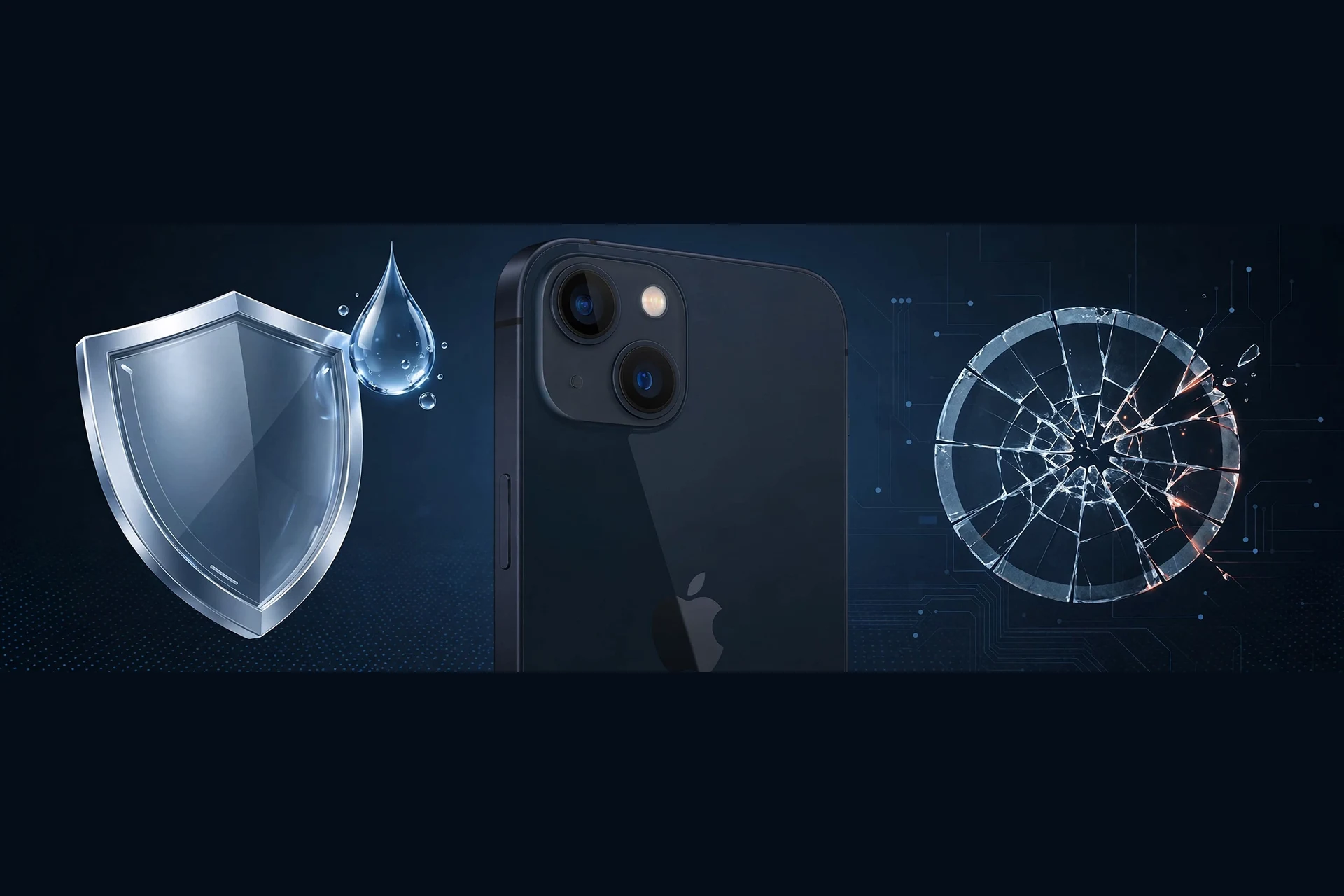
Methodology: a desk review, not a hands-on test
FixUpPhone did not drop-test, scratch-test or soak-test this phone. This review is a desk review: it compares Apple’s published specifications with findings from iFixit’s teardown of the iPhone 13 line and Notebookcheck’s laboratory review of this exact model, the base iPhone 13, and it labels every number by source. No drop height, scratch hardness, soak duration or survival figure is printed anywhere in this article, because no such figure for this model is quoted from a primary source used here. Where a figure comes from Apple, it is called a manufacturer specification. Where it comes from iFixit or Notebookcheck, it is called an attributed third-party finding. No build figure from the iPhone 13 Pro, the iPhone 13 Pro Max, the iPhone 13 mini or any later iPhone is used as a figure for this phone.
Sources used: Apple’s iPhone 13 technical specifications (read via faithful reproductions of Apple’s specs text, as recorded in the verified pack of 15 October 2026, because Apple’s live page for this discontinued model is not directly readable); iFixit’s iPhone 13 teardown and its iOS 15.2 repairability-score update (2021); Notebookcheck’s iPhone 13 laboratory review (October 2021). Repair fees are the current figures in the verified pack, with the sourcing caveat in the Repair section: Apple’s own US page is estimator-only, so the current back-glass and other-damage lines rest on the named AASP and aggregator reproductions stated there.
Quick Expert Summary
Verdict in one line: beautifully built and honestly light for a glass phone — but it is glass on both sides, so the case you skip is the repair you eventually price.
- Build: aluminum design, Ceramic Shield front, plain glass back (Apple’s specs wording) — not stainless steel, not titanium, not color-infused glass.
- Weight and size: 174 g and 146.7 × 71.5 × 7.65 mm (manufacturer specifications) — lighter than the Pro models of its generation.
- Water resistance: IP68 to 6 metres for 30 minutes (manufacturer specification, IEC 60529) — a lab rating, not a promise, and liquid damage is never covered by Apple’s warranty.
- Teardown verdict: iFixit scored the iPhone 13 line 5 out of 10 at first, then raised it to 6 out of 10 after iOS 15.2 removed the Face ID failure that had followed screen swaps.
- The expensive panel: back glass is $169 at Apple’s current fee line, $29 with AppleCare+ — and there is no easy way to replace the rear glass, in iFixit’s words.
Specifications
All figures in this section are manufacturer specifications from Apple unless noted.
| Frame | Aluminum design |
|---|---|
| Front glass | Ceramic Shield front (plain specs wording) |
| Back | Glass back (plain specs wording) |
| Weight | 174 g |
| Dimensions | 146.7 × 71.5 × 7.65 mm |
| Water resistance | IP68, 6 metres up to 30 minutes (IEC 60529) |
| Finishes at launch | (PRODUCT)RED, Starlight, Midnight, Blue, Pink |
| Later finish | Green, added 8 March 2022 — never a launch finish |
| Buttons | Volume, Ring/Silent switch, Side button |
| Sensors | Face ID, barometer, 3-axis gyro, accelerometer, proximity, ambient light |
| Not present | No Crash Detection, no Emergency SOS via satellite, no LiDAR |
Finding, not a gap in this review: Apple does not publish a drop rating, a scratch rating or a breakage figure for this model, and none is printed here. The frame is aluminum — the stainless steel frame belongs to the iPhone 13 Pro, and titanium belongs to later Pro models. The back is plain “Glass back” in Apple’s wording: it is not color-infused glass, which is later wording, and it is not Ceramic Shield, which is the front glass only.
Analysis: what the build means in daily life
The frame: genuinely light, genuinely ordinary metal
At 174 g, the iPhone 13 is a comfortable phone to hold all day, and that lightness is a durability advantage in itself: a lighter phone carries less energy into a fall, and it is less tiring to grip securely. The aluminum frame is not a premium-material claim — Apple calls it an aluminum design, full stop, and does not use the word “unibody” for this model. Notebookcheck’s laboratory review found that the aluminum case achieves a premium look regardless of colour choice, that the clearances are extremely tight, and that the centre of the display only slightly yields under pressure. That is a build-quality finding, not a toughness claim: tight clearances and a stiff body mean the phone feels solid, not that it survives drops unscathed.
The front: Ceramic Shield, with limits
The front glass is Ceramic Shield, in Apple’s plain specs wording — not “Ceramic Shield 2”, which is branding from the iPhone 17 generation. Ceramic Shield is a drop-performance claim about the front glass, not a scratch-proof or shatter-proof guarantee, and Apple publishes no drop figure for this model to attach to it. The practical reading is simple: the front is the tougher of the two glass panels, but it is still glass, it still sits in a frame that transmits impact to its edges, and a face-down fall onto a hard corner can still crack it. A screen protector remains cheap insurance for the panel that costs $279 to replace at Apple’s current fee line.
The back: the expensive panel
The back is plain glass, and it is the panel with the worse repair story. iFixit’s teardown notes that double glass means double drop damage, and that despite improvements to durability over the years, there is still no easy way to replace the rear glass. That is why the back-glass fee matters more than its price suggests: at $169 currently, back glass is 21.2% of the $799 launch starting price (a labelled historical anchor, never a current price), and a cracked back is not a cosmetic footnote — it exposes the internals to dust and moisture, it weakens the phone’s water resistance, and it turns a phone you might otherwise keep into a phone you need to repair. At launch there was no separate back-glass out-of-warranty line at all; back-glass damage priced through other damage. The current $169 line exists only in the current schedule, with the sourcing caveat in the Repair section.
Water resistance: a lab rating, not a promise
IP68 to 6 metres for 30 minutes under IEC 60529 is a controlled laboratory rating: fresh water, a new phone, a still tank. It is not a swimming rating, not a soap or salt-water rating, and not a permanent property — Apple states that resistance may decrease as a result of normal wear, and liquid damage is never covered by Apple’s warranty. A five-year-old iPhone 13 with a cracked back or a previously opened body does not carry the same resistance as a new one, and no article should tell a buyer otherwise. If a used unit has any sign of liquid exposure, treat it as a risk to price, not a story to dismiss: corrosion continues after drying, and the relevant repair route is the other-damage line, $479 currently, not a water-damage-only fee (no such separate fee exists for this model).
Age and wear: what five years do to this design
The iPhone 13 was released on 24 September 2021 and discontinued on 9 September 2024, so every unit on the used market in November 2026 is at least two years old and most are five. Age shows in this design in predictable places: the aluminum frame picks up dings that a case would have taken, the glass back accumulates hairline cracks that owners stop noticing, the Lightning port collects lint that masquerades as a charging fault, and the battery — covered in the battery-life review — ages faster than the frame. None of that makes the design fragile; it makes inspection more important than brand loyalty. The Ring/Silent switch, retained on this model, is a small durability plus: it is a mechanical control that keeps working when software controls are buried, and its absence on later Pro models is one of the few places where this older phone is the more practical device.
Pros & Cons
Pros
- Light at 174 g, with a tight, premium-feeling aluminum build (Notebookcheck).
- Ceramic Shield front glass — the tougher panel is the one you look at all day.
- IP68 rating to 6 metres for 30 minutes, with a physical nano-SIM tray plus eSIM on US models.
- Ring/Silent switch retained — a mechanical control, not a software-only one.
- Display and battery replacements remain a design priority in iFixit’s teardown.
Cons
- Glass on both sides — double glass means double drop damage (iFixit).
- No easy way to replace the rear glass (iFixit), and back glass is $169 at Apple’s current line.
- Water resistance is not permanent and liquid damage is never covered by warranty.
- Software component pairing still complicates some repairs (iFixit).
- No Crash Detection and no Emergency SOS via satellite — both debut on iPhone 14.
Buying: the durability checks that matter
If you are buying a used iPhone 13, inspect it in this order: frame corners and edges for dings that suggest hard falls; front glass for cracks and touch dead zones; back glass for hairline cracks, especially around the diagonal camera module, where a crack can spread; the Lightning port for lint and looseness; the Ring/Silent switch for a clean click; and the SIM tray for a proper fit, since US models of this generation have a physical nano-SIM tray as well as eSIM. Check the battery health reading and the parts-and-service history in Settings, and ask whether the screen or back has ever been replaced — a repair history is exactly what the Repair section prices below. Do not accept “waterproof” as a description of a used phone: IP68 is a lab rating on a new phone, and any prior opening or crack changes it.
Repair angle: the two glass panels dominate this phone’s repair economics. Screen $279 and back glass $169 are separate current lines that together sum to $448, or 56.1% of the $799 launch price — as separate lines, not as a combined fee, which does not exist for this model. If both panels are damaged, price both before you pay for the phone.
Repairability: durability
Screen and back-glass replacement are offered at all three FixUp stores and by mail-in. Turnaround is 1–7 days depending on parts and workload, and repairs carry a 3-month warranty. FixUp does not publish a fixed repair price: you receive a quote after assessment, because the final scope depends on whether the damage is limited to the glass, the panel beneath it, or the frame around it. iFixit’s story for this model is a repair-history lesson in miniature: the teardown initially scored the iPhone 13 line 5 out of 10, after a screen swap was found to break Face ID; after iOS 15.2 removed that failure, iFixit added a point back, to 6 out of 10, noting that the phone was physically more repairable than the iPhone 12 because the Face ID and front-camera components were no longer tied to other screen components. Apple’s own current figures below give the out-of-warranty comparison point.
Repair & Mail-In: iPhone 13 durability
Apple’s iPhone 13 repair fees below are the CURRENT figures in the verified pack. Apple’s own US page is estimator-only — it renders per-model fees through an interactive selector, so no static per-model figure is readable from it — and the current back-glass ($169) and other-damage ($479) lines therefore rest on the named AASP and aggregator reproductions in the pack: a US Apple Authorized Service Provider’s published price list (screen $279, back glass $169, liquid/other damage $479) and current schedule tables that confirm the fee lines. Launch history is given where it differs: screen $279 (unchanged), battery $69 at launch, other damage $449 at launch, and no separate back-glass line at launch. There is NO combined screen + back-glass out-of-warranty fee for this model in either era. FixUp’s own pricing is a quote after assessment, never a published fixed price. If the battery is swollen, hot or venting, stop using the phone, do not charge it, and do not mail it — contact support@fixupphone.com first.
| Repair | Apple current fee | With AppleCare+ |
|---|---|---|
| Screen | $279 | $29 |
| Back glass | $169 (current line only) | $29 |
| Battery | $89 | $0 if below 80% health |
| Rear camera | No US fee found — via other damage | $99 (other damage) |
| Other damage | $479 | $99 |
AppleCare+ also carries a $58 combined screen + back-glass incident fee. That is an AppleCare+ incident structure only; it is not an out-of-warranty combined price, and no such combined price exists for this model. Back glass is 21.2% of the $799 launch starting price and other damage is 59.9% of it (both labelled historical anchors, never current prices). The launch-day one-year warranty expired in September 2022, so any cover today is through AppleCare+ or a later purchase date, and liquid damage was never covered in any case.
FixUp stores
- Lynwood: 3100 E Imperial Hwy, Store M1002, Lynwood, CA 90262 — open daily 11 AM–8 PM — (805) 857-4225
- Santa Barbara: 619 A State St, Santa Barbara, CA 93101 — Mon–Fri 11 AM–8 PM, Sat 10 AM–8 PM, Sun 12 PM–7 PM — (805) 857-4226
- Las Vegas: 875 S Grand Central Pkwy, Unit TT32, Las Vegas, NV 89106 — Mon–Sat 10 AM–8 PM, Sun 10 AM–7 PM — (818) 482-3605
Mail-in repair
Mail-in is available for screen and back-glass repair. You pay the inbound postage and FixUp pays the return postage. Back up first, and do not ship your phone before your mail-in instructions are confirmed — confirm instructions before shipping. Never mail a hot or swollen phone — contact support@fixupphone.com first. Repairs take 1–7 days once the phone is received, and carry a 3-month warranty.
What to do first
- Back up the phone before any repair.
- Photograph every crack and ding before handing the phone over — it settles scope disputes.
- Get the quote after assessment before authorising work.
Decision
Buy the iPhone 13 for its build if you want a light, well-fitted phone and you are willing to case it. The aluminum frame, tight clearances and Ceramic Shield front are genuine strengths, and the 6-out-of-10 iFixit score after iOS 15.2 is a fair reflection of a phone that is repairable without being easy. Do not buy it expecting ruggedness: glass on both sides, a rear panel with no easy replacement route, and water resistance that fades with wear are permanent characteristics of this design, and no case retroactively fixes a phone you already dropped uncased. For a used purchase, the back glass deserves as close an inspection as the screen — it is the panel buyers forget to check and the repair they least expect to price.
FAQ
Is the iPhone 13 durable?
It is well built — aluminum frame, Ceramic Shield front, tight clearances in Notebookcheck’s laboratory review — but it is glass on both sides, and iFixit notes that double glass means double drop damage. No drop-test figure for this model is quoted here, because no primary source used here publishes one.
Is the iPhone 13 frame titanium or stainless steel?
Neither. Apple’s specs wording is aluminum design. Stainless steel belongs to the iPhone 13 Pro, and titanium belongs to later Pro models.
Is the iPhone 13 waterproof?
No phone is waterproof. The iPhone 13 is rated IP68 to 6 metres for 30 minutes under IEC 60529, as a manufacturer specification on a new phone. Resistance is not permanent, it decreases with wear, and liquid damage is never covered by Apple’s warranty.
How much does iPhone 13 back-glass repair cost?
Apple’s current fee line is $169 out of warranty and $29 with AppleCare+, with the estimator-only sourcing caveat in the Repair section. There was no separate back-glass out-of-warranty line at launch. FixUp quotes after assessment, with 1–7 day turnaround and a 3-month warranty.
Does replacing the iPhone 13 screen break Face ID?
Not on current software. iFixit found that a screen swap broke Face ID at launch, then confirmed that iOS 15.2 removed the failure and raised the iPhone 13 line’s repairability score from 5 out of 10 to 6 out of 10.
Does the iPhone 13 have a SIM tray?
Yes, on US models: a physical nano-SIM tray plus eSIM. US eSIM-only iPhones start with iPhone 14, not here.
What should I check on a used iPhone 13’s body?
Frame corners, front glass, back glass around the diagonal camera module, the Lightning port, the Ring/Silent switch, the SIM tray fit, and the battery health and parts history in Settings. Photograph any damage before a repair.
What do I do if my iPhone 13 battery is swollen?
Stop using it, do not charge it, and do not mail it. Contact support@fixupphone.com for instructions. Never heat, puncture or open a swollen battery.
Desk review — no hands-on testing by FixUpPhone · Every number labelled by source · Sources dated in the sources section
FixUp repairs: 1–7 days · 3-month warranty · Quote after assessment · Mail-in: you pay inbound, FixUp pays return
Questions? support@fixupphone.com · Lynwood (805) 857-4225 · Santa Barbara (805) 857-4226 · Las Vegas (818) 482-3605
Sources
- Apple — iPhone 13 technical specifications (aluminum design, Ceramic Shield front, glass back, 174 g, 146.7 × 71.5 × 7.65 mm, IP68 to 6 metres for 30 minutes, launch finishes, Green added later, buttons, sensors, no LiDAR). Apple’s live page for this discontinued model is not directly readable; specifications rest on faithful reproductions of Apple’s specs text, as recorded in the verified pack (checked 15 October 2026).
- Apple — iPhone 13 Green finish announcement, 8 March 2022 (Peek Performance event), as recorded in the verified pack addendum (checked 15 October 2026).
- Notebookcheck — “Apple iPhone 13 Smartphone Review” (October 2021): aluminum case with premium look, extremely tight clearances, display centre only slightly yielding under pressure. Page re-read 2 November 2026.
- iFixit — iPhone 13 teardown (September 2021) and “iOS 15.2 Fixes iPhone 13’s Face ID Repair Trap” (December 2021): score 5 out of 10 at first, raised to 6 out of 10 after iOS 15.2; double glass means double drop damage; no easy way to replace the rear glass; software component pairing complicates repairs. Pages read 2 November 2026.
- Apple — iPhone repair estimator (support.apple.com/iphone/repair), as recorded in the verified pack (checked 15 October 2026): page states inspection determines the final fee and renders per-model fees through an interactive selector; no per-model figure readable in page text, so current $279 / $169 / $479 lines rest on the named US AASP list and current schedule reproductions stated in the Repair section.