iPhone 16 Pro Performance Review: Speed, Heat & Daily Use
The performance record for this model divides cleanly into what Apple publishes and what two laboratories measured. Apple publishes the architecture: an A18 Pro chip with a 6-core CPU, 6-core GPU and 16-core Neural Engine, USB 3 transfers up to 10Gb/s, and battery claims of 27 hours of video playback and 22 hours streamed. The measurements belong to the labs that made them: GSMArena’s lab recorded a Geekbench 6 score of 8,283 and a 3DMark Wild Life Extreme score of 4,898 on this exact model, and Android Headlines’ purchased review unit held 67.7% stability in the 3DMark Wild Life Extreme Stress Test, peaking at a measured 108 °F surface temperature in that test. This review keeps those lanes separate — and states plainly what nobody publishes: Apple claims no vapor chamber, no temperature figure and no throttling percentage for this phone.
How This Review Was Researched
This is a desk review. It is based on Apple’s published technical specifications for this model (archived capture, checked in October 2026 — Apple has removed the live page for this discontinued model) and on two named third-party sources for this exact model, each checked in October 2026: GSMArena’s lab tests of the iPhone 16 Pro (published September 2024) and Android Headlines’ review of a purchased iPhone 16 Pro (September 2024), which ran Geekbench 6, the 3DMark Wild Life Extreme Stress Test and a set of surface-temperature measurements. FixUpPhone did not hands-on test an iPhone 16 Pro and ran no benchmark. Every score or temperature on this page is labelled a third-party laboratory result and attributed to the outlet that produced it; every architectural figure is labelled a manufacturer specification or claim. Nothing measured on the iPhone 16 Pro Max — a larger phone with a different thermal envelope — is used here.
Methodology note: a benchmark score is one lab’s result on one unit under its own conditions. Two reputable labs testing this model produced different Geekbench numbers; both are reported, attributed, and neither is presented as “the” score.
ϟ Quick Expert Summary
The A18 Pro’s published configuration (manufacturer specifications) is a 6-core CPU, a 6-core GPU and a 16-core Neural Engine, paired with USB 3 wired transfers up to 10Gb/s and ProMotion up to 120Hz — a flagship sheet that has not been cut down for the smaller body. The measured record, from this model’s own reviews: GSMArena’s lab recorded Geekbench 6 at 8,283, AnTuTu v10 at 1,871,052 and 3DMark Wild Life Extreme at 4,898 (third-party laboratory results); Android Headlines’ purchased unit scored Geekbench 6 at 2,981 single-core and 7,939 multi-core, held 67.7% stability across the 3DMark stress loop, and peaked at 108 °F on its surface during that test (third-party laboratory results). Apple publishes no temperature, throttling or cooling-system figure for this model — some launch coverage credited a vapor chamber, but no such claim exists in Apple’s own record, and this review does not repeat it. Two years on, the performance question for a used unit is less the chip than the battery: Apple treats a battery below 80% maximum capacity as consumed, and the published battery service fee is $119.
Desk-review guidance from published specifications and attributed laboratory results — not a hands-on report, a benchmark run or a FixUpPhone price quote.
✓ Performance Is a Reason to Buy When
- You want the full A18 Pro configuration in the smaller, 199 g body
- You move large files by cable — USB 3 up to 10Gb/s, where base models carry USB 2
- You read benchmark claims carefully — these are launch-window laboratory results for this model
- The used unit’s battery health is verified, not assumed
× Think Twice When
- A listing quotes Pro Max benchmark or thermal figures for this phone — a different body with different results
- You expect a published cooling specification — Apple makes no vapor-chamber or temperature claim for this model
- The unit is already below 80% battery health and priced as if it were not
A18 Pro
6-core CPU · 6-core GPU · 16-core Neural Engine
8,283
Geekbench 6 — GSMArena lab result for this model
10Gb/s
USB 3 wired transfers — a data speed, not a charging speed
$119
Apple’s published battery service fee
Published architecture.
Measured results.
Apple’s figures and the laboratories’ figures — kept in separate lanes.
① Key Specifications
| Chip | A18 Pro — 6-core CPU, 6-core GPU, 16-core Neural Engine (manufacturer specifications) |
|---|---|
| Storage | 128GB / 256GB / 512GB / 1TB — not expandable; this model has no 2TB tier |
| Connector | USB-C, USB 3 up to 10Gb/s (manufacturer specification — a data-transfer speed) |
| Display | 6.3-inch Super Retina XDR OLED, 2622×1206, 460 ppi, ProMotion adaptive up to 120Hz, Always-On |
| Battery (Apple claims) | Video playback up to 27 hours; streamed video up to 22 hours — one published set for this model |
| Charging — wired (Apple claim) | Up to 50% in around 30 minutes with a 20W adapter or higher (sold separately) |
| Charging — wireless (Apple claims) | MagSafe up to 25W; Qi2 up to 15W — a separate line from the wired claim, everywhere |
| Operating environment | Operating ambient temperature 0° to 35 °C (manufacturer specification) |
| Weight | 199 g |
| US starting price | $999 for 128GB (launch price; model discontinued 9 September 2025) |
| Release date | September 20, 2024 |
Apple Support — iPhone service and repair; Apple technical specifications (archived capture, checked October 2026)
One footnote, kept from this series’ standing rule: Apple’s specifications do not publish a cooling-system description or a sustained-performance percentage for this model, and neither does this review.
② Performance Deep-Dive
Analysis based on Apple’s published specifications and attributed laboratory results for this model. No benchmark, temperature or frame-rate figure on this page is FixUpPhone’s own.
The architecture Apple actually publishes
Start with what is specified rather than measured. The A18 Pro in this phone carries a 6-core CPU, a 6-core GPU and a 16-core Neural Engine (manufacturer specifications) — the same published configuration as the larger Pro Max, in the smaller and lighter body. Around the chip, two specification lines do daily work: USB 3 wired transfers up to 10Gb/s — a data speed, relevant to anyone moving ProRes video or large photo libraries by cable, and explicitly not a charging figure — and ProMotion, the adaptive refresh up to 120Hz that governs how fluid the interface can render. Apple’s battery claims for the model (27 hours video playback, 22 hours streamed) are claims about a new battery, stated as such wherever they appear here. That is the complete published performance record; Apple adds no clock speeds, no benchmark scores and no thermal figures to it.
What the laboratories measured on this model
Two named outlets published instrumented results for the iPhone 16 Pro at launch, and this review uses both — attributed, and as the launch-window results they are. GSMArena’s lab recorded Geekbench 6 at 8,283, AnTuTu v10 at 1,871,052 and 3DMark Wild Life Extreme at 4,898 (third-party laboratory results, GSMArena, September 2024). Android Headlines, testing a purchased retail unit, recorded Geekbench 6 at 2,981 single-core, 7,939 multi-core and 32,846 in its GPU test (third-party laboratory results, Android Headlines, September 2024). The two multi-core numbers differ — 8,283 against 7,939 — because they are different units, different runs and different test conditions; that spread is normal between laboratories and is reported here rather than averaged away. Read together, they place the model where its architecture suggests: at the top of its launch window’s field. Neither lab’s Pro Max figures are quoted — that phone’s results belong to that phone.
Sustained performance and heat: the measured record, and the missing one
Peak scores are the easy half; sustained load is where phones separate. The attributed record for this model: Android Headlines ran the 3DMark Wild Life Extreme Stress Test — twenty consecutive loops of a one-minute graphics benchmark — and its unit held 67.7% stability between its best and worst loops, peaking at a measured surface temperature of 108 °F during that test (third-party laboratory results). In a gentler sustained load — recording 4K60 video — the same review measured 89 °F at five minutes and 93.7 °F at ten minutes. Two honest fences belong around these numbers. First, they are one outlet’s measurements on one purchased unit in September 2024, not a specification. Second, Apple publishes no counterpart figure at all: no surface-temperature claim, no throttling percentage, and — the point launch coverage most often got wrong — no vapor chamber in Apple’s own description of this phone. Some reviews credited one anyway; Apple’s record does not, and a feature Apple never claimed should not be repeated as this model’s specification. The phone’s specified operating ambient range, 0° to 35 °C (manufacturer specification), is the only thermal number Apple stands behind.
Daily use: where the specification shows up
Outside benchmarks, the performance a user actually meets is the sum of the specified parts: ProMotion’s adaptive 120Hz ceiling on every scroll, USB 3’s 10Gb/s on every large wired transfer, and the A18 Pro’s headroom on every export and edit. Android Headlines’ applied test is a useful anchor here — its purchased unit exported the outlet’s standard 60-second CapCut video in 5.11 seconds, the fastest time that outlet had recorded at the time (third-party laboratory result) — the kind of figure that maps to the work creators actually repeat daily. What daily use also includes, on a two-year-old unit, is the software side of slowness: restarts, freezes and heat under ordinary loads are not performance characteristics, they are symptoms — and the service ladders for them are linked in the repairability section below rather than reviewed as if they were features.
Two years on: the battery is the performance part that ages
Silicon does not wear out on this timescale; batteries do. Apple’s own decision line is explicit — below 80% maximum capacity, the battery is treated as consumed — and a consumed battery shows up in daily use as shorter days and, on a worn unit, behaviour that reads as “the phone got slow”. The published fix is priced: Apple’s battery service fee for this model is $119, or $0 with AppleCare+ when capacity is under 80%. On a discontinued phone bought used, the battery-health percentage in Settings is therefore a performance specification of that individual unit — the only one that changes between two otherwise identical phones — and it should be checked before the benchmark history is admired.
③ Pros & Cons
✓ Pros
- Full A18 Pro configuration — 6-core CPU, 6-core GPU, 16-core Neural Engine (manufacturer specifications)
- Launch-window laboratory results at the top of the field: Geekbench 6 of 8,283 (GSMArena) and 7,939 multi-core (Android Headlines) on this model
- USB 3 transfers up to 10Gb/s for large media workflows
- A measured stress-test record exists for this exact model — 67.7% stability (Android Headlines) — not borrowed from the Max
× Cons
- Apple publishes no cooling, temperature or sustained-performance figure — the thermal record is reviewers’ measurements only
- The smaller body is the tighter thermal envelope of the two Pro models; sustained-load results must come from this model’s reviews, not the Max’s
- Two laboratories’ Geekbench results differ by several percent — single-score shopping misleads
- On used units, battery wear — not the chip — is the performance variable, and it is priced separately at $119
The Repair Angle: When Performance Problems Are Faults
A healthy iPhone 16 Pro does not overheat on ordinary loads, restart itself, or freeze on the Apple logo. When a unit does those things, the question stops being performance and becomes diagnosis. Apple’s published fees (current figures, checked October 2026) frame the two service routes; FixUpPhone quotes independently after assessment and publishes no fixed price for this model.
| Your route | Published price | What it means |
|---|---|---|
| Apple — battery service | $119 | Apple’s published battery fee for this model — 11.9% of the $999 launch starting price (calculated). $0 with AppleCare+ when maximum capacity is under 80%. |
| Apple — “other damage” | $649 | The catch-all tier if overheating or restarts trace to board-level or multi-part damage; $99 with AppleCare+. |
| FixUpPhone — diagnosis & repair | Quote after assessment | No fixed price is published. The cause is confirmed first, and work proceeds only after you approve the quote. |
Check Apple’s current iPhone repair terms, fees and coverage routes
Request a diagnosis and an assessed quote for your exact phone
Apple fees checked October 2026. Prices and terms can change. None of Apple’s figures is a FixUpPhone price. Start with the iPhone 16 Pro overheating guide — the free checks come before any fee.
④ Repairability & Common Issues
Overheating has a ladder, not a verdict
Warm under a game is physics; hot on a phone call is a symptom. The overheating guide separates normal load heat from the patterns that mean a fault — and the safety steps that come first.
Random restarts are data
A phone that restarts itself is logging why. The randomly restarting guide works through the panic-log and battery checks before anyone prices a board repair.
Stuck on the Apple logo
A boot loop after an update, a full-storage freeze and a hardware fault can look identical from outside. The stuck on logo guide orders the recovery steps so the free ones come first.
After any repair, run the standard checks on the phone: a full charge cycle, a long video recording, Face ID, and every camera lens — then keep the paperwork with the phone. Every FixUpPhone repair includes a 3-month warranty, and the general repair timeframe is 1–7 days.
Performance Problems With Your iPhone 16 Pro?
Tell FixUpPhone what the phone is doing and choose a local store or a mail-in enquiry.
- Overheating on ordinary loads
- Random restarts or shutdowns
- Stuck on the Apple logo
- Battery draining with visible slowdowns
An online booking is a request; the team confirms the next step with you.
Mail-In Repair Service
Start with the repair request form and choose Mail-In Repair. You pay to ship the phone to FixUpPhone; FixUpPhone pays the return shipping. Do not send the device until the receiving store and shipping instructions have been confirmed.
Start Mail-In Repair →Back up first where possible. Describe when the problem happens — load, charging, idle — it speeds up the diagnosis. Never mail a hot or swollen phone. Questions: support@fixupphone.com.
Prefer to visit? Find a repair location →Visit a FixUpPhone Store
Lynwood, CA · 3100 E Imperial Hwy, Store M1002, Lynwood, CA 90262 · Every day 11 AM–8 PM · (805) 857-4225
Santa Barbara, CA · 619 A State St, Santa Barbara, CA 93101 · Mon–Fri 11 AM–8 PM; Sat 10 AM–8 PM; Sun 12 PM–7 PM · (805) 857-4226
Las Vegas, NV · 875 S Grand Central Pkwy, Unit TT32, Las Vegas, NV 89106 · Mon–Sat 10 AM–8 PM; Sun 10 AM–7 PM · (818) 482-3605
How It Works
- BookSubmit the model, store or mail-in choice, and symptoms for review.
- DiagnoseThe team confirms whether the battery, the software or the board is at fault.
- ApproveReview the finding and confirmed quote before authorising work.
- RepairThe general repair timeframe is 1–7 days, plus shipping time for mail-in.
- Collect or ReturnCollect in store or receive the mail-in return; repairs include a 3-month warranty.
⑤ Who Should Buy It — and Who Should Skip
The chip is not the risk in this purchase; the individual unit is. Buy the specification, verify the unit.
| Reader | Verdict | Why |
|---|---|---|
| Creators moving big files | Buy | USB 3 at 10Gb/s and the A18 Pro’s measured export speed are the working tools, not spec-sheet decoration. |
| Power users in a smaller body | Buy | The full Pro chip configuration at 199 g — with this model’s own lab results to read, not the Max’s. |
| Sustained-load specialists | Read the stress record | 67.7% stress stability and a 108 °F measured peak (Android Headlines) are the honest figures to judge by. |
| Buyers of any cheap used unit | Check the battery first | Below 80% health, the unit’s real performance spec is a $119 battery service — price it in. |
⑥ Alternatives & Comparison
Newer A-series chips raise every measured figure and restore a standard warranty — at current-model prices.
Explore option →If your current phone only feels slow, a battery service on it may restore more performance per dollar than a change of handset.
Explore option →Work the free diagnosis ladder before pricing any repair — the overheating guide orders the checks.
Explore option →⑧ Frequently Asked Questions
Did FixUpPhone benchmark the iPhone 16 Pro for this review?
No. This is a desk review. Every score and temperature here belongs to a named laboratory that tested this model — GSMArena’s lab tests and Android Headlines’ review of a purchased unit, both published in September 2024 and checked in October 2026 — and is labelled a third-party laboratory result.
What is the iPhone 16 Pro’s Geekbench score?
It depends on the laboratory, which is the honest answer. GSMArena’s lab recorded 8,283 in Geekbench 6; Android Headlines’ purchased unit recorded 7,939 multi-core and 2,981 single-core. Different units and test runs produce different figures; both are reported here with their sources rather than merged into one invented “official” score.
Does the iPhone 16 Pro have a vapor chamber?
Apple has never claimed one for this model. Some launch coverage credited a vapor chamber anyway, but no cooling-system claim — vapor chamber or otherwise — exists in Apple’s published specifications or announcement for the iPhone 16 Pro, and this review does not repeat it as fact. The measured thermal record (a 108 °F peak surface temperature in Android Headlines’ stress test) stands on its own without the label.
How hot does the iPhone 16 Pro get?
Apple publishes no temperature figure. The attributed measurements for this model come from Android Headlines’ purchased unit: a peak surface temperature of 108 °F during the 3DMark Wild Life Extreme Stress Test, and 89 °F rising to 93.7 °F across ten minutes of 4K60 video recording (third-party laboratory results, September 2024). Apple’s only thermal specification is the operating ambient range of 0° to 35 °C.
Is USB 3 the same as fast charging?
No. USB 3 up to 10Gb/s (manufacturer specification) is a data-transfer speed. Charging is a separate set of Apple claims: wired, up to 50% in around 30 minutes with a 20W adapter or higher; wireless, MagSafe up to 25W and Qi2 up to 15W. This review keeps the wired and wireless claims on separate lines, and neither has anything to do with the 10Gb/s figure.
Why does a used iPhone 16 Pro feel slower than the reviews say?
Usually the battery, not the chip. The launch reviews measured new units; a two-year-old unit’s battery may be near or below Apple’s 80% “consumed” line, which shortens the day and can present as sluggishness. Check Settings → Battery → Battery Health before blaming the A18 Pro — the published battery service fee is $119.
My iPhone 16 Pro overheats or restarts. Is that normal performance?
No — those are symptoms, not specifications. Work through the free checks in the overheating and randomly restarting guides linked above first; if they point to hardware, the route is assessment, not a benchmark. Never mail a hot or swollen phone.
What does FixUpPhone charge to diagnose a performance problem?
FixUpPhone publishes no fixed price for this model — the quote follows an assessment, because the cause decides the job. General repair time is 1–7 days; repairs carry a 3-month warranty. Apple’s published fees for the likely service routes are in the repair angle above.
Sources & Editorial Notes
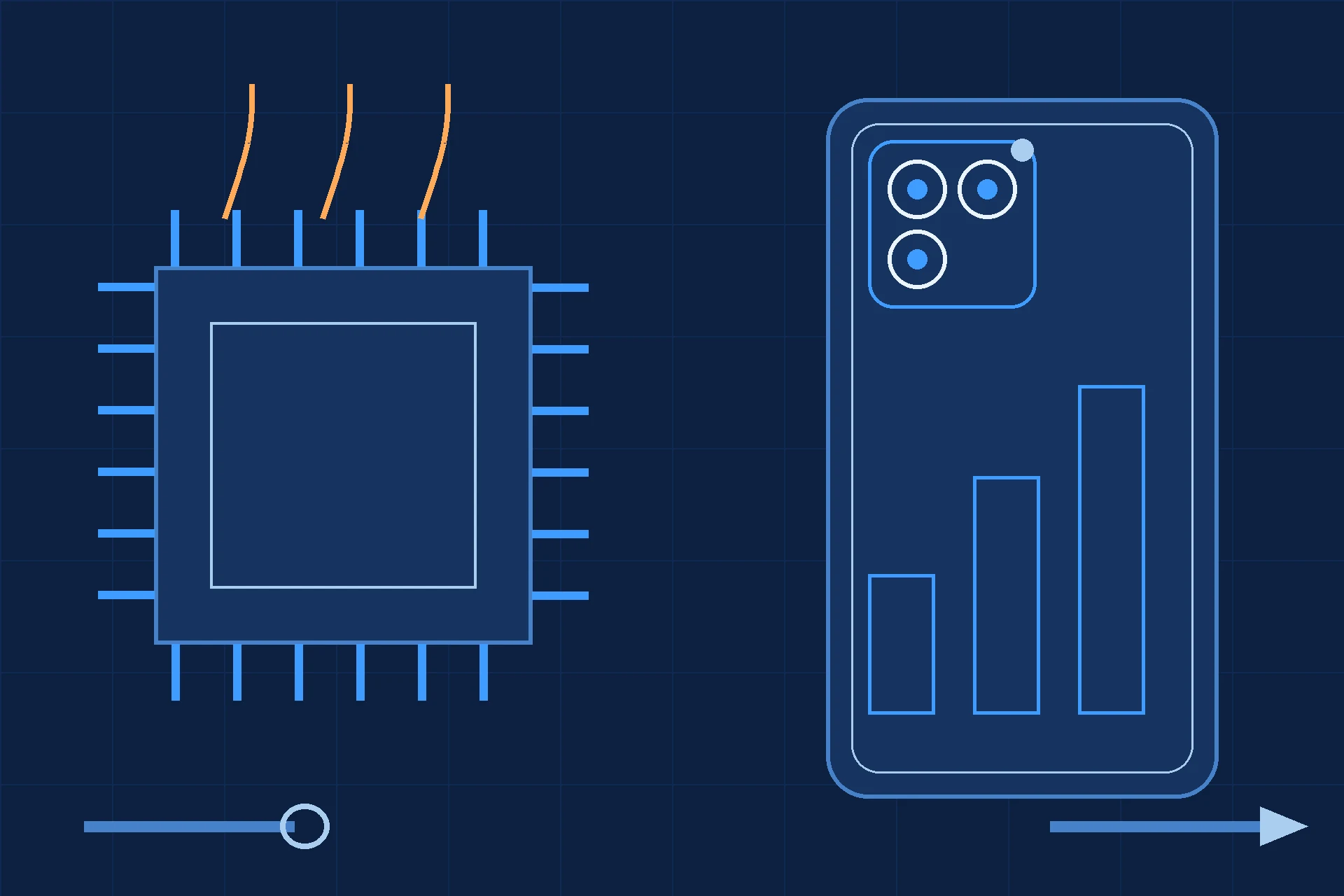
Prepared by FixUpPhone Editorial. Documentation checked October 2026. Apple specifications and claims are distinguished from third-party laboratory results, which are attributed to the outlet that produced them and describe that outlet’s test unit under its conditions. No hands-on testing, benchmark, temperature measurement, customer experience or fixed FixUpPhone price is claimed for this model. The featured artwork is an original illustration. Apple is not affiliated with FixUpPhone.
- Apple — iPhone 16 Pro technical specifications (archived capture, checked October 2026 — A18 Pro configuration, storage tiers, USB 3 up to 10Gb/s, ProMotion, battery and charging claims, operating ambient range — manufacturer specifications and claims). Apple has removed the live specifications page for this discontinued model.
- GSMArena — iPhone 16 Pro lab tests (published with GSMArena’s review of this model, September 2024; checked October 2026) — Geekbench 6: 8,283; AnTuTu v10: 1,871,052; 3DMark Wild Life Extreme: 4,898 (third-party laboratory results).
- Android Headlines — “Apple iPhone 16 Pro Review” (September 2024; purchased retail unit; checked October 2026) — Geekbench 6: 2,981 single-core / 7,939 multi-core / 32,846 GPU; 3DMark Wild Life Extreme Stress Test stability 67.7%; surface temperatures 108 °F (stress test peak), 95.8 °F (one hour of Genshin Impact — used in the gaming review in this series), 89 °F / 93.7 °F (4K60 recording at 5 / 10 minutes); CapCut export 5.11 seconds (third-party laboratory results).
- Apple Support — iPhone service and repair (inspection determines the final fee; warranty scope; AppleCare+ terms, including battery service at no charge below 80% capacity)
- Apple’s published US service fees for this model, current figures checked October 2026 (battery $119; other damage $649; AppleCare+ battery $0 below 80% capacity, other damage $99)
- FixUpPhone — Phone Repair Services and Mail-In Phone Repair, checked October 2026
- FixUpPhone — Locations, checked October 2026
For corrections or device help, contact FixUpPhone.