iPhone 17 Pro Max Durability Review: Build Quality & Common Risks
Durability reviews are usually drop tests and scratch videos. This one is neither: it is a desk review of what the iPhone 17 Pro Max is actually built from — an aluminum unibody, Ceramic Shield 2 on the front and Ceramic Shield (no “2”) on the back — and what the published repair fees say about each risk a year into the phone’s life. Apple publishes no drop-test result for this phone, and neither does this article.
How This Review Was Researched
This is a desk review based on Apple’s published specifications and service fees, checked in October 2026. FixUpPhone did not drop, scratch, bend or submerge this device, and no durability test result of any kind is claimed. No third-party drop, scratch or bend test for this model is cited either, because none had been verified from a primary source when this article was written. Material claims are manufacturer specifications; repair figures are Apple’s published fees.
Methodology note: “built from” is a verifiable fact. “Survives a two-metre drop” would be a test result — and no such result is published or invented here.
ϟ Quick Expert Summary
The construction story is precise: an aluminum unibody (manufacturer specification) — this generation is not titanium — with Ceramic Shield 2 glass on the front and Ceramic Shield glass on the back, at 231 g. The rating story needs care: IP68 is a laboratory rating for a new device, resistance is not permanent, and liquid damage is not covered by Apple’s warranty. The risk story is in the fees: back glass is a $159 repair at Apple ($29 with AppleCare+), a screen is $379 ($29), both together are $469 ($58), and unlisted damage falls into the $799 “other damage” tier. A year after release, the earliest buyers are also past the standard one-year warranty line, which makes those fees the working reality rather than a hypothetical. The durability picture is honest: strong materials, real repair costs, no miracles.
Source-based editorial guidance, not a hands-on durability test, a drop result or a FixUpPhone price quote.
✓ Build Quality Works in Your Favour When
- You use a case — the unibody and glass are protected where it matters
- Your risks are scratches, splashes and everyday knocks
- You budget AppleCare+ or a repair reserve from day one
× The Risks Are Real When
- You carry it caseless — both faces are glass
- Your work involves heights, concrete or water
- You assume IP68 means liquid damage is covered — it is not
Unibody
Aluminum unibody construction
Shield 2
Ceramic Shield 2 front glass
IP68
Laboratory rating when new
$159
Apple’s published back-glass fee
Strong materials.
Honest limits.
What it is built from, what can still break, and what each break costs.
① Key Specifications
| Construction | Aluminum unibody |
|---|---|
| Front glass | Ceramic Shield 2 |
| Back glass | Ceramic Shield (not “Ceramic Shield 2”) |
| Finishes | Silver, Cosmic Orange, Deep Blue |
| Weight | 231 g |
| Water and dust resistance | IP68 laboratory rating when new (up to 6 metres for up to 30 minutes, IEC 60529) |
| Display | 6.9-inch Super Retina XDR OLED |
| Operating ambient | 32–95°F (0–35°C) |
| US starting price | $1,199 for 256GB |
| Release date | September 19, 2025 |
Apple technical specifications (archived capture)
The back-glass wording matters: Apple specifies Ceramic Shield 2 for the front only. Any source claiming “Ceramic Shield 2 front and back” for this model is wrong.
② Durability Deep-Dive
Analysis based on Apple’s published specifications and service fees. No drop, scratch or bend test by FixUpPhone — or cited from anyone else — appears in this section.
Aluminum unibody: what this generation is built from
Apple specifies an aluminum unibody for this model (manufacturer specification). A buyer can reason about that without any test: a single-piece metal body has no separate frame rails to loosen. What this review will not do is rank it against earlier materials with invented drop outcomes — no comparative test result is published in the sources used here, so none is quoted.
Two faces of glass, two different specifications
The front is Ceramic Shield 2; the back is Ceramic Shield (both manufacturer specifications). They are different parts with different published repair fees — $379 for the screen assembly, $159 for back glass at Apple — which is the practical reason the distinction matters more than any marketing line. Apple’s table also prices the pair together at $469, the row that matters after the worst kind of drop. Both faces being glass means the two most likely damage events in any phone’s life, a face-down drop and a back-down drop, both land on glass. A case and a screen protector remain the cheapest durability upgrade available, and no specification on this page changes that arithmetic.
IP68: a laboratory rating, not a promise
Apple rates the phone IP68 (manufacturer specification) — a laboratory result for a new device under controlled conditions, specified as up to 6 metres of water for up to 30 minutes under IEC 60529. Apple’s own terms are consistent across generations: resistance is not permanent, it can decrease with normal wear, and liquid damage is not covered under warranty. Read the rating as “engineered to survive the splashes and accidents it describes, when new” — not as permission to swim with the phone, and not as cover if water gets in. The water damage guide linked below exists because rated phones still arrive at repair counters wet.
One moving part this camera does not have
The main camera on this model has a fixed ƒ/1.78 aperture (manufacturer specification). That is worth stating in a durability review because it defines what can and cannot go wrong: there is no aperture mechanism to jam after an impact. The exposed durability surface is the camera plateau itself — three 48MP lenses behind cover glass on the back of the phone — and Apple prices a rear-camera repair at $249 ($99 with AppleCare+). A case that sits proud of the plateau is the standard, cheap mitigation.
Weight is a durability factor too
At 231 g (manufacturer specification), this is a heavy phone, and mass is part of every drop it will ever take. The weight buys the largest display and battery in the range — but the same fall arrives with more energy here, and it lands on glass at either face. Grip, case and habit matter more at this size, not less.
A year on: the warranty line has moved
The phone was released on September 19, 2025, so launch-cohort units crossed the standard one-year Apple warranty line on September 19, 2026. For those owners the published fees above are no longer a remote hypothetical — they are the out-of-warranty price list, unless AppleCare+ was bought and is still active. Durability decisions also age: seals and resistance are at their best when new, which is another reason the IP68 wording above is written the way it is.
Questions to ask before you approve a damage repair
- Is the damage glass-only, or is the frame or an internal part involved?
- What exactly is included in the quote — parts, labour, seals, tax?
- Will wireless charging and MagSafe alignment be tested afterwards (back-glass work)?
- Could AppleCare+ cover this more cheaply at the $29 service fee?
- Is there any sign of liquid damage I should know about?
③ Pros & Cons: Build Quality on the Evidence
✓ Strengths From the Specifications
- One-piece aluminum unibody — no separate frame to work loose
- Ceramic Shield 2 front glass, Ceramic Shield back
- IP68 laboratory rating against dust and immersion when new
- Back glass is a separately priced repair — $159, not the $799 tier
- Fixed-aperture main camera — no aperture mechanism to jam
× Risks the Specifications Cannot Remove
- Both faces are glass; 231 g gives every drop more energy
- Liquid damage is excluded from warranty despite IP68
- A drop breaking both faces is a $469 Apple repair
- Unlisted damage falls into Apple’s $799 “other damage” tier
The Repair Angle: What Each Kind of Damage Costs
Durability, priced. Apple’s published fees (checked October 2026) attach a number to each common accident; FixUpPhone quotes independently after assessment.
| Damage | Apple published fee | With AppleCare+ |
|---|---|---|
| Back glass | $159 | $29 service fee |
| Screen | $379 | $29 service fee |
| Screen + back glass | $469 | $58 service fee |
| Rear camera | $249 | $99 service fee |
| Other damage | $799 | $99 service fee |
| FixUpPhone — damage assessment & repair | Quote after assessment | No fixed price is published for this model; work proceeds only after you approve the quote. |
Check Apple’s current iPhone repair terms, fees and coverage routes
Request an assessment and an assessed quote for your exact phone
Apple fees checked October 2026. Prices and terms can change. None of Apple’s figures is a FixUpPhone price. Full detail: the back glass repair cost guide and the screen replacement cost guide.
④ Repairability & Common Damage Patterns
Water damage still happens to rated phones
Seals age, and a phone that has been opened or dropped can lose resistance it had when new. If yours gets wet and misbehaves, the water damage guide covers the do-first steps and what a repair involves.
Back glass is its own repair
A cracked back does not automatically mean a screen bill too. Apple prices back glass separately at $159, and the back glass repair cost guide walks through the routes, the combined $469 row, and what the job involves.
Screen damage is the most priced risk
The screen is the largest single part and the most common casualty. Apple’s $379 fee and the $29 AppleCare+ route are broken down in the screen replacement cost guide, including when repair stops making sense against the phone’s value.
Request a FixUpPhone assessment
Possible causes and service considerations only, not claims of a model-wide defect. Back up before any repair. Tell the repairer about liquid exposure, heat or battery damage before mail-in — never mail a hot or swollen phone.
Damage to Your iPhone 17 Pro Max?
Tell FixUpPhone what happened and choose a local store or a mail-in enquiry.
- Cracked back glass or screen
- Damage after a drop or a bend
- Liquid exposure or corrosion signs
- Camera faults after an impact
An online booking is a request; the team confirms the next step with you.
Mail-In Repair Service
Start with the repair request form and choose Mail-In Repair. You pay to ship the phone to FixUpPhone; FixUpPhone pays the return shipping. Do not send the device until the receiving store and shipping instructions have been confirmed.
Start Mail-In Repair →Back up first where possible. Flag any liquid exposure, heat or battery damage in your request; never mail a hot or swollen phone. Questions: support@fixupphone.com.
Prefer to visit? Find a repair location →Visit a FixUpPhone Store
Lynwood, CA · 3100 E Imperial Hwy, Store M1002, Lynwood, CA 90262 · Every day 11 AM–8 PM · (805) 857-4225
Santa Barbara, CA · 619 A State St, Santa Barbara, CA 93101 · Mon–Fri 11 AM–8 PM; Sat 10 AM–8 PM; Sun 12 PM–7 PM · (805) 857-4226
Las Vegas, NV · 875 S Grand Central Pkwy, Unit TT32, Las Vegas, NV 89106 · Mon–Sat 10 AM–8 PM; Sun 10 AM–7 PM · (818) 482-3605
How It Works
- BookSubmit the model, store or mail-in choice, and what happened.
- AssessThe team separates cosmetic damage from frame or internal damage.
- ApproveReview the finding and confirmed quote before authorising work.
- RepairThe general repair timeframe is 1–7 days, plus shipping time for mail-in.
- Collect or ReturnCollect in store or receive the mail-in return; repairs include a 3-month warranty.
⑤ Who Should Buy It — and Who Should Skip
Nothing in the specification sheet makes this a fragile phone — or an indestructible one. The decision turns on your environment and your protection plan.
| Reader | Verdict | Why |
|---|---|---|
| Case-and-protector users | Buy | The construction plus basic protection covers the realistic risks. |
| Site, trade and outdoor workers | Buy with a plan | Add AppleCare+ or a rugged case — your accident rate is the variable, not the phone. |
| Caseless carriers with a drop history | Think carefully | Two glass faces at 231 g, with a $379 screen fee and a $799 other-damage tier, is an expensive habit. |
| Anyone expecting “waterproof” | Reset expectations | IP68 is a lab rating on a new phone; liquid damage is not warranty-covered. |
⑥ Alternatives & Comparison
Same aluminum unibody and Ceramic Shield construction in a lighter 204 g body, from $1,099 — less mass in every fall.
Explore option →A case, a screen protector and AppleCare+ change the risk maths more than any model swap does.
Explore option →Back glass is its own $159 repair at Apple — price it before assuming the worst.
Explore option →⑧ Frequently Asked Questions
Is the iPhone 17 Pro Max made of titanium?
No. Apple specifies an aluminum unibody for this model. The front is Ceramic Shield 2 and the back is Ceramic Shield — without the “2” — per Apple’s technical specifications.
Does Ceramic Shield 2 cover the back as well?
No. Ceramic Shield 2 is the front glass specification. The back glass is Ceramic Shield. Sources claiming “Ceramic Shield 2 front and back” for this model are repeating an error.
Is the phone waterproof?
It is rated IP68 in laboratory conditions when new — up to 6 metres for up to 30 minutes under IEC 60529. Resistance is not permanent, and Apple does not cover liquid damage under warranty. Treat the rating as accident protection, not swimming permission.
How much does back-glass repair cost?
Apple’s published fee is $159 out of warranty, or a $29 service fee with AppleCare+. FixUpPhone quotes after assessment and publishes no fixed price for this model.
What if my screen and back glass both break?
Apple’s table has a combined row for exactly that: $469 out of warranty, or $58 with AppleCare+. It is less than the two separate fees added together.
What does Apple charge for damage that is not on the list?
Damage outside the listed categories falls into Apple’s “other damage” tier: $799 out of warranty, or $99 with AppleCare+. Inspection determines which fee applies.
Should I buy AppleCare+ for durability alone?
The arithmetic is in the fee table: with AppleCare+, screen and back-glass incidents are $29 each instead of $379 and $159, and other damage is $99 instead of $799. Whether the plan is worth its premium depends on your accident history.
Can I mail a damaged phone to FixUpPhone?
Yes — start a repair request and choose Mail-In Repair, and do not post the phone until the receiving store and instructions are confirmed. You pay inbound shipping and FixUpPhone pays the return. Never mail a hot or swollen phone.
Sources & Editorial Notes
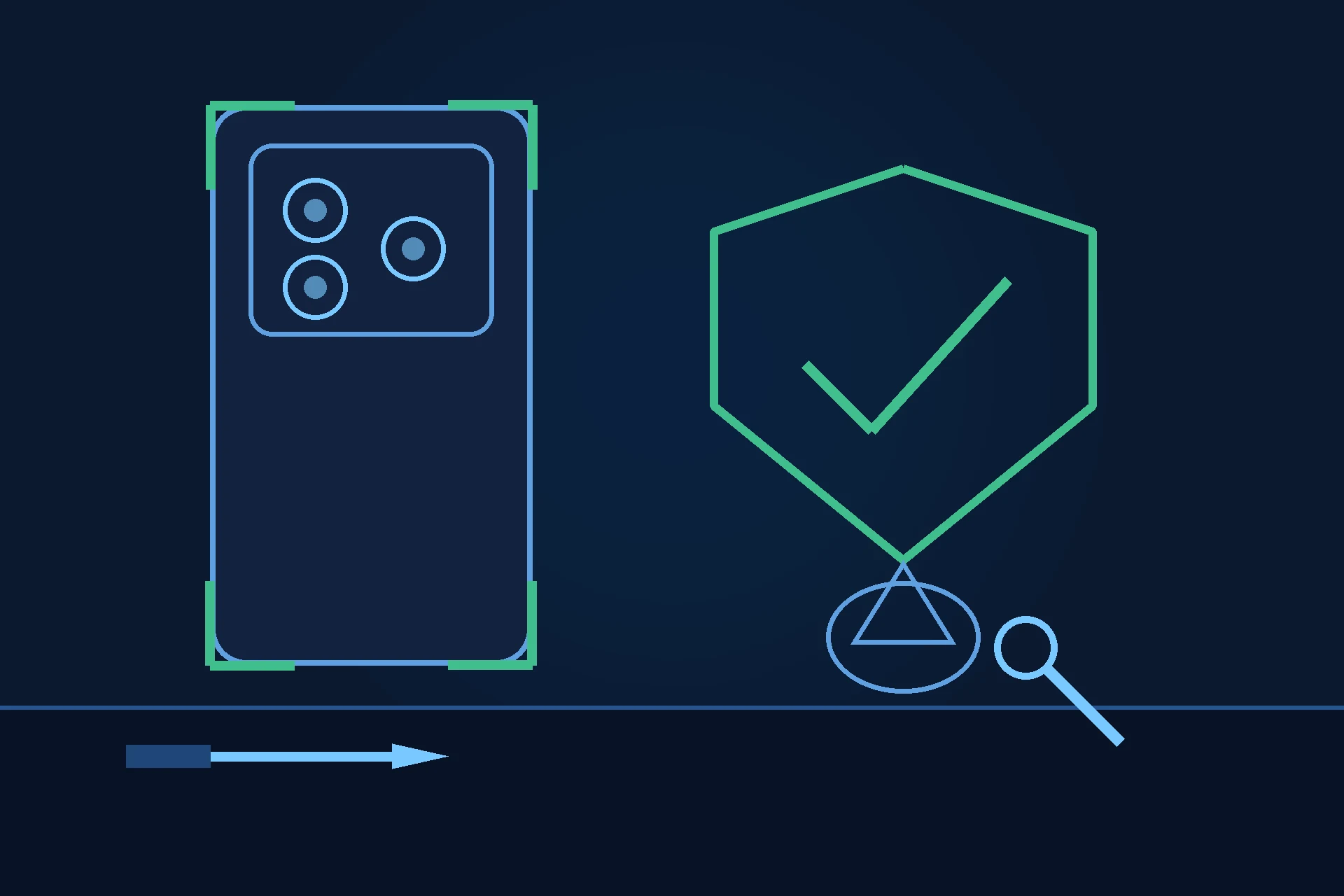
Prepared by FixUpPhone Editorial. Documentation checked October 2026. Apple specifications and service fees are distinguished from FixUpPhone’s assessed repair process. No hands-on durability test, drop result, customer experience or fixed FixUpPhone price is claimed for this model. The featured artwork is an original illustration. Apple is not affiliated with FixUpPhone.
- Apple — iPhone 17 Pro and iPhone 17 Pro Max technical specifications (archived capture of Apple’s specs page, captured September 23, 2025; Apple has since removed the live page — aluminum unibody; Ceramic Shield 2 front; Ceramic Shield back; IP68 rating; weight; fixed ƒ/1.78 main camera)
- Apple Support — iPhone service and repair (inspection determines the final fee; warranty scope, including liquid-damage exclusion; AppleCare+ terms)
- 9to5Mac, September 12, 2025 — Apple’s published US service fees for this model (back glass $159; screen $379; screen + back glass $469; rear camera $249; other damage $799; AppleCare+ fees $29 / $58 / $99)
- FixUpPhone — Phone Repair Services and Mail-In Phone Repair, checked October 2026
- FixUpPhone — Locations, checked October 2026
For corrections or device help, contact FixUpPhone.