iPhone 14 Pro Camera Not Focusing: Lens Checks & Fixes
An iPhone 14 Pro camera not focusing is rarely one problem: this phone has three rear lenses, plus a 2x view that is a crop of the main sensor, not a lens at all. A smudged lens, a case edge, a magnetic mount or a subject too close can all imitate a broken camera — and all are free to rule out. This guide tests each lens in turn, then prices a real failure: Apple services the rear camera as one unit at $219 ($99 with AppleCare+); independent repair is quoted after diagnosis.
ϟ Quick Expert Summary
Test lens by lens before you budget. Clean every lens, remove the case, protector and any magnetic mount, then photograph the same well-lit subject at 0.5x, 1x, 2x and 3x, noting which view hunts or stays soft. Remember 2x is a crop of the main camera: blur at 1x and 2x together is one fault, not two. Blur only at 3x points at the telephoto; blur only up close is usually minimum focus distance or the automatic macro switch. If one lens still will not settle in good light, treat it as hardware and compare Apple’s $219 fee with an assessed repair.
Source-based editorial guidance, not a FixUpPhone price quote, hands-on repair report or technician case history.
✓ A Repair Makes Sense When
- One view hunts or stays soft while the others stay sharp
- The camera buzzes, or the image visibly shakes
- Focus failed straight after a drop or liquid exposure
- Case off, covers clean, restart done — and it is still blurry
× Do Not Pay Yet When
- You have not cleaned the covers or removed the case and mount
- Only very close subjects blur — step back and retest
- The blur appears in one app only, not in the Camera app
- AppleCare+ is active — rear camera damage is $99 at Apple
48MP
Main camera, 24mm ƒ/1.78
$219
Apple rear camera fee
$99
With AppleCare+, rear camera
Quote
FixUp price after diagnosis
One lens at a time.
Find the fault first.
Smudges, cases, magnets, minimum distance and real actuator damage — separated.
① Key Specifications
| Main camera | 48MP, 24mm, ƒ/1.78, second-generation sensor-shift optical image stabilisation, 100% Focus Pixels |
|---|---|
| 2x view | 12MP at 48mm — a crop of the main camera’s sensor; there is no separate 2x lens |
| Ultra Wide camera | 12MP, 13mm, ƒ/2.2, autofocus with Focus Pixels, macro capability |
| Telephoto camera | 12MP, 77mm, ƒ/2.8, optical image stabilisation — the dedicated 3x lens |
| Zoom views | 0.5x, 1x, 2x (crop) and 3x; digital zoom up to 15× |
| Front camera | 12MP TrueDepth camera, ƒ/1.9, autofocus with Focus Pixels |
| Focus assistance | LiDAR scanner, which assists autofocus in low light; sapphire crystal lens covers |
| Display | 6.1-inch Super Retina XDR OLED, 2556×1179 at 460 ppi, ProMotion 120Hz, Always-On, Dynamic Island; 1,000 / 1,600 / 2,000 nits (typical / HDR / outdoor) |
| Design | Stainless steel design, Ceramic Shield front, textured matte glass back; Space Black, Silver, Gold or Deep Purple; 206 g |
| Chip and storage | A16 Bionic; 128GB, 256GB, 512GB or 1TB |
| Battery and charging | Video up to 23 hours, streamed up to 20 hours (lab figures); wired fast charge 50% in ~30 minutes (20W+) over Lightning; MagSafe 15W; Qi2 15W with iOS 17.2 or later |
| Connector and wireless | Lightning connector, USB 2 speeds up to 480Mb/s; Wi-Fi 6; Bluetooth 5.3; Side and volume buttons, Ring/Silent switch |
| Water and dust resistance | IP68 laboratory rating when new |
| US starting price | $999 for 128GB at launch |
| Release date | September 16, 2022, with iOS 16 |
Apple announcement and specifications
Three real lenses and one sensor crop — a fault at 2x is a main-camera fault.
② FixUpPhone Expert Analysis
Practical diagnosis and repair-cost analysis based on Apple’s published specifications, service fees and coverage terms, plus FixUpPhone’s published service information.
Three lenses, one crop: why isolation works
The rear system is three separate cameras — 48MP main, 12MP ultra wide and 12MP 3x telephoto — each with its own focus mechanism, plus a LiDAR Scanner that helps focus in the dark. The 2x view is not a fourth camera: it is a crop of the main sensor, inheriting its faults. A fault at one stop only belongs to that lens; a fault everywhere points at software or the scene. Apple prices the rear system as one unit, but which lens fails decides whether you need a repair at all.
Step one: clean, uncover, de-magnetise
Start with the lens covers, not the settings. A fingerprint smudge is the most common “focus” complaint: it scatters light and gives autofocus nothing clean to read, so the camera hunts. Wipe each rear lens and the front camera with a dry microfibre cloth. Look closely as you clean: dirt ON a cover wipes away; condensation or debris visible INSIDE a lens does not — that difference matters later. Then remove the case, any lens protector and any magnetic mount, and retest bare: a case lip can crowd the ultra wide’s view, and magnets near the camera can disturb stabilisation and autofocus.
Step two: the per-lens test
Start in Apple’s Camera app — testing there first rules out a third-party app fault. In good light, photograph the same textured subject 1–2 metres away at 0.5x, 1x, 2x, then 3x, tapping to focus each time; press and hold for AE/AF Lock to test whether a view can lock and stay locked. Read the pattern: soft at 1x and 2x together is the main camera — one fault, seen twice, because 2x is its crop. Soft only at 3x is the telephoto; soft only at 0.5x needs the distance check below. Then test the front camera at arm’s length. That plain-distance test is the control: if the Main camera will not lock there in good light, it is no longer technique.
Distance honesty: minimum focus and the macro surprise
Every lens has a minimum focus distance, and inside it nothing comes sharp however often you tap — back up a few centimetres and retest before concluding anything. Close-up work belongs to the ultra wide, which has autofocus and macro: as you move close, the phone switches to it automatically, and the view may visibly jump and reframe as the lens changes — that switch is designed, not a fault. Macro Control in Camera settings lets you manage when it happens. Blur from being too close, or from that switch, is a technique answer; blur at proper macro distance, cover clean, is worth assessing.
Technique and software: the free ladder
Work the ladder in order, retesting after each rung. Tap to focus rather than trusting the frame’s centre; use AE/AF Lock for a moving subject. Restart, then install any iOS update. Test in a second app, such as FaceTime: failure in one app only is that app’s problem; soft in Portrait mode but sharp in Photo mode is a mode behaviour, not a lens. Only late, reset all settings: data stays, but Wi-Fi passwords need re-entering. A full restore is last, only with a backup. If one lens still hunts in good light, stop troubleshooting software.
Dark-only trouble: where LiDAR fits
Autofocus needs contrast, and low light offers little of it, so focus slows and hunts in the dark on any phone. This model’s LiDAR Scanner assists low-light focusing, which is why the control test matters: test again in good light. A camera perfect all day that fails only in the dark can implicate that assistance path rather than a lens. If Portrait depth edges are also degrading alongside the focus trouble, say so: the LiDAR shares that depth story, functionally.
Hardware tells: buzzing, shaking, dead after a drop
Some symptoms skip the ladder: hunting or pulsing that never settles in good light; a rattle or buzz from the camera area when the Camera app opens — the stabiliser and autofocus mechanism moving loosely; blur on one lens only after a drop; internal debris or condensation that does not clear. Each is a sign to have the phone checked, never a certain diagnosis on its own. Do not keep forcing it, and never shake the phone to “test” a rattle. Camera work means opening the phone and fitting a new seal; after any opening the factory IP68 rating cannot honestly be re-certified.
The front camera is a different conversation
Selfie focus faults are not the rear camera repair. The front TrueDepth camera is a separate assembly, and Apple publishes no front-camera fee — a front-only fault falls in the “other damage” conversation at $649, as the prices section sets out. If the rear views all focus and only selfies hunt in good light at arm’s length, you are in a repair-or-replace discussion, not a $219 one.
Questions to ask before you approve
- Which view failed — ultra wide at 0.5x, main at 1x, the 2x crop, telephoto at 3x, or front?
- Did you rule out the case, any lens protector and any magnetic mount first?
- What is included in the quote — parts, labour, seals, tax?
- Will every view be tested afterwards — 0.5x, 1x, 2x, 3x and front?
- Could AppleCare+ cover this more cheaply at the $99 fee?
③ Pros & Cons: Independent Repair vs Apple’s Fee
✓ Reasons for an Assessed Independent Repair
- Diagnosis first — your fault may be a magnet or a case, not a camera
- The failing lens is identified before you commit to a unit price
- Keeps a $999 phone whose only fault is one camera unit
- Available in CA or NV, or by mail-in
× Reasons to Use Apple Instead
- AppleCare+ active? Rear camera damage is a $99 service fee at Apple
- Launched September 2022 — the one-year warranty expired in September 2023 for launch buyers
- Apple’s $219 fee covers the rear camera system as one unit
- Any opening of the phone breaks the factory seal, whoever does it
Camera Still Not Focusing? Check the Published Prices
The rear camera has a published Apple price, so the honest table is Apple’s fees plus the assessed route. Apple inspects before confirming its final fee; tax and shipping may apply.
| Your route | Published price | What it means |
|---|---|---|
| Apple — rear camera repair, no cover | $219 | Apple’s published out-of-warranty fee — about 22% of the $999 launch price. One price for the whole rear system; no per-lens fee exists. |
| Apple — rear camera damage, with AppleCare+ | $99 | The AppleCare+ fee for rear camera damage. If your plan is active, check this route first. |
| Apple — front camera or wider damage | $649 | No front-camera line exists: that fault falls in this “other damage” tier after inspection. |
| FixUpPhone — camera diagnosis | Quote after diagnosis | No fixed price is published. The failing lens is confirmed first; work proceeds only after you approve. |
| DIY fixes | Free checks only | Cleaning, removing accessories and the software ladder are the safe home limit. |
Apple’s repair terms, fees and coverage routes
Request a diagnosis and assessed quote
Apple’s US fees are its published September 2022 launch figures, checked October 15, 2026; no post-launch revision has been published. The $219 line follows Apple’s fee table as carried into September 2023 comparison coverage. None is a FixUpPhone price.
④ Repairability & Common Repair Needs
One unit, three behaviours
Apple replaces the rear camera as one unit, but the lenses fail differently: the main camera’s mechanism can hunt, pulse or stick; the ultra wide adds macro to its autofocus duties; the telephoto works at 3x, where handshake is magnified. Tell the repairer which view failed.
Stabilisation shares the mechanism
Focus and stabilisation share an assembly on the main and telephoto cameras, so a hard drop can disturb both while the sapphire covers stay perfect — the classic pattern is hunting from the day the phone fell. Report any buzz, shake or rattle, and never shake the phone to check.
Document the diagnosis
Ask for the finding in writing: which view failed, an accessory or software cause, or a unit replacement. It protects you from paying for a camera when a magnetic mount was the whole story.
Apple service and repair information · Request a FixUpPhone diagnosis
Possible causes and service considerations, not claims of a model-wide defect. Back up before any repair. Flag drops or liquid exposure before mail-in shipment. Never mail a hot or swollen phone.
Camera Focus Problems With Your iPhone 14 Pro?
Tell FixUpPhone what the camera is doing and choose a store or mail-in.
- Main camera hunts or pulses and never settles
- One view stays soft while the others are sharp
- Camera buzzes, or the image visibly shakes
- Focus died straight after a drop
- Focus fine in one app, failing in another
An online booking is a request; the team confirms the next step with you.
Mail-In Repair Service
Start with the repair request form and choose Mail-In Repair. You pay to ship the phone to FixUpPhone; FixUpPhone pays the return. Do not send the device until the receiving store and shipping instructions are confirmed.
Start Mail-In Repair →Back up first. State which lens fails and in which app — a precise note gets a precise diagnosis, and a software-only finding is returned honestly rather than repaired. Flag liquid damage, overheating or a damaged battery before shipping; never mail a hot or swollen phone.
Prefer to visit? Find a repair location →Visit a FixUpPhone Store
Lynwood, CA — FixUpPhone store · 3100 E Imperial Hwy, Store M1002, Lynwood, CA 90262 · Every day 11 AM–8 PM · (805) 857-4225
Santa Barbara, CA — FixUpPhone store · 619 A State St, Santa Barbara, CA 93101 · Mon–Fri 11 AM–8 PM; Sat 10 AM–8 PM; Sun 12 PM–7 PM · (805) 857-4226
Las Vegas, NV — FixUpPhone store · 875 S Grand Central Pkwy, Unit TT32, Las Vegas, NV 89106 · Mon–Sat 10 AM–8 PM; Sun 10 AM–7 PM · (818) 482-3605
Questions? Email support@fixupphone.com.
How It Works
- BookSubmit the model, store or mail-in choice, and symptoms.
- DiagnoseThe team isolates the failing view and rules out accessories.
- ApproveReview the finding and quote before authorising work.
- RepairThe general timeframe is 1–7 days, plus mail-in shipping time.
- Collect or ReturnCollect in store or receive the return; repairs include a 3-month warranty.
⑤ Should You Repair or Replace It?
If a cloth, removing the case, or stepping back fixes it, the correct spend was nothing; if a restart or update fixes it, you needed software, not parts. Only a lens still soft after the checks is a repair decision — and there the rear maths favour repair: $219, about 22% of the $999 launch price, or $99 with AppleCare+. The front camera is the exception, at $649.
| Diagnosis | Right move | Why |
|---|---|---|
| Smudged cover, case, protector or magnetic mount | Clean and remove — free | The camera was never faulty. |
| Too-close subject, or macro switching mid-shot | Step back; use the macro control deliberately | Minimum distance and the automatic switch are design, not damage. |
| Soft in one app or one mode only | Update, restart, reset all settings | Focus that works in other apps is software. |
| Rear focus mechanism failed, AppleCare+ active | Apple at the $99 fee | The plan covers rear camera damage at that fee. |
| Rear focus mechanism failed, no cover | Compare Apple’s $219 with an assessed repair | Both price the same unit job — compare quote and warranty. |
| Front camera fault, or camera plus other major damage | Combined written quote | Use the repair-or-replace framework on the total. |
⑥ Alternatives & Comparison
Every camera symptom on this model — black viewfinder, spots, flash, cracked cover — with fees.
Explore option →The same lens-by-lens isolation on the larger, newer Pro model, with its own prices.
Explore option →If a lens is fogged from inside after liquid, the water damage guide covers the routes.
Explore option →⑦ Accessories We Recommend
A smudged cover imitates a broken camera. Keep a clean, dry cloth for the lenses only.
A raised lip keeps lens covers off surfaces and absorbs knocks that disturb focus mechanisms.
Not all “blur” is focus — handshake softens photos too, worst at 3x. A tripod separates shake from a genuine fault.
Check specifications and compatibility before ordering.
⑧ Frequently Asked Questions
Why is my iPhone 14 Pro camera not focusing?
Work from the outside in: a smudged lens cover; a case, protector or magnetic mount; a subject too close to focus on; low light; a software hiccup — and only then a failed focus mechanism.
How do I know which camera has the focus problem?
Photograph the same well-lit subject at 0.5x, 1x, 2x and 3x, then with the front camera. A fault at 1x and 2x together is the main camera — 2x is a crop of it. Only at 3x is the telephoto; only at 0.5x needs a distance check first.
Why do close-ups look blurry?
Every lens has a minimum focus distance, and inside it nothing comes sharp. Close-up work belongs to the ultra wide’s macro mode, which switches on automatically as you move in — the view jumping is that switch, and Macro Control manages it. Blur closer than the main lens can focus is design, not damage.
Can a case or magnetic mount stop the camera focusing?
Yes. A case lip can crowd the ultra wide’s view, and magnets near the camera can disturb stabilisation and autofocus. Remove them and retest bare before suspecting hardware.
Why is focus only bad in low light?
Autofocus needs contrast, and darkness offers little — some hunting after dark is normal. This model’s LiDAR scanner assists autofocus in low light, so a camera perfect all day but failing only in the dark is a distinct pattern: retest in daylight and report it at assessment.
Why does the image shake or the camera buzz?
That points at the focus or stabilisation actuator — hardware, most often after a drop. Stop driving it, do not shake the phone to test a rattle, and book a diagnosis: it is not a setting and will not clear with a restart.
How much does it cost to fix an iPhone 14 Pro camera that will not focus?
If diagnosis confirms a failed rear focus mechanism, Apple’s fee is $219 out of warranty, or $99 with AppleCare+ — one unit price, no per-lens fee. A front-camera fault falls in the $649 “other damage” tier after inspection. FixUpPhone quotes after diagnosis.
Can I mail my iPhone 14 Pro to FixUpPhone for a camera focus repair?
Yes — start a repair request, choose Mail-In Repair, and do not post the phone until instructions are confirmed. You pay inbound shipping; FixUpPhone pays the return. Back up first, state which lens fails and in which app, and flag any liquid damage or damaged battery.
Sources & Editorial Notes
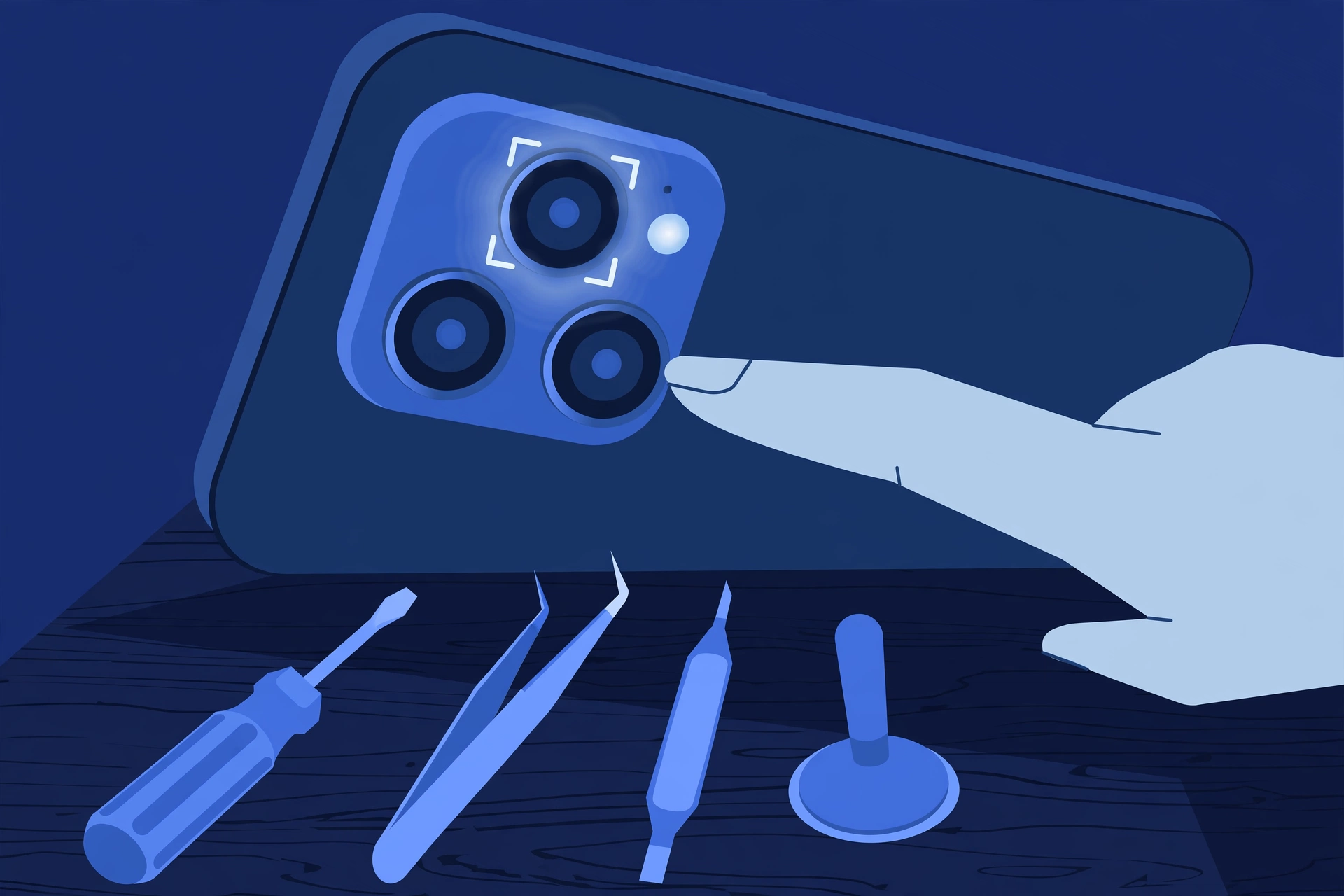
Prepared by FixUpPhone Editorial; documentation checked October 15, 2026. No hands-on repair, case history, customer experience, test result or fixed FixUpPhone price is claimed. The artwork is an original illustration.
- Apple Newsroom, September 7, 2022 — Apple debuts iPhone 14 Pro and iPhone 14 Pro Max (design, camera system, LiDAR, pricing, release)
- Apple Support — iPhone service and repair (inspection determines the final fee; AppleCare+ terms)
- Apple’s published US fees — September 2022 launch table as reported by Tom’s Guide and PhoneArena (rear camera $219; other damage $649; AppleCare+ $99). The $219 line follows September 2023 comparison coverage recording it as unchanged to the successor model, plus a September 2024 quote of Apple’s repair estimator
- FixUpPhone — Phone Repair Services and Mail-In Phone Repair, checked October 15, 2026
- FixUpPhone — Locations, checked October 15, 2026
For corrections or device help, contact FixUpPhone.